(+44) 7900 515 552
28 Oct 2026
 insurance backed guaranteeinsurance backed guarantee
Hearing scratching in the loft at dawn or dusk is one of the most common calls we get that turns into a roof repair job. Squirrels are agile, persistent, and surprisingly strong for their size.
Once one finds a way into your loft space, it rarely stays alone for long.
This guide covers how squirrels get in and the damage they actually cause to a roof and loft. It also covers what UK law says about dealing with them, whether your insurance will pay out, and when the job stops being pest control and starts being roofing work.
Grey squirrels need a gap of only around 4cm to squeeze through, and overhanging branches near the roofline make finding one far easier. On most houses that gap already exists somewhere, and it is usually a maintenance issue rather than a design flaw.
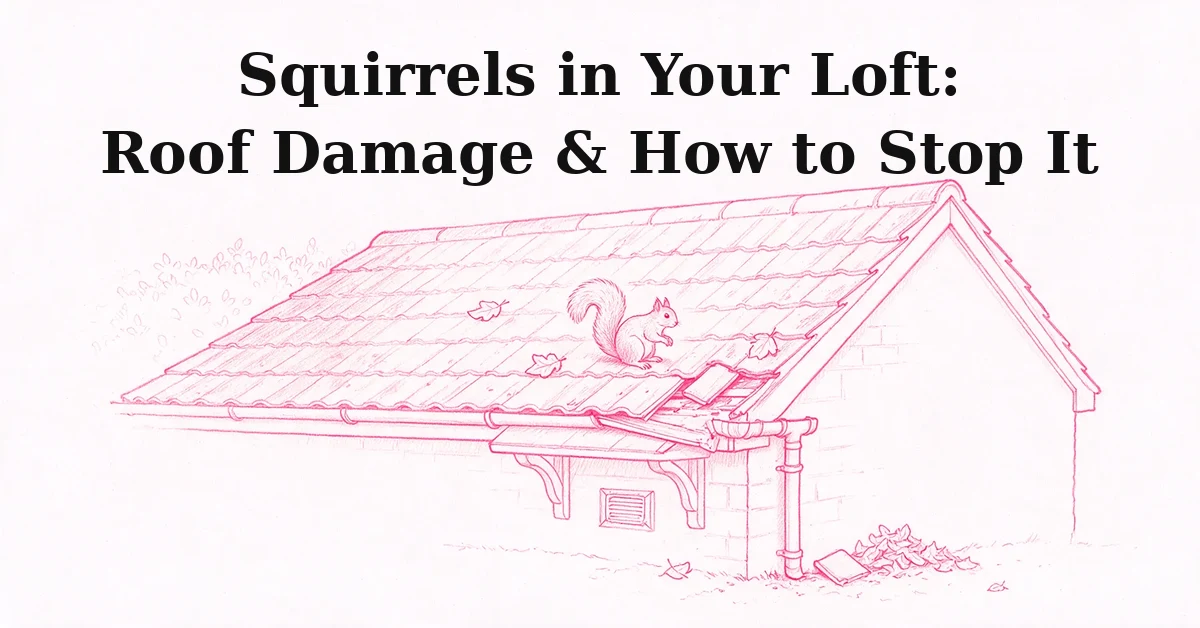
The usual entry points are a lifted or missing roof tile, a gap where a soffit or fascia board has rotted or pulled away from the wall, a damaged section of dry verge, or a loose section of lead flashing around a chimney.
An overhanging tree branch within jumping distance of the roofline makes every one of these gaps far easier to find and use.
A roof that is coming to the end of its life has more of these small failure points at once. Timber battens can sag, nail fixings can work loose, and felt or membrane can tear at the edges.
None of this is usually enough to let water in straight away. But it is more than enough for a squirrel.
A squirrel does not need a hole big enough to walk through. It needs a weakness big enough to widen, and a roof past its best gives it plenty to work with.
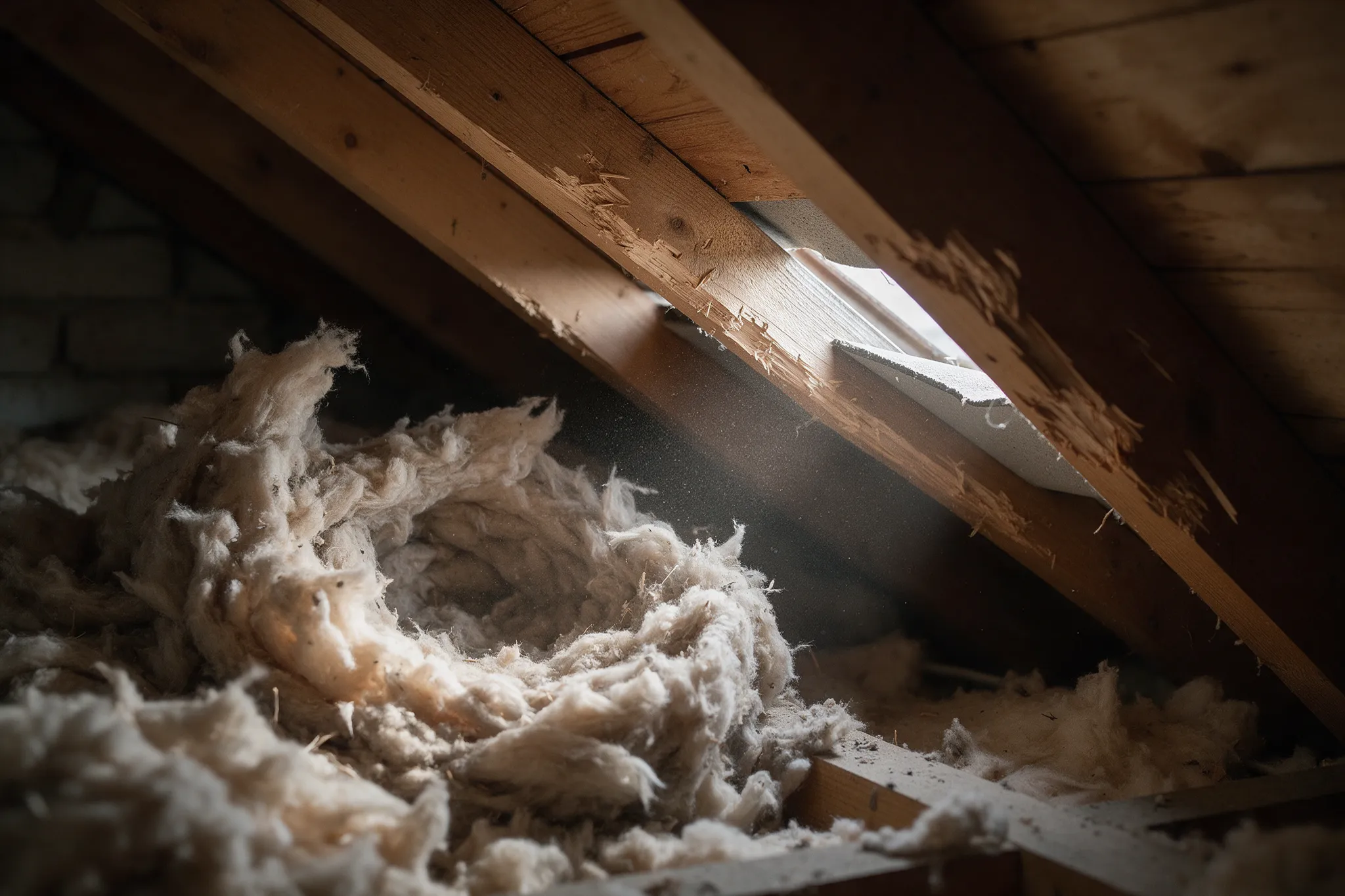
Squirrels are rodents, and like all rodents their front teeth grow continuously, so they gnaw to keep them in check. In a loft space, that gnawing has three main targets.
On top of the direct damage, droppings and urine build up over time and can soak into timber and plasterboard. That is unpleasant to clear and can mean more than a quick hoover-out once a nest has been there a while.
Scratching and scurrying in the loft, particularly early morning and early evening, is the first thing most people notice.
A few other signs are worth checking for before assuming it is squirrels rather than birds, mice, or bats. Look for chewed timber with visible teeth marks and insulation pulled into a rough nest shape in a corner.
Droppings are another clue, roughly pellet-shaped and about the size of a large raisin. If you spot daylight through a gap in the soffit or roofline from inside the loft, that is very likely the entry point.
Squirrels are not the only thing capable of getting into a loft space this way. We have covered how pigeons exploit similar gaps in a roofline and what to do if you find bats rather than squirrels, since the two are treated very differently under UK law.
If the noise turns out to be a different culprit entirely, woodworm causes its own, slower kind of timber damage. It can look similar from the outside but needs a different fix.
This is the part people get wrong most often. It matters because the two species are treated completely differently under UK law.
| Species | Legal status | What this means for a homeowner |
|---|---|---|
| Grey squirrel | Not a protected species. An invasive non-native species in the UK. | Can be humanely trapped or controlled on your own property, but it is illegal to release a trapped grey squirrel back into the wild. |
| Red squirrel | Fully protected under the Wildlife and Countryside Act 1981 (Schedule 5). | It is an offence to kill, injure, capture, or disturb one, or to damage or block access to its shelter. Red squirrels are extremely rare in most of England and Wales. |
In practice, almost every squirrel found in a loft in Berkshire and the surrounding area is a grey squirrel. Red squirrels now survive mainly in isolated pockets of Scotland, parts of northern England, and a handful of islands.
Even so, humane treatment is still a legal requirement. The Animal Welfare Act 2006 means any trapping has to avoid causing unnecessary suffering, and DIY trapping done carelessly can fall foul of this.
A kill trap set without checking the area first, or a trapped animal released a few streets away, can both cause problems. One is legal, the other is simply inhumane.
A professional pest controller will know the local rules and the correct humane methods. That is one good reason not to sort this out with whatever is in the shed.
This catches a lot of homeowners out. Standard buildings insurance in the UK generally treats pest infestation as a maintenance issue, not an insured event.
That means the cost of removing the squirrels themselves is very unlikely to be covered.
The damage a pest causes can be a different story to the pest problem itself. Sudden, accidental damage may be claimable even when the infestation that caused it is not.
Buildings insurers specifically flag grey squirrels damaging roof timbers as the kind of claim worth checking rather than dismissing outright.
Gradual gnawing over months is more likely to be treated as wear and tear and excluded. Sudden damage, such as a chewed cable causing a small fire, has a stronger case for a successful claim.
The practical lesson is to deal with an infestation quickly, rather than let it become a slow, gradual problem an insurer can wave away.
Removing squirrels properly and stopping them coming back is a two-stage job. Skip either stage and you tend to end up doing the whole thing again within a few months.
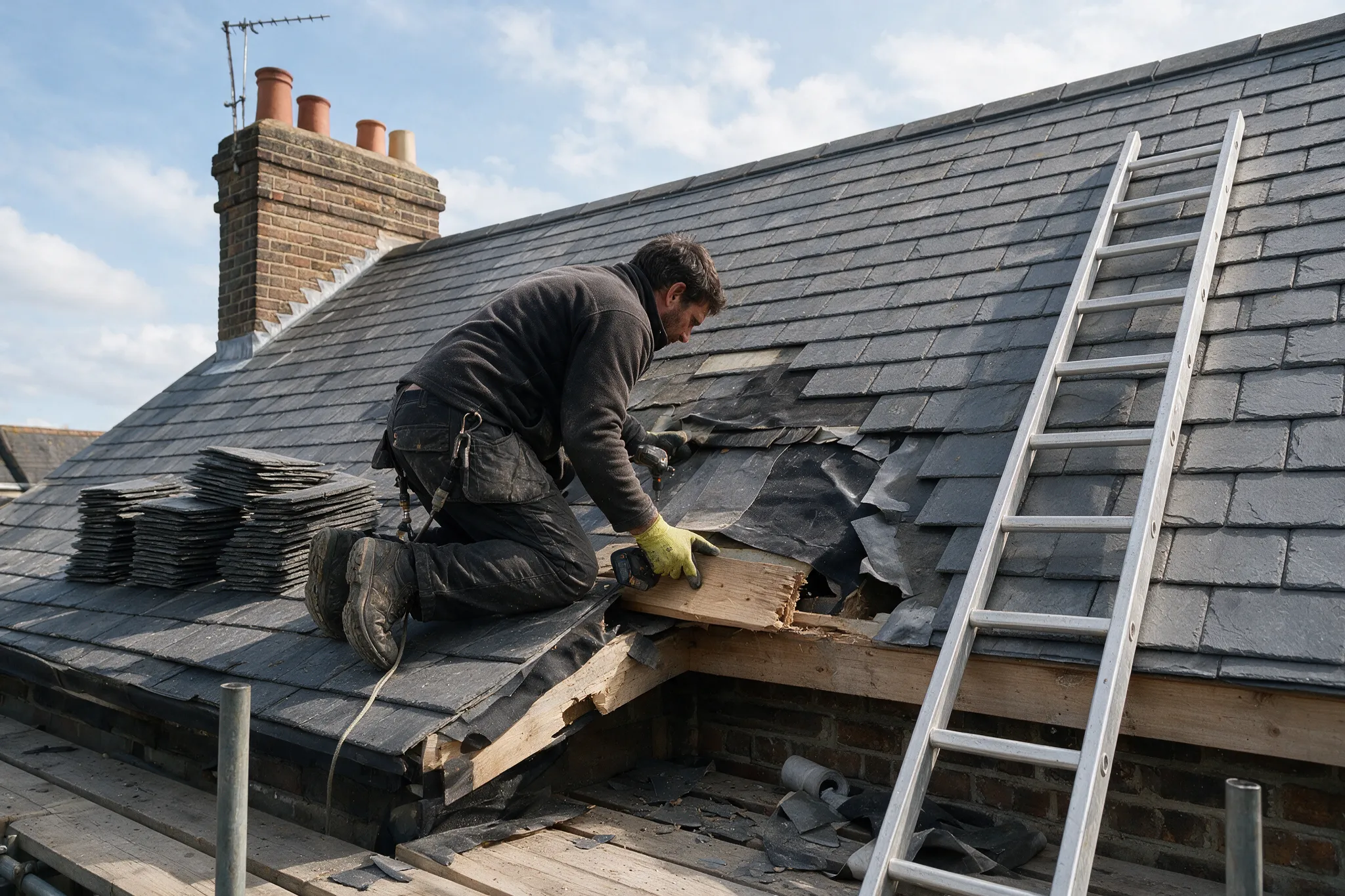
Pest control and roofing are two different trades solving two different halves of the same problem. A pest controller’s job ends once the squirrels are gone and the obvious gaps are blocked.
Whether that blocking actually holds, and whether the roof itself is sound again, is a roofing question.
This is the stage we get called in for most often: chewed soffits and fascias that need replacing rather than patching, felt or membrane torn by nesting that needs a proper repair, and tiles lifted to make the original gap that now need re-bedding or replacing.
Where the damage runs deeper, for example rotted timber a squirrel exploited rather than created, that is worth flagging honestly rather than quietly papering over. A cosmetic fix on a structural problem does not last.
As a CORC-registered contractor working under an insurance-backed guarantee, any repair work we carry out on squirrel-damaged roofing is covered the same way as any other job. That matters if you are already dealing with an insurance claim on the same roof.
If you are getting quotes for the repair side of this, our guide on how to choose a roofing contractor covers the questions worth asking before you commit to anyone.
Two separate bills tend to show up here. It helps to know which is which before a quote lands on the table.
| Job | Typical UK cost (2026) | Notes |
|---|---|---|
| Pest control survey and removal (single squirrel) | £120 to £200 | Covers survey, trap setup, and return visits |
| Pest control for a family group or established nest | £200 to £350 | More traps, more return visits, longer timeline |
| Clearance plus proofing of entry points | £300 to £720 | Higher end reflects London and South East pricing |
| Roofing repair (soffit/fascia, felt, tile re-bedding) | Varies by scope | Priced separately from pest control, based on the actual roofing damage found |
Costs rise with the number of squirrels, how awkward the nest location is to reach, and how many return visits are needed. London and the South East tend to run 20 to 30 per cent higher.
None of these pest control figures include repairing gnawed cables, timber, or insulation, and they do not include any roofing work at all. That is a separate, follow-on quote once the loft is confirmed clear.
Only once you are certain nothing is still inside. Sealing an entry point with an animal trapped behind it causes a worse problem, both for the animal and for whatever it does trying to get out. Confirm the loft is clear first, ideally via a pest controller, then seal properly with materials a squirrel cannot chew through.
No, grey squirrels are not a protected species and can be lawfully controlled on your own property, provided it is done humanely under the Animal Welfare Act 2006. What is illegal is releasing a trapped grey squirrel back into the wild.
Timing and sound are the best clues. Squirrels are most active at dawn and dusk and sound heavier and more scurrying than birds. Bats tend to be heard at dusk as they leave to feed and are far quieter. Chewed timber and shredded insulation point to squirrels rather than either.
It depends what you are claiming for. The cost of removing the squirrels is very unlikely to be covered. Sudden damage they cause, such as a chewed cable causing a small fire, has a reasonable chance of being covered. Gradual gnawing damage built up over months is more likely to be treated as wear and tear and excluded.
More than most people expect. A single determined squirrel can widen a small gap in a soffit into a proper hole within weeks, and once inside it will keep gnawing timber and cabling as its teeth grow. The real cost usually comes from an established nest rather than one animal passing through.
Usually both, in that order. A pest controller deals with the animals and the immediate entry point. A roofer then assesses and repairs whatever roofing damage caused or resulted from the infestation, since proofing a gap without fixing what is underneath it rarely lasts.