
 (+44) 7900 515 552
16 Oct 2026
 insurance backed guaranteeinsurance backed guarantee
A roof valley leak usually announces itself in the most annoying way possible. You spot a brown mark on the ceiling after a night of rain, or you hear a steady drip in the loft when the rest of the house is quiet. By that point, the water may have been travelling for some time.
On many Berkshire homes, the valley is where trouble starts. It’s the line where two roof slopes meet, and it handles a lot of runoff every time it rains. That concentrated flow is exactly why valley defects need a calm, methodical response. Sometimes a clean-out or short-term patch will buy you time. Sometimes anything short of a proper strip and reline is just delaying more damage.

A roof valley is the channel where two pitched roof faces meet. On a tiled or slated British roof, that junction has to collect water from both sides and move it quickly into the guttering. If the valley blocks up, if flashing splits, or if the surrounding covering starts to fail, water can get where it shouldn’t.
That matters because, in the UK, roof leaks are closely tied to moisture-related building damage. Guidance summarised in this roof valley leak overview notes that water ingress has long been treated as a common cause of avoidable roof deterioration in domestic properties, and valleys are especially vulnerable because they concentrate runoff.
The safest place to begin is the loft. Take a torch and look uphill from the stain, not just directly above it. Water often runs along rafters, battens, felt, or the underside of sarking before it finally drops onto the ceiling below.
Look for these signs:
You don’t need to go up a ladder to do an initial diagnosis. Stand back and use binoculars. On a typical house in Windsor, Reading, Maidenhead or the surrounding towns, you can often spot enough from ground level to decide whether it’s a cleaning issue or something more serious.
Watch for:
Water rarely drips straight down from the point where it entered. If you only focus on the ceiling stain, you can miss the actual fault by a fair distance.
If you want a broader method for tracing roof leaks safely, this guide on how to find a roof leak is worth reading before you decide what kind of repair roof valley leak work is needed.
Before any repair starts, decide whether you’re inspecting, carrying out a minor tidy-up, or taking on actual roof work. Those are three different things. A homeowner can often manage basic observation from the ground and sometimes simple debris removal at low level. Once tiles, slates, lining or flashing are involved, the risk rises quickly.
Wet roofs in Berkshire are bad enough. Add moss, frost, awkward access or a steep pitch and a simple repair turns dangerous.
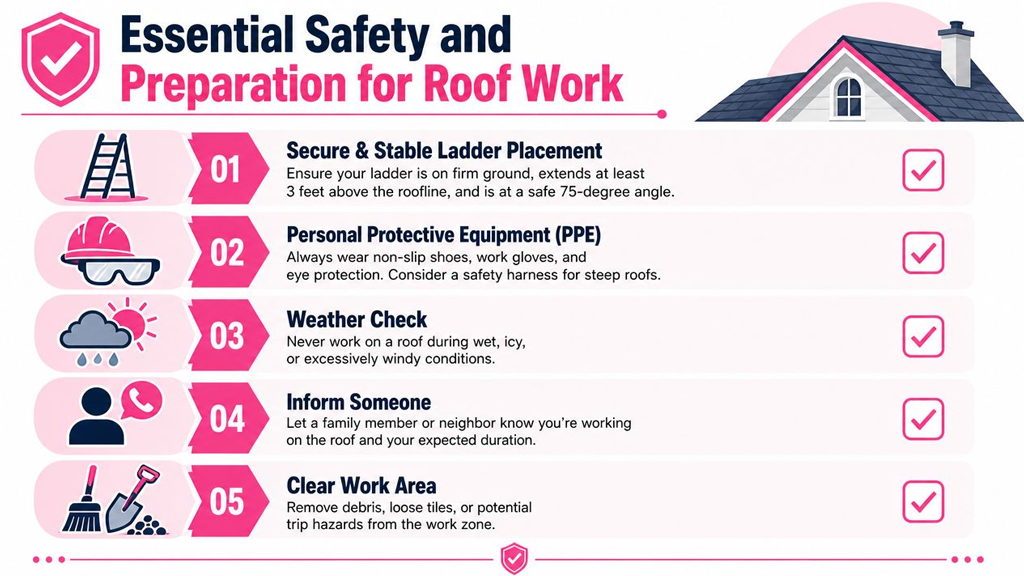
For any hands-on work, the basics matter:
If the roof is high, steep, brittle, or awkward to access over a conservatory or extension, a ladder alone isn’t enough. That’s where proper access equipment comes in. On many valley repairs, scaffolding isn’t a luxury. It’s the difference between controlled work and risky improvisation.
If you’re preparing for a small, suitable repair, get everything ready before you leave the ground.
Useful tools
Likely materials
Practical rule: If you can’t set up the work area so both hands stay free and your footing stays secure, don’t start the repair.
A proper inspection often reveals access issues before they become a problem. This explanation of what a free roof inspection actually involves gives a realistic sense of what a roofer looks for before tools even come out.
Once you’ve confirmed the valley is the issue, the question is simple. Are you dealing with a blocked drainage path, a localised defect, or a failed valley assembly?
That choice matters more on UK roofs than people think. A valley on a plain tiled roof behaves differently from one on a slate roof. Tiles can shift, crack or bridge poorly at the cut. Slate valleys often show trouble around fixings, spacing, or ageing metalwork. In both cases, British weather punishes shortcuts.
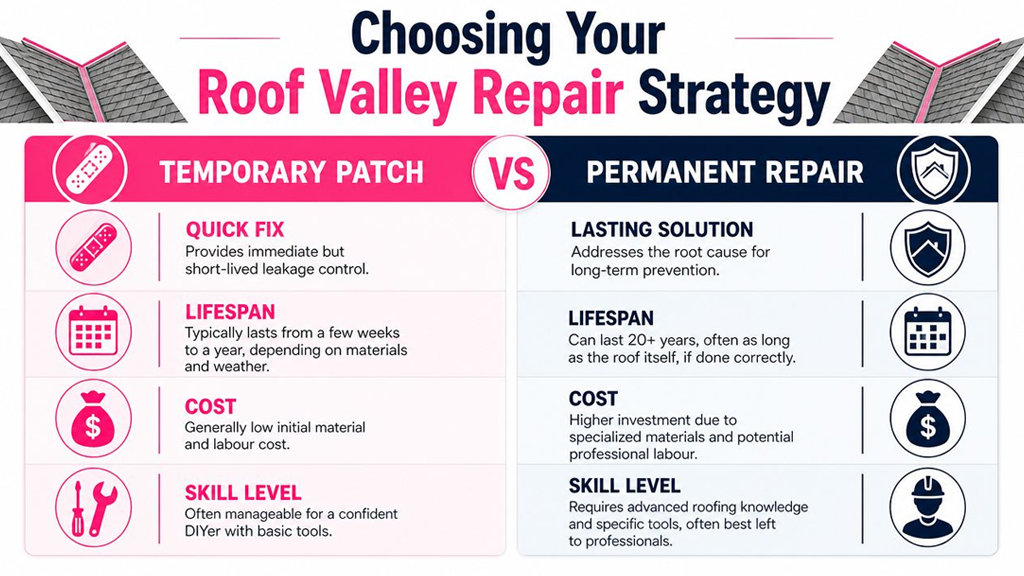
If the valley is choked with leaves, moss and silt, a careful clean and inspection may solve the issue. If the leak returns once the next spell of rain arrives, the problem is deeper.
| Repair route | Best for | What it actually does | Main drawback |
|---|---|---|---|
| Temporary patch | Short-term control in dry weather while waiting for proper repair | Slows or redirects water at a known defect | Rarely fixes the cause |
| Targeted local repair | Small isolated damage around a few tiles, slates or a short flashing section | Replaces the failed piece and restores the surrounding detail | Only works if the rest of the valley is sound |
| Full valley repair | Repeated leaks, aged lining, hidden damp, poor past repairs | Opens the area and rebuilds the waterproofing properly | More labour, more disruption, higher upfront cost |
A patch has its place. If rain is due, materials are on order, and the leak point is obvious, a temporary measure can reduce further ingress. That’s especially true after storm damage when the roof needs immediate protection but full repair has to wait for dry conditions.
A sensible temporary fix might suit:
It should not be mistaken for a finished job.
If water has already reached the underlay or timber, relying on sealant alone is usually a false economy.
This is where experience matters. If the valley has been patched before, if staining keeps returning, or if the covering has to be disturbed in several places to reach the fault, stop thinking in tubes of sealant and start thinking in layers.
On slate roofs, recurring valley leaks often point to ageing metal, failed fixings or hidden wear beneath the visible slate line. On tiled roofs, repeated trouble usually means water is getting under the cut edges or past old valley materials. In either case, a proper repair roof valley leak approach means dealing with the waterproofing system, not just the symptom.
A lasting valley repair starts with restraint. Don’t rip open more roof than needed, but don’t kid yourself that a smear of sealant over a suspect joint counts as workmanship. The strongest approach is to open the area properly, inspect what sits underneath, and rebuild the weathering in the right order.
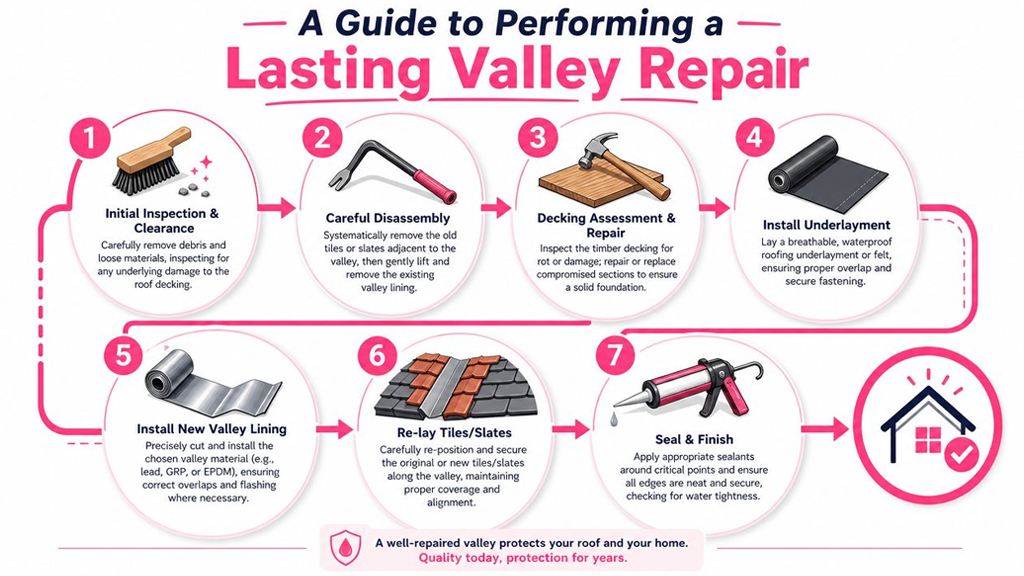
Start by removing the affected courses on both sides of the valley. With slate, that means lifting and stripping without snapping neighbouring pieces. With tiles, it means freeing the surrounding units without breaking nibs or disturbing sound courses higher up the slope.
Once exposed, inspect the deck, battens and any old lining. You’re looking for softness in the timber, darkened underlay, corrosion, previous patch mastic, and nail placement that sits too close to the water path.
For a durable result, the most effective method is the strip-and-reline approach. The method involves lifting the affected courses, checking the decking, applying a self-adhering waterproof membrane directly to the deck, fitting metal valley flashing over it, and then re-laying the roof covering with fixings kept clear of the centreline. That guidance also cites 20-inch valley flashing and nails kept within 10 inches of the valley centre as a practical benchmark.
That point about nail location is one many failed repairs ignore. Valleys don’t forgive lazy fixing. Put nails too close to the centre and you create future entry points exactly where the roof carries the heaviest water flow.
The waterproofing should work as a system. Deck, membrane, flashing and covering all need to support each other.
In the roof valley, even a good repair can still go wrong. The cut line needs to stay neat and consistent so runoff stays in the valley. Tile edges shouldn’t overhang awkwardly into the channel. Slates shouldn’t pinch the flow path or sit under stress because the spacing has drifted.
A good finish usually involves:
If rotten decking turns up, stop and deal with it before anything is covered over. A valley repair over bad timber doesn’t last. It just hides the problem until the next spell of wind-driven rain.
Costs for valley work vary more than many homeowners expect. Access, roof height, pitch, material choice, and the amount of hidden damage all affect the final figure. A low-level tiled valley with clean access is one thing. A high slate valley above an extension or conservatory is another.
Because precise prices depend on site conditions, the sensible way to budget is by looking at categories rather than chasing a made-up flat rate.
A homeowner tackling a limited repair usually pays for materials, waste handling, and sometimes tool hire. The list often includes replacement tiles or slates, membrane, flashing, fixings, sealant for finishing, and safe access equipment.
The hidden cost is time. A repair that sounds like a Saturday morning job can stretch once you start lifting fragile coverings, matching materials, and discovering that the old valley has been patched before. If you need to stop halfway because weather turns or extra materials are required, the roof may be left vulnerable.
A roofer’s quote usually reflects more than labour. It includes proper diagnosis, safe setup, material matching, removal of defective work, and rebuilding the detail so it performs in British weather.
Common quote factors include:
A cheap repair can become the expensive one if it fails and the valley has to be reopened. That’s especially true where repeated patching allows water to sit in the structure longer than the original defect would have done.
For a broader sense of budgeting, this guide to roof repair costs in the UK is a useful place to start. If you like comparing how other homeowner guides frame roofing costs, even outside the UK market.
A straightforward valley clean and minor local repair may be dealt with quite quickly in good weather. A full strip-and-reline takes longer because the work has to be opened, assessed, rebuilt, and checked before the area is closed up.
If you’re planning around weather, give yourself margin. Berkshire rain doesn’t always wait for convenient weekends, and valley work is one of the last jobs you want to rush.
There’s no shame in stopping before a repair gets beyond your skill level. In roofing, that’s often the smartest call you can make. Valleys sit at a critical junction, and poor workmanship there can feed water into underlay, battens and rafters long before the ceiling below shows the full story.
Modern UK practice places real emphasis on valley detailing. Stricter building control and NHBC rules have increasingly treated valleys as a critical detail, and older pre-2000 roofs often lack modern breathable membranes and durable valley flashings. That’s one reason recurring valley leaks on older Berkshire homes often need more than cosmetic patchwork.
Put the tools down if any of these apply:
A proper valley repair isn’t just about stopping today’s drip. It’s about restoring the roof junction so it performs as a weathering detail. On modern pitched roofs, that means working to sound UK practice and understanding details such as fixing zones, support, underlay behaviour and tile or slate layout.
For homes in Windsor, Reading, Slough, Bracknell, Maidenhead and nearby towns, professional help is usually the right move when the valley needs opening up, not just tidying.
If you’ve got a valley leak and want a clear answer on whether it needs a temporary patch or a full repair, contact All Custom Roofing in Windsor for expert roof repairs across Berkshire. We cover Windsor, Reading, Slough, Bracknell, Maidenhead, and surrounding towns, with practical advice, transparent quoting, and repairs that are built to last.