
 (+44) 7900 515 552
26 Mar 2026
 insurance backed guarantee
insurance backed guarantee
insurance backed guarantee
That dark patch on your ceiling is the most obvious signal that something’s amiss, but finding the true source of a roof leak often requires a bit of detective work. The best approach is to work from the inside out, gathering all the clues inside your home before you even think about heading into the loft or onto the roof.
This methodical process helps you pinpoint the general area of the problem, making the search much more efficient.

Before you grab a ladder, your investigation should start right in your living space. The tell-tale signs of a leak aren’t always as dramatic as a steady drip. In many homes across Berkshire, the first clues are far more subtle.
Water is a master of disguise. It can travel along rafters and joists, which means the visible damage on your ceiling might be metres away from the actual entry point. We’ve seen this countless times in properties from Windsor to Reading, where a leak on one side of a pitched roof shows up as a stain on the complete opposite side of the room.
You need to train your eye to spot the less obvious indicators of water intrusion. These subtle signs are often the earliest warnings you’ll get, and catching them early can save you a lot of trouble and expense.
Water damage remains the leading cause of roof deterioration in the UK. Our famously damp weather is responsible for the vast majority of roof-related issues, with some studies showing that nearly 1 in 5 UK homes currently need some form of roof repair.
The table below breaks down what these interior signs might mean for your roof, helping you connect the dots before you move on to the next stage of your inspection.
| Interior Sign | Potential Roof Problem | Your Next Inspection Point |
|---|---|---|
| Stains on a top-floor ceiling | Cracked/missing tiles, compromised flashing | The loft space directly above the stain |
| Damp patches on walls | Leaking valleys, failing chimney flashing | The loft, focusing on rafters and wall plates |
| Peeling paint near windows/dormers | Damaged dormer or window flashing | The area around the window in the loft |
| Musty smell with no visible stain | Slow, hidden leak in the roof structure | Insulation, roof deck, and rafters in the loft |
This initial survey gives you a solid starting point, but remember that the location of the stain is rarely the final answer. Documenting these interior signs is a vital first step. For a broader perspective, you can also explore some easy DIY tips for finding water leaks elsewhere in your home.
By playing detective inside your property first, you gather the evidence needed to inform the next, more hands-on stage of your search. A detailed record of these clues will be invaluable, whether you continue the search yourself or decide to call in a professional. You can learn more about what to include when you document your findings in our guide to creating a thorough roof inspection report.
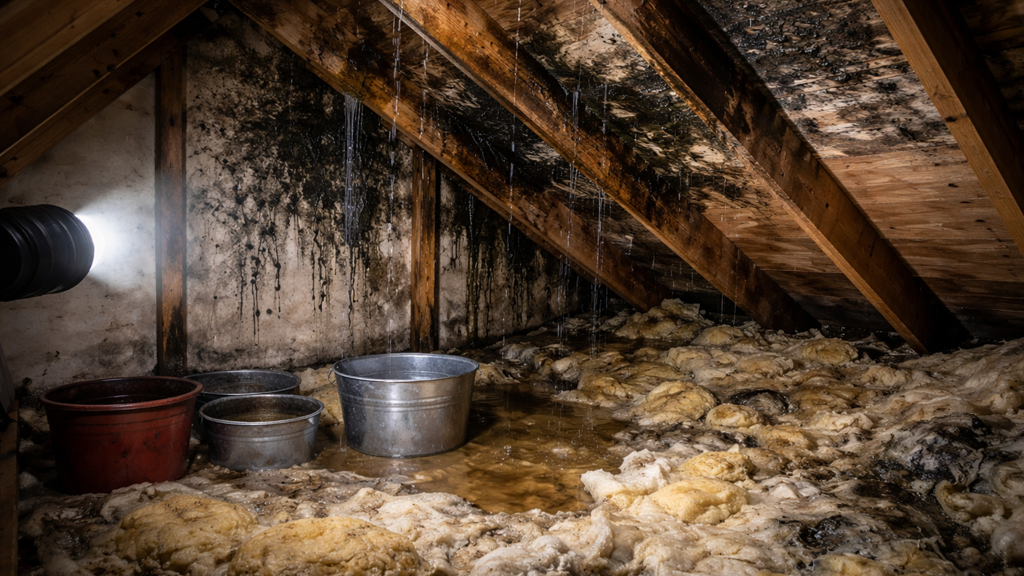
Once you’ve spotted the signs downstairs, your loft is the best place to continue the investigation. It’s here you’ll get the clearest view of your roof’s underside, but you need to know what you’re looking for. A word of warning first: always tread carefully on the joists. Never step on the plasterboard between them, as it won’t hold your weight. Grab a powerful torch, and let’s get started.
Your main goal up here is to follow the trail. Water does not always drip straight down, so methodically sweep your torch beam across the underside of the roof deck and along the timber rafters. You’re looking for anything that catches the light differently—damp patches, glistening beads of moisture, or shiny surfaces on the wood are all tell-tale signs of an active leak.
Focus on finding solid proof of water coming in. A bit of systematic detective work will help you figure out if you’re dealing with a new problem or just the ghost of an old, repaired leak.
A crucial tip is to distinguish between an active leak and an old stain. A fresh leak will feel damp to the touch and the wood around it may appear darker than an old, dry stain which will be the same temperature as the surrounding timber.
One of the most common things we see homeowners mistake for a roof leak is actually condensation. In fact, poor ventilation is a significant cause of damp issues in UK homes. Trapped, moist air condenses on the cold surfaces in your loft, creating dampness that can look just like a leak. Reports from building control bodies sometimes find that new builds fail to meet minimum roof ventilation standards, often causing timber rot.
So, how can you tell the difference? Condensation usually creates a fine, uniform layer of dampness or tiny droplets across a wide area, often on the colder, north-facing side of the roof. A leak, on the other hand, almost always leaves a distinct trail or drip point coming from a specific failure point, like a cracked tile or failed flashing.
If your loft inspection reveals a clear water trail, your next job is to trace it back to the source on the outside. But if you see widespread dampness with no obvious path, you could have a ventilation issue on your hands, which still needs a professional look. For a definitive diagnosis in the Windsor, Slough, or Maidenhead area, don’t hesitate to contact All Custom Roofing.
Once you’ve traced the signs of a leak inside, the next port of call is the exterior of your home. You can actually learn a surprising amount about your roof’s condition without ever leaving the ground.
But let’s be clear: this is all about playing detective from a safe distance. Never, ever get on the roof yourself or use a wobbly, unstabilised ladder. Your safety comes first. Instead, grab a pair of binoculars and find a good spot in your garden or an upper-floor window where you can get a clear view.
The best time to do this is often on a clear day just after it has rained, as damp patches can make problem areas much easier to spot.
Most homes across Berkshire have pitched roofs, usually covered with tiles or slates. From your safe viewing point, scan the entire surface, section by section. You’re looking for anything that just does not seem right.
Keep an eye out for these common culprits:
Flat roofs are very common on extensions and garages in areas like Slough and Maidenhead, and they come with their own unique set of warning signs. While you cannot see the top surface from the ground, the edges often tell the story.
Look for these tell-tale signs:
Remember, this ground-level check is for assessment only. Spotting a slipped tile does not mean you should try and push it back up. Take photos of anything you find. This information is gold dust when you call a professional roofer.
Don’t forget to check your gutters. Blocked or damaged gutters are a surprisingly frequent source of leaks. If water is spilling over the side during a downpour, it can easily run down your exterior walls or seep back under the eaves. That’s why understanding how properly installed rain gutter outlets is so important for UK homes is key to preventing future issues.
If your inspection turns up any of these problems, you now have strong evidence pointing to the source of your leak. For a professional assessment and a lasting repair in Windsor, Reading, or the surrounding towns, get in touch with All Custom Roofing. We have the right safety equipment and expertise to get to the root of the problem and fix it properly.
Sometimes, a leak is maddeningly elusive. It does not appear with every shower, only showing up during that specific kind of heavy, wind-driven rain that batters homes across Berkshire. For these stubborn situations, a controlled water test using a garden hose is an old roofer’s trick that can be a real game-changer.
This is not a one-person job, though. You’ll need a spotter inside the loft with a bright torch, ready to shout the moment they see a drip. Meanwhile, someone else will operate the hose from the ground outside. Clear, constant communication between the two of you is absolutely essential for this to work.
The secret here is patience and a systematic approach. Do not just blast the whole roof at once; you’ll have no idea where the water is actually getting in. The only way to do this properly is to isolate small sections at a time, starting from the lowest point on the roof and working your way up.
Always use low water pressure to mimic a steady rain, not a jet wash. Let the water saturate one small area for several minutes, giving it time to seep through any potential weak spots. All the while, the person inside must keep their eyes peeled on the underside of that exact area.
A great tip from the field is to have your mobile phones ready. The spotter inside can immediately call the person with the hose the second they spot moisture. This instant communication helps you mark the exact exterior spot that corresponds to the interior leak, leaving no room for guesswork.
This simple process of checking from the ground first, then focusing on specific tiles and flashings, is the foundation of any good roof inspection.

The key takeaway is to be methodical. A broad overview with binoculars helps you spot obvious issues before you get the hose involved.
To avoid misleading results, you absolutely must work from the bottom up. If you start at the top, water will just run down over other potential problem areas, making it impossible to isolate the true source of the leak. Think of it as filling a container from the bottom; you need to rule out the lower sections first.
This table breaks down the process for a typical UK roof. Following this sequence prevents water from higher up from contaminating the test on lower sections.
| Area to Test | Water Application Technique | Common Failure Points to Watch For |
|---|---|---|
| Gutters and Fascias | Let water run directly into the gutters from the hose. | Water backing up under the eaves due to blockages or misaligned guttering. |
| Roof Eaves | Gently spray the first row of tiles or slates along the bottom edge. | Rotting fascia boards or water ingress at the felt line. |
| Flashings | Methodically soak the lead flashing around chimneys, dormers, and vents. | Cracked or lifted flashing, failed sealant, or deteriorated mortar. |
| The Main Roof Field | Move up the roof, testing small 1m x 1m sections of tiles or slates at a time. | Cracked, slipped, or missing tiles; porous materials. |
This technique is incredibly effective for finding the exact entry point. Once you have this invaluable information, you’ll be able to give a precise report to a professional roofer, saving them time and you money.
If you do find a leak and need to act fast, our guide on handling emergency roof leak repair has some crucial next steps. For expert help tracing and fixing any leak in Windsor, Reading, or Bracknell, don’t hesitate to contact All Custom Roofing.
There’s a fine line between a rewarding DIY fix and a costly mistake, and nowhere is that line clearer than on your roof. While tracking down the signs of a leak yourself can be satisfying, it’s vital to know your own limits. The goal is always to protect your home, and sometimes, the smartest move is to put down the tools and pick up the phone.
Attempting a repair that’s beyond your skill set can turn a small problem into a major disaster. Knowing when to call in an expert is not admitting defeat; it’s a crucial skill that protects your property and your safety. If you spot any of the following red flags, it’s time to stop and get a professional opinion.
Some roofing issues are simply too complex or dangerous for a homeowner to tackle. If your inspection uncovers any of these problems, your next step should be to contact a qualified roofer.
In these scenarios, a professional roofer is not just a repair person; they are a diagnostician. We have the training, safety equipment, and experience to trace complex leaks that defy simple inspection methods.
When a leak proves stubborn or its source is difficult to access, professional roofers can turn to modern solutions like to identify problems with incredible accuracy. Technology allows us to pinpoint hidden issues without causing extensive disruption to your home.
For homeowners in Windsor, Slough, Maidenhead, and the surrounding Berkshire towns, calling a local expert is essential. At All Custom Roofing, we combine years of hands-on experience with the right equipment to trace even the most complex leaks. We will provide a lasting repair, preventing further costly damage to your home and giving you complete peace of mind.
When you spot a leak, your mind starts racing with questions. It’s a situation we see all the time across Windsor and the wider Berkshire area. As seasoned roofers, we’ve heard just about every question there is, so here are some straight-talking answers to the most common ones we get.
The short answer? Immediately. Even a tiny drip that seems to come and go is a serious red flag. It’s a sign that the main line of defence for your home has been breached.
That small amount of water might seem harmless, but it can quickly saturate your loft insulation, making it useless and pushing up your energy bills. Worse still, it will seep into the timber joists and rafters, creating the perfect conditions for wood rot. A minor nuisance today can easily become a major structural repair bill tomorrow.
This is a tricky one, and it all comes down to your specific policy and what caused the leak in the first place. Most UK home insurance policies cover damage from “perils,” which means sudden, unexpected events like a storm ripping tiles off or a tree branch falling on your roof.
However, they almost never cover issues that arise from a lack of maintenance or simple wear and tear. If the leak is from old, cracked flashing, tiles that have slipped over time, or gutters you have not cleared out, you will probably find your claim is denied. Your best bet is to dig out your policy documents, but be prepared for the fact that general upkeep is usually the homeowner’s responsibility.
We always advise clients to take dated photographs of any storm damage as soon as it is safe to do so. This can be crucial proof to show your insurer that the damage was sudden and not a pre-existing problem.
Please do not. Slapping some paint or sealant over a water stain on your ceiling is one of the worst things you can do. All you are doing is hiding the evidence, not solving the actual problem.
While the stain is covered up, water is still getting in. It is pooling in your loft, soaking into plasterboard until it is heavy enough to collapse, and quietly rotting the essential timbers of your roof structure. You have to find and fix the leak at its source on the roof itself to stop the damage for good.
From our years working on homes all over Windsor, Reading, and Bracknell, we see the same culprits pop up again and again. Nine times out of ten, the problem lies in one of these areas:
Flat roofs, which we see a lot on extensions in Maidenhead and Slough, are another common source of leaks, especially along the seams or at the edges where the material has started to peel back.
If you’ve tracked down a leak but do not feel confident tackling the repair, or if you simply cannot find where the water is getting in, it’s time to call in a professional. For a fast, reliable, and expert diagnosis across Berkshire and the surrounding towns, contact All Custom Roofing. We cover Windsor, Reading, Slough, Bracknell, Maidenhead, and surrounding towns. We have the right tools and years of experience to find and fix any leak, securing your home for the future. Find out more about our roofing services today.