 (+44) 7900 515 552
01 Apr 2026
 insurance backed guarantee
insurance backed guarantee
insurance backed guarantee
When you’re choosing insulation for your roof, how well it keeps your home warm is only half the story. The other, arguably more critical half, is its fire rating. This isn’t just some technical jargon on a label; it’s a direct measure of how your roof will perform in a fire, impacting the safety of your family and your home.
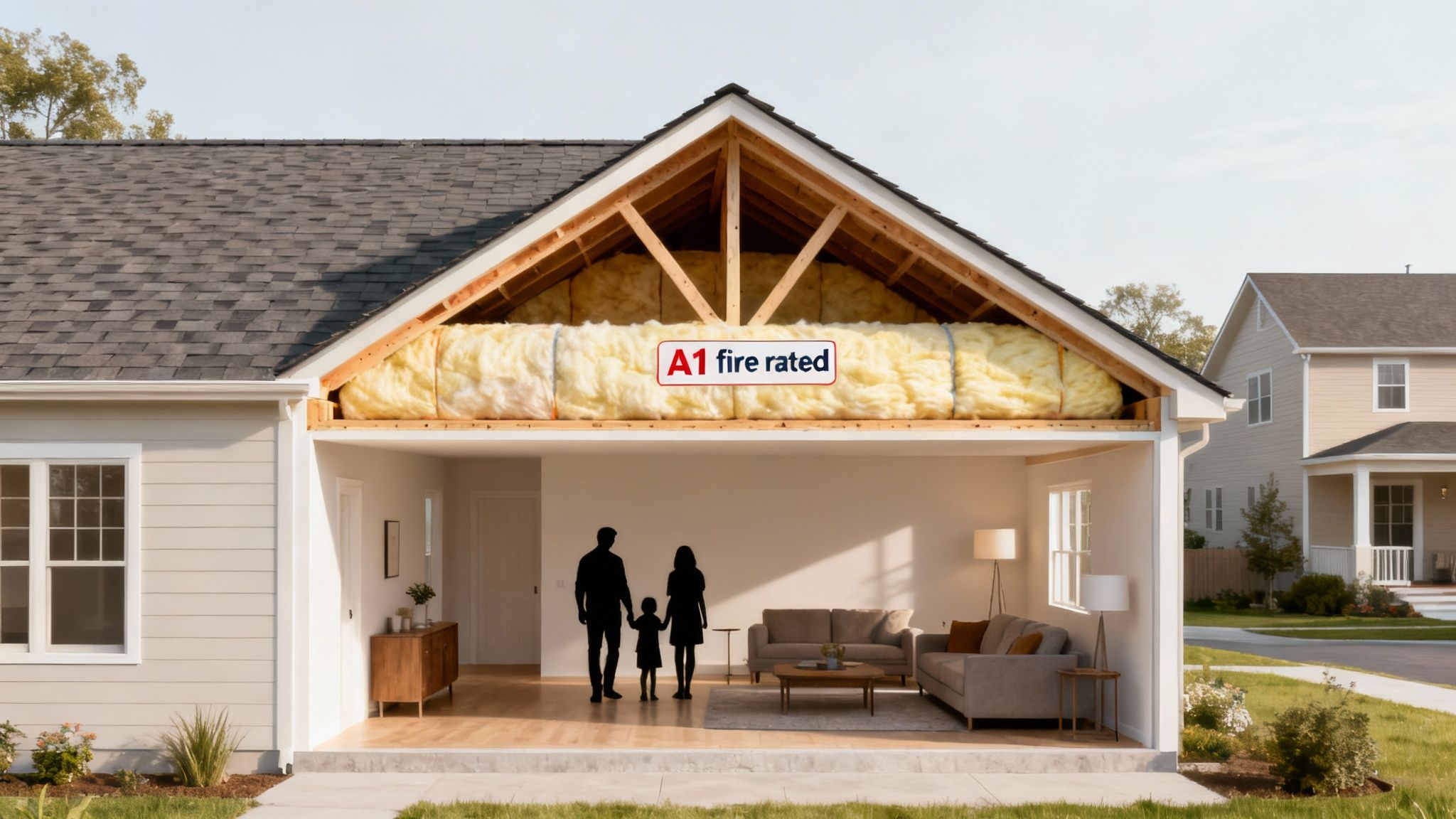
Think of your roof as the main shield for your property. It does a fantastic job protecting you from the unpredictable British weather, but its role in a fire is just as vital. The materials tucked away inside your roof structure, especially the insulation, can either help contain a blaze or, unfortunately, help it spread.
This guide will break down exactly what those fire ratings mean in real-world terms for property owners in Windsor and the surrounding areas. In the UK, fire safety standards for building materials have become rightly strict, and getting your head around them is key to making a safe, smart decision for your home.
If the worst happens and a fire breaks out, every single second counts. The materials used to build your home dictate how quickly flames can travel from one part of the house to another, and your insulation plays a huge part in that.
Some insulation materials are non-combustible, which means they simply won’t burn. Instead, they act as a barrier, slowing a fire down. Other materials are combustible and, if they aren’t treated with fire retardants, could actually fuel the flames, releasing smoke and accelerating the fire’s journey through your roof space.
This has a few crucial knock-on effects:
Choosing insulation with a high fire rating is one of the most effective passive fire protection measures you can take. It’s a silent guardian, working behind the scenes to protect what matters most.
Understanding this single factor empowers you to look beyond just thermal performance and ask the right questions when planning a new roof or an insulation upgrade. For local expertise, All Custom Roofing helps property owners across Berkshire and Surrey choose insulation that delivers both exceptional warmth and complete peace of mind.
Trying to make sense of the technical datasheets for insulation can feel like you’re reading a foreign language. But once you know what to look for, understanding the UK’s fire rating system is surprisingly straightforward. The main standard you need to know is the Euroclass system, officially called BS EN 13501-1.
Think of the Euroclass system as a simple A to F report card for how a material reacts when faced with fire. It gives property owners and builders in Windsor a clear, consistent way to compare the fire performance of different insulation products.
An ‘A1’ rating is the best you can get, reserved for materials like stone wool or glass wool that are completely non-combustible. At the other end of the scale, an ‘F’ rating is given to materials that catch fire easily and can fuel the flames, much like a pile of dry paper.
The main Euroclass ratings run from A1 down to F, but there are a couple of extra codes that paint a much clearer picture of how a material behaves in a real fire. These add-ons measure smoke production and the risk of flaming droplets.
So, when you see an insulation product rated A2-s1, d0, you know it’s non-combustible (or has very limited combustibility), produces almost no smoke, and creates no dangerous flaming droplets. For any roofing project in Berkshire or Surrey, this full rating gives you the complete story on safety.
You might still spot references to an older system, the British Standard BS 476. For decades, this was the benchmark for fire safety in UK construction, using terms like ‘Class 1’ or ‘Class 0’ to describe how flames spread across a surface.
However, the Grenfell Tower tragedy in 2017 tragically highlighted the shortcomings of older rating systems and pushed the UK to fully adopt the more rigorous Euroclass standard. The historic BS 476, which had been around since 1932, was largely replaced by EN 13501, which gives a much more detailed and realistic assessment of a material’s reaction to fire. You can learn more about this crucial transition and why modern ratings like A1 (non-combustible) are now mandatory for high-rise buildings by reading expert insights on BS 476 fire ratings.
Understanding the shift from BS 476 to EN 13501 is key. The Euroclass system isn’t just a new label; it represents a more comprehensive and demanding test of how materials truly behave in a fire, offering property owners far greater assurance.
To make things a bit clearer, here’s a simple comparison table to help you see how the old and new systems roughly line up.
| Euroclass Rating (EN 13501-1) | Description | Typical Materials | Old BS 476 Equivalent (Approx.) |
|---|---|---|---|
| A1 | Non-combustible, makes no contribution to fire. | Mineral wool, glass wool, stone. | N/A (Exceeds older standards) |
| A2 | Very limited contribution to fire. | Plasterboard, some treated insulation boards. | Class 0 |
| B | Limited contribution to fire. | Fire-retardant treated PIR/PUR foam boards. | Class 0 |
| C | Minor contribution to fire. | Some wood-based products, standard foam boards. | Class 1 |
| D | Medium contribution to fire. | Untreated wood products. | Class 3 |
| E | High contribution to fire. | Some plastics, untreated expanded polystyrene (EPS). | Class 4 |
| F | Easily flammable, no performance determined. | Materials that fail to achieve any other rating. | N/A |
By getting familiar with these classifications, you’ll be able to read manufacturer datasheets with confidence and make an informed decision, ensuring the fire rating of insulation you choose for your home meets the highest safety standards.
For expert advice on selecting the right materials for your roof, contact All Custom Roofing in Windsor. We serve homes and businesses across Berkshire, Surrey, and beyond.
To really get why modern fire ratings are so important, it helps to look back at how we used to think about insulation and safety. The story of UK insulation is one of learning and improving, shifting from just trying to stay warm to truly understanding how materials perform when a fire breaks out.
After the Second World War, the main goal was simply to build houses, and fast. Insulation was an afterthought, and fire safety wasn’t the top priority it is today. That mindset started to shift as building science improved, giving us a much clearer picture of how different materials act in a fire.
The 1976 Building Regulations was a game-changer. For the first time, it became a legal requirement for building materials to meet certain fire performance standards. This forced the entire construction industry to start thinking seriously about the fire rating of insulation. Materials like mineral wool, which is naturally non-combustible, became a popular and trusted choice for insulating lofts and cavity walls.
This new focus on safety paved the way for more innovation. Back in 1976, the regulations completely changed how insulation was viewed in UK homes. By the 1980s, high-performance rigid foam boards like PIR (polyisocyanurate) and PUR (polyurethane) hit the market, offering fantastic thermal efficiency while also achieving the best ‘Class 0’ fire rating under the old BS 476 standard.
Data from that time suggests that as more homes complied with these new standards, roof fire incidents dropped by around 15% through the 80s and 90s. You can discover more about the historical development of UK insulation on this topic.
This journey shows just how far UK building standards have advanced. It also explains why a home built in Maidenhead or Woking in the 1980s might have insulation that was considered cutting-edge then but wouldn’t pass today’s much stricter safety tests under the Euroclass system.
Yesterday’s ‘best practice’ isn’t the same as today’s legal and safety standard. An older property’s insulation might keep you warm, but it could pose a fire risk that modern materials are specifically engineered to prevent.
Understanding this history is vital for property owners. It underlines why getting your roof’s insulation checked by a professional is so important, especially if you live in an older property. What was once considered good enough could now be dangerously outdated, and upgrading to materials with a modern, high fire rating is a critical investment in your family’s safety.
For straightforward advice on assessing and upgrading your roof insulation, Contact All Custom Roofing in Windsor for expert advice. We help homeowners and businesses across Berkshire, Surrey, and beyond make sure their properties are both energy-efficient and fire-safe.
When you’re choosing insulation for your roof, you’re juggling a few different things: thermal performance, cost, and critically, fire safety. The truth is, not all materials react the same way when things heat up, and understanding the fire rating of insulation is non-negotiable.
Let’s break down the most common options you’ll find on UK roofs. This isn’t about jargon; it’s a straightforward look at how they stack up in a real-world fire scenario. Whether you’re a homeowner in Woking or a landlord in Staines-upon-Thames, this will help you have a confident, informed chat with your roofer about what’s safest for your project.
Often hailed as the gold standard for fire safety, mineral wool is made from molten rock or glass spun into fibres. Its very nature makes it non-combustible.
It can withstand temperatures soaring past 1,000°C, which is a huge asset in protecting the timber frame of your roof and giving occupants that crucial extra time to get out safely.
Polyisocyanurate (PIR) and Polyurethane (PUR) boards are everywhere, and for good reason—their thermal performance is outstanding. You get more insulation for less thickness than almost anything else. Their fire performance, however, is a different story compared to mineral wool.
The key with these boards is proper installation. They must be part of a tested system, often shielded by a fire-resistant layer like plasterboard, to ensure the complete roof assembly meets safety standards.
This snapshot of UK insulation history shows how our priorities have evolved, moving from the basic need for warmth after WWII to today’s much more sophisticated, safety-first approach.
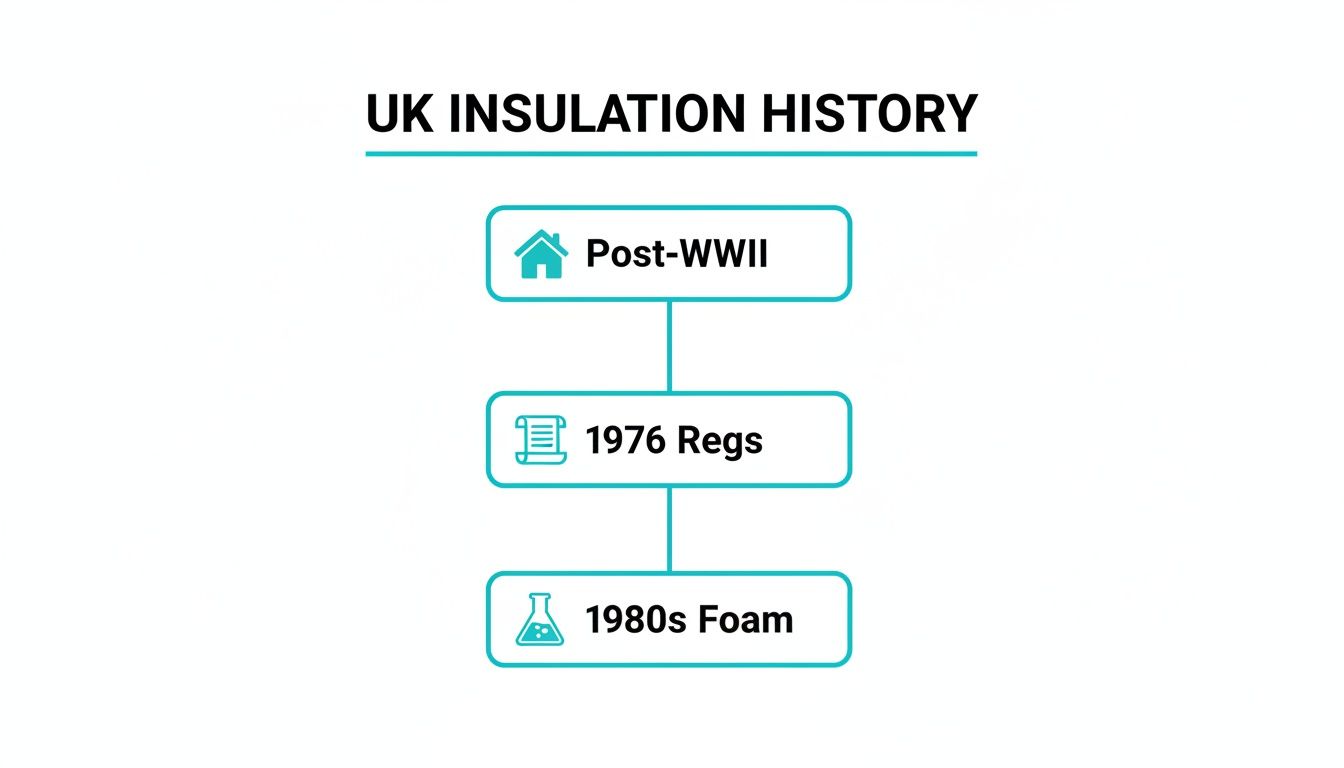
From the early rebuilding days to the first formal regulations in 1976 and the rise of high-performance foams in the 1980s, the focus has sharpened considerably.
Expanded (EPS) and Extruded (XPS) Polystyrene are lightweight, cheap foam options. You see them a lot in floors and walls, but they do sometimes crop up in roofing.
Because of its poor reaction to fire, using polystyrene in a roof demands meticulous design and installation to comply with UK Building Regulations. Many roofers simply avoid it, opting for materials with better inherent fire safety.
Eco-friendly insulation choices are becoming more popular, but their fire performance can be a mixed bag and often relies on added treatments.
If you’re drawn to these greener options, it’s absolutely vital to scrutinise the manufacturer’s data sheet to confirm the exact fire rating.
To make things even clearer, here’s a side-by-side look at how the main contenders compare. It’s a quick reference to help you weigh up the pros and cons of each material for your roof.
| Insulation Material | Typical Euroclass Rating | Thermal Performance (U-value) | Best For | Key Considerations |
|---|---|---|---|---|
| Mineral Wool | A1 (Non-combustible) | Good | Loft spaces, fire breaks, complex roofs | Excellent fire safety, good acoustic properties. |
| PIR/PUR Boards | B to D (Combustible) | Excellent | Flat roofs, warm pitched roofs, extensions | Top thermal efficiency for its thickness; must be installed correctly. |
| Polystyrene (EPS/XPS) | E to F (Highly combustible) | Good | Limited use; only when fully encapsulated | Melts and creates flaming droplets; requires very careful installation. |
| Natural Fibres | C to E (Combustible) | Good | Eco-conscious projects, breathable constructions | Fire performance heavily depends on retardant treatments; check data sheets. |
Ultimately, the right choice always comes down to your specific property, your budget, and how much thermal performance you need. For a deeper dive into material selection, you can check out our guide on choosing the best materials for your new roofing project.
Knowing the Euroclass system is one thing, but figuring out how it applies to your own roof is where the theory meets reality. In the UK, Approved Document B (Fire Safety) lays down the law for what your roof assembly needs to achieve. But there’s no single, universal rule for the fire rating of insulation—it all depends on your type of property and the specific design of your roof.
This isn’t just about getting a sign-off from building control. It’s about making sure that if the worst happens, your roof works to contain a fire, not help it spread. For anyone undertaking a roofing project in Berkshire and Surrey, from a small extension to a full reroof, getting this detail right is absolutely essential.
Pitched roofs are the classic look for most homes across the UK, from the terraced houses in Maidenhead to the detached properties in Woking. When it comes to fire safety, the regulations are laser-focused on one key risk: preventing a fire from spreading between connected properties.
This is a massive deal for terraced and semi-detached homes. If a fire breaks out in one loft, the whole system is designed to stop it from simply hopping over the party wall into your neighbour’s roof space. This is done through a few key measures working together:
For homes attached to other properties, fire safety is a shared responsibility. Using A1-rated insulation in your loft isn’t just protecting your home; it’s a critical measure to protect your neighbours too.
Flat roofs, which are a common feature on extensions, garages, and commercial buildings, come with their own distinct fire safety rules. Because they are often built closer to property boundaries or other buildings, the regulations are particularly strict.
The main worry here is how the roof would hold up if a fire started in a building next door. The roof covering must be able to resist the spread of flames across its surface and stop a fire from breaking through into the structure below for a set amount of time. The exact rating you need is dictated by how close the building is to the boundary line.
The way you insulate your roof—in what’s known as a ‘warm roof’ or ‘cold roof’ design—also has a huge impact on your fire safety plan.
Choosing the right insulation for your specific roof type and design is vital for both safety and compliance. For a professional assessment of what your property in Windsor or the surrounding areas needs, contact All Custom Roofing for expert advice. We’ll make sure your roof isn’t just warm and weatherproof, but also fully compliant with UK fire safety standards.
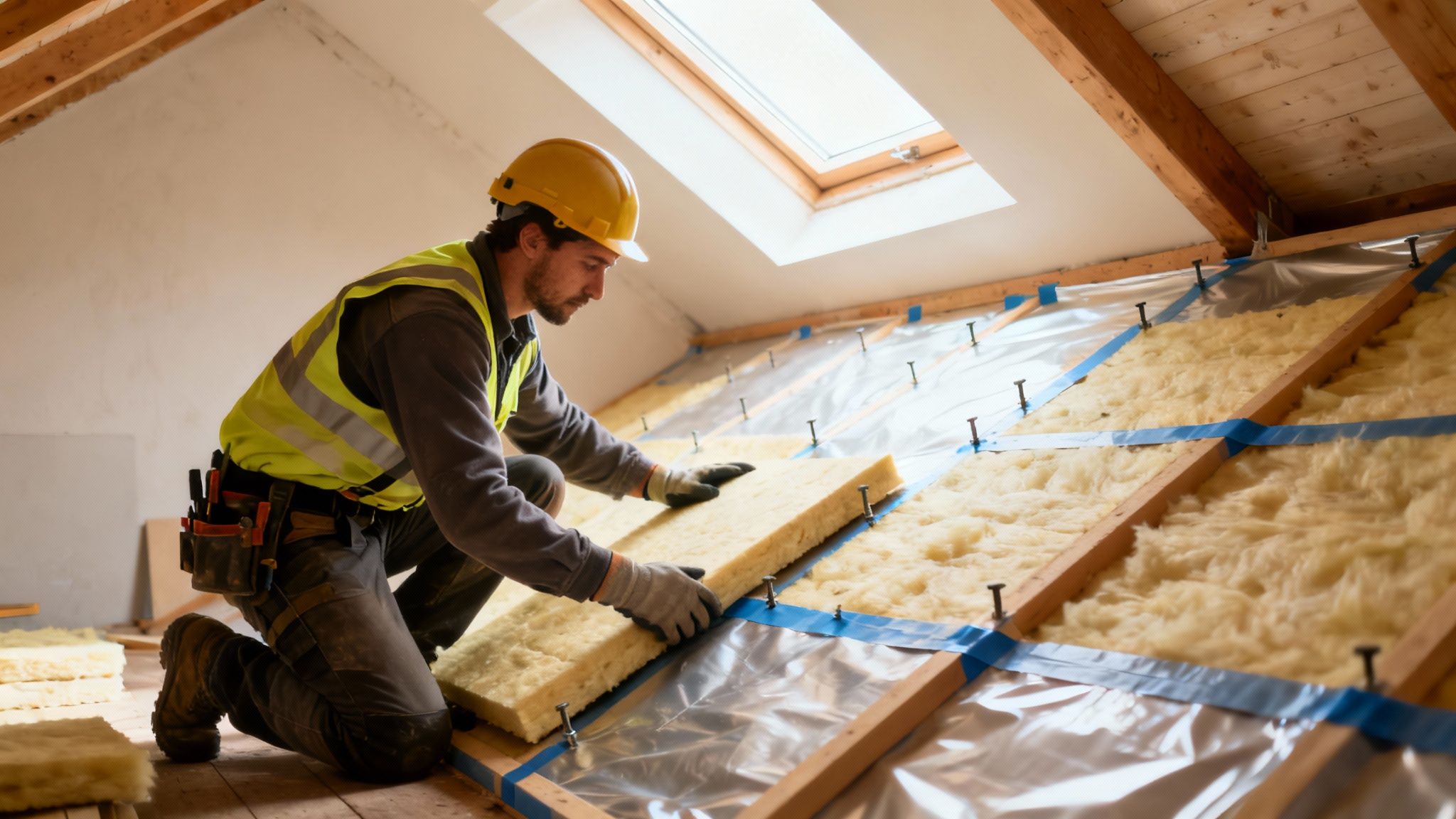
Choosing an insulation material with an A1 ‘non-combustible’ rating is a fantastic first step. But here’s something we’ve seen time and again: the true fire rating of insulation is only as good as its installation. Even the best materials can be dangerously compromised by poor workmanship, turning a smart investment into a false sense of security.
Think of it like this: your roof’s fire protection has to work as a complete, unbroken system. It’s like a waterproof coat—a single unzipped section or a tiny tear is all it takes to let the rain pour in. It’s the same with insulation. Small gaps between boards, the wrong fixings, or a poorly sealed vapour barrier can create little chimneys for fire and smoke, letting them bypass the material’s protective qualities entirely.
This is exactly why getting a professional installer is non-negotiable for property owners and landlords in Windsor and the surrounding areas.
A DIY or amateur job might seem like it saves a bit of cash upfront, but it can introduce serious risks that completely cancel out the product’s safety rating. These hidden flaws can have devastating consequences in a fire.
Some of the most common installation mistakes we see are:
A fire rating is achieved under controlled lab conditions. Professional installation is what makes sure your insulation can deliver that same level of protection in the real world, where it really counts.
Regulations have long been improving safety in UK homes. The Furniture and Furnishings (Fire) Safety Regulations 1988, for instance, drastically cut household fire risks. This focus on system-wide safety has been mirrored in roofing, where properly installing materials like rockwool in cavities post-1988 was shown to reduce loft fire spread by a significant 25%.
This data highlights a crucial point: materials don’t work in isolation. A professional company like All Custom Roofing doesn’t just fit a product; we install a complete, integrated system. We understand how every single component—from the tiles and underlay right down to the insulation and ventilation—has to work together to protect your property.
Our experience serving homes and businesses across Berkshire, Surrey, and beyond means we know the local housing styles and their unique challenges. We make sure every layer is fitted perfectly, creating the seamless, fire-resistant barrier your home deserves.
By entrusting your project to a skilled team, you’re not just buying insulation; you’re investing in genuine safety and the peace of mind that comes with it.
Here are some quick, clear answers to the questions we hear most often from property owners about the fire safety of their roof insulation. We’ll cut through the jargon and get straight to the practical concerns to help you make the right choice for your home.
Without a doubt, the highest and safest rating you can get is Euroclass A1. This classification means the material is completely non-combustible.
Mineral wool—both stone and glass wool varieties—is a widely available A1-rated option. It won’t contribute to a fire, produce smoke, or create dangerous flaming droplets. For homes in Windsor, particularly terraced or semi-detached properties where fire can spread between lofts, an A1 product offers the best possible protection.
Yes, but this is where professional installation becomes critical. It’s not just about the insulation itself; it’s about the entire roof system working together.
Combustible insulation materials like PIR foam boards, which often have a B or C rating, can be used safely when they’re installed correctly as part of a tested and certified assembly. This typically means enclosing the insulation with a fire-resistant layer, like plasterboard, to ensure the whole structure meets UK Building Regulations. A professional roofer is essential to guarantee the system is compliant and safe.
Choosing insulation is about more than just the product’s label; it’s about ensuring the entire roof assembly works together to protect your home. Correct installation is what activates the material’s fire safety potential.
In most situations, yes. Older insulation might not meet today’s fire safety standards and could even be a fire risk. Just as importantly, leaving old, compressed material in place can create gaps and squashed layers, which seriously undermines the performance of your brand-new insulation.
A professional roofer will always assess the condition of your existing setup and recommend the safest, most effective course of action. This ensures your new, fire-resistant insulation can actually do its job properly. For a detailed breakdown of project expenses, you can learn more about how much a new roof costs in the UK.
For a professional assessment of your roof’s insulation and expert installation, trust All Custom Roofing. Contact us today for a no-obligation quote.