 (+44) 7900 515 552
16 Oct 2026
 insurance backed guaranteeinsurance backed guarantee
If you’re running a warehouse, office block, retail unit, school, or mixed-use commercial property around Windsor, you usually don’t start thinking seriously about the roof until it forces the issue. A leak over stock, damp staining above suspended ceilings, rising heating bills, or repeated patch repairs are often the point where a business owner decides the old system has stopped being serviceable.
At that stage, a roof isn’t just a building element. It’s a business risk. It protects staff, equipment, tenants, fit-out, and day-to-day operations. A poor replacement can leave you with the same problems in a few winters’ time. A well-planned installation gives you weather protection, better thermal performance, cleaner drainage, and fewer nasty surprises.
Commercial roofing installations in Berkshire need a practical approach. The South East gets regular rain, exposed sites can catch strong winds, and many local roofs carry plant, skylights, walkways, and awkward edge details that make a simple-looking job more technical than it first appears. Good outcomes come from survey work, suitable materials, proper detailing, and realistic planning around access and disruption.
Most commercial clients ask the same core questions. Can the existing roof be overlaid, or does it need a full strip? Which system makes sense for the building? How disruptive will the works be? What drives the cost? And how do you avoid paying for a new roof only to discover the drainage or detailing was wrong from day one?
Those are the right questions.
In Berkshire, the answer often depends less on the brochure description of a membrane and more on the roof’s real conditions. A warm deck on a retail parade has different demands from a metal-clad industrial unit in Slough, or a school extension near Maidenhead with a mix of outlets, parapets, and old patch repairs. The roof covering matters, but so do the deck condition, insulation build-up, drainage falls, wind exposure, and how the installer handles the details around penetrations.
Practical rule: A commercial roof should be priced and planned as a system, not as rolls of membrane laid over a problem.
A good installation starts with diagnosis, not materials sales. You need to know what’s there now, what’s wet, what’s moving, what drains properly, and what doesn’t. You also need a contractor who can explain the trade-offs in plain English, especially if you’re balancing budget, tenancy pressures, and a live site.
The right system depends on building use, exposure, access, drainage design, and budget. In this part of the UK, most commercial roofing installations centre on single-ply membranes, built-up felt systems, and metal roofing. Each can work very well when matched to the building. Each can also disappoint if it’s used in the wrong setting or installed badly.
Single-ply is common on flat and low-slope commercial roofs. The main options are EPDM, TPO, and PVC.
EPDM is a rubber membrane. It suits straightforward roof areas and can be a sensible choice where flexibility matters. TPO and PVC are thermoplastic membranes with heat-welded seams, which many project managers prefer on larger roofs with more detailing because seam quality is easier to verify on site than an adhesive-only approach.
For UK conditions, the main strengths are relatively quick installation, lighter weight, and compatibility with modern insulation build-ups. The weakness is that these systems are unforgiving of rushed workmanship. Bad seam welding, poor perimeter detailing, or careless treatment around outlets and upstands will shorten the roof’s service life far more quickly than most owners expect.
For a closer look at flat roof options on local projects, this guide to commercial flat roof systems is worth reading.
Built-up roofing still has a place on UK commercial properties. Modern felt systems are familiar to many contractors and can be effective on smaller commercial blocks, extensions, and roofs with complicated shapes.
They tend to suit projects where a durable, layered covering is preferred over a sheet membrane. They can also be practical on refurbishment work where the crew needs flexibility around awkward details. The trade-off is labour intensity. The quality of laps, substrate preparation, and detailing matters hugely, and older-style felt work often gets unfairly judged because people remember poor installations rather than properly executed modern systems.
On many older Berkshire properties, felt isn’t the problem. The problem is that someone kept patching a failing roof instead of dealing with wet insulation, tired outlets, and bad falls.
Metal works well on certain commercial and industrial buildings, especially where the roof profile is part of the building envelope rather than just a weathering layer on a flat deck. It can be a strong fit for units, agricultural-commercial buildings, workshops, and premises where long-term durability is the priority.
The upside is durability and a clean finish. The downside is that metal roofs demand accurate detailing at laps, fixings, flashings, and penetrations. They also need an installer who understands movement, condensation control, and noise expectations. A metal roof can be excellent, but it isn’t a shortcut product.
| Roof System | Typical Lifespan (Years) | Relative Cost | Key Benefit for UK Climate |
|---|---|---|---|
| Single-ply membrane | Varies by product, specification, and maintenance | Medium | Lightweight and practical for flat and low-slope roofs with modern insulation |
| Built-up roofing | Varies by build-up and upkeep | Medium | Layered protection that can suit complex roof shapes and refurbishment work |
| Metal roofing | Varies by metal type, coating, and detailing | Medium to high | Strong weather resistance for suitable industrial and commercial structures |
A proper commercial roofing job shouldn’t feel chaotic from the client’s side. You should know what happens first, what happens next, and what the crew is checking before they move on.
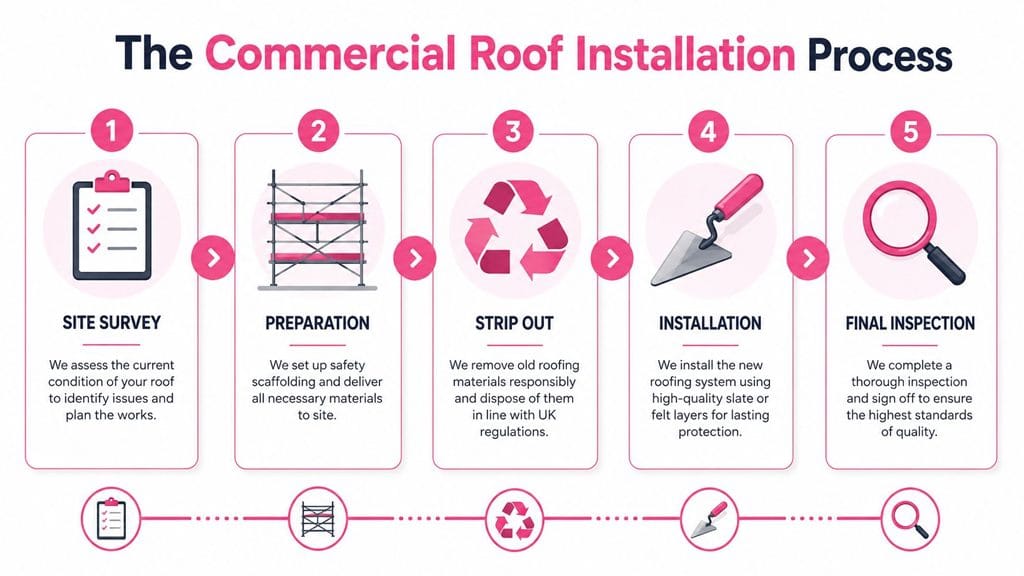
Everything begins with a site survey. That means measuring the roof, inspecting the surface, checking outlets, edge details, flashings, penetrations, plant supports, and signs of trapped moisture or deck deterioration. On some sites, drone surveys help inspect inaccessible areas safely before anyone commits to access equipment. For owners comparing modern inspection methods digital surveys can improve planning and record-keeping.
The survey stage is where a lot of expensive mistakes are prevented. If the insulation is saturated, if the falls are wrong, or if the deck has localised failure, those issues need dealing with in the specification rather than discovered halfway through the job.
A homeowner-focused article can still be useful for understanding the broad workflow. This explanation of a step-by-step guide to new roof installation outlines the same logic of preparation before covering.
Once the specification is agreed, the next phase is logistics. Access routes, scaffold or edge protection, loading areas, waste removal, working hours, and safe segregation from staff or visitors all need sorting before materials land on site.
On live commercial sites in Windsor, Reading, or Bracknell, this part matters just as much as the roofing itself. A technically good job can still become a bad project if delivery vehicles block operations, noisy strip-out starts at the wrong time, or pedestrian routes aren’t protected.
Typical pre-start planning includes:
Old coverings are removed in controlled sections, not just ripped off wholesale unless the building and weather window allow for it. This reduces exposure and gives the crew a chance to inspect the deck as they go.
If the substrate is unsound, the new roof shouldn’t go on until that is corrected. There’s no value in fitting premium materials over a failing base. On many commercial roofs, deck repairs, localised timber replacement, metal deck treatment, or vapour control upgrades are where the fundamental quality of the project is decided.
Site reality: The visible membrane is only part of the roof. The hidden condition below it often determines whether the installation lasts.
The new build-up usually goes in layers. Vapour control layer where required, insulation, the chosen waterproofing system, perimeter details, rainwater outlets, trims, and flashings. Every stage needs checking before the next one covers it up.
The handover stage should include a final inspection, snagging, site clean-down, and clear records of what was installed. A professional project doesn’t end with the last weld or final cap sheet. It ends when the roof is watertight, tidy, and properly documented.
Commercial roof pricing isn’t just about square metres. Two roofs of similar size can come out very differently because the labour, access, detailing, and hidden repairs are rarely identical.
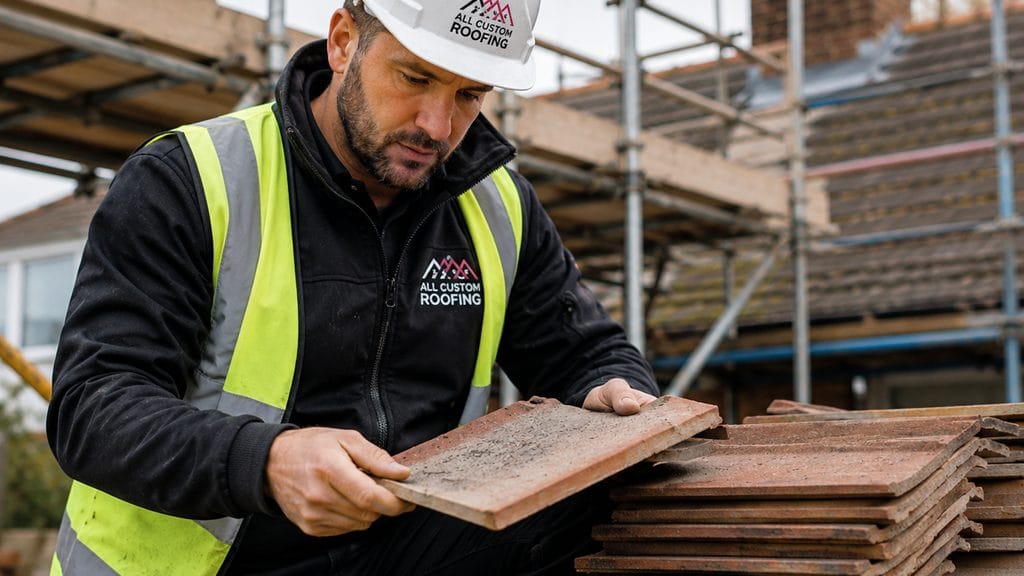
A simple open roof on a clear industrial unit is cheaper to install than a town-centre roof with restricted access, parapet detailing, multiple rooflights, duct penetrations, and tenants below. Complexity adds time. Time adds labour. Labour affects everything else.
The biggest pricing factors usually include:
For a broader breakdown of residential and re-roof pricing logic that also helps owners understand quotations, this guide on factors that influence new roof costs is a useful reference.
A low figure can mean one of three things. The contractor has found a smarter method. They’ve missed part of the scope. Or they’ve left out steps that should never be optional.
Common omissions include inadequate preparation, unrealistic allowance for edge metalwork, poor waste assumptions, and no meaningful provision for deck repairs if defects appear. Those aren’t minor line items. They are often the difference between a roof that beds in well and one that starts needing call-backs after the first hard winter.
Budget check: Ask what happens if the crew uncovers wet insulation or damaged deck. A serious contractor will have a clear method for dealing with that, not vague wording.
Commercial owners don’t always want to delay a replacement until a leak becomes disruptive. Spreading the cost can make a planned project more manageable, especially where preserving operations matters more than chasing the lowest immediate outlay.
Where finance is available through a regulated partner, subject to status, it can help owners move from reactive patching to planned replacement. That’s often a better commercial decision than paying repeatedly for temporary repairs while the roof condition gets worse.
Drainage is where many flat commercial roofs either prove their worth or start failing early.
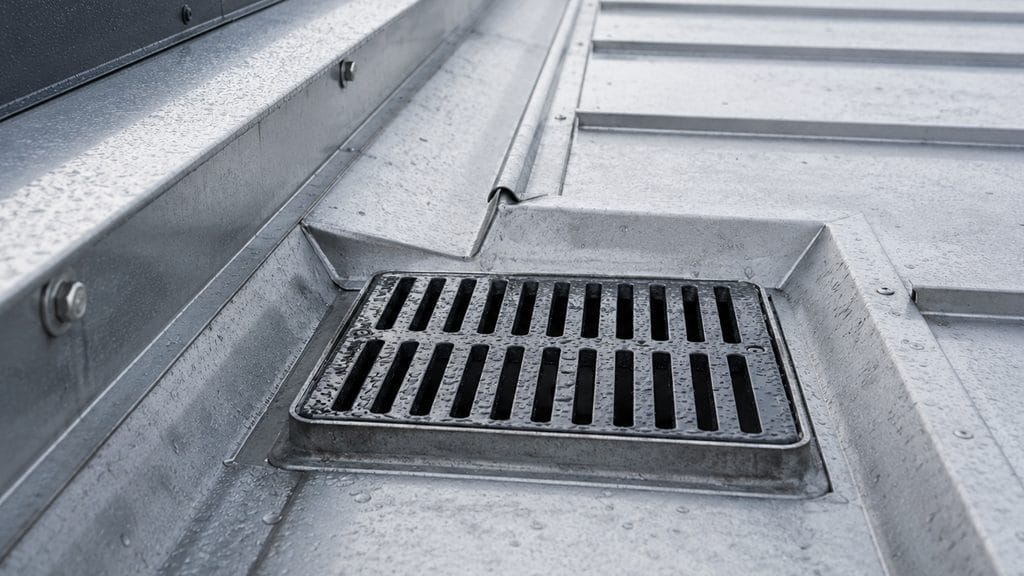
A flat roof shouldn’t really be flat in practical terms. It needs planned falls that move water towards outlets or gutters. If the insulation is laid level and the deck doesn’t already provide the correct run-off, water will sit. Once water sits regularly, every weakness in the roof gets tested harder.
BS 6229 is clear on the need for proper drainage design. On site, that usually means discussing tapered insulation, outlet positions, overflow provision, and the relationship between roof height and door thresholds before the first board is fixed. Tapered insulation is insulation cut to create a controlled slope. It does a quiet but vital job.
Drainage problems rarely start on the day the roof is finished. They show up after repeated rainfall exposes shortcuts that were built in from the start.
Good drainage planning has a lot in common with broader construction preparation. Groundwork and preparation determine how well the finished structure performs.
Commercial roofing installations aren’t only about what goes on top. Site prep affects safety, cleanliness, and programme control. Deliveries need staging areas. Materials need dry storage. Waste needs a route off site that doesn’t interfere with staff or customers. Internal protection may be needed below vulnerable roof sections, especially during strip phases.
A short visual explanation of drainage and roof planning can help make those issues easier to picture:
When a project is set up properly, the crew works more cleanly, the programme is easier to control, and the building owner gets fewer surprises.
A commercial roof lasts longer when three things line up. The design follows UK standards. The installation is carried out properly. The owner maintains the roof after handover.
For flat and low-slope work, BS 6229:2018 is one of the standards that matters in real-world performance, not just paperwork. In UK commercial roofing, compliance with BS 6229:2018 is vital for preventing wind uplift, which causes around 40% of insurance claims on low-slope roofs. That same source notes that insufficient fixings can lead to membrane detachment, and that under-fixed roofs failed during Storm Arwen at pressures that BS-compliant systems withstood.
For Berkshire businesses, the practical lesson is simple. Perimeters, corners, and fixing patterns are not small details. They are part of the structural logic of the roof covering.
There are usually two layers of protection after installation:
Owners sometimes assume a warranty means they can ignore the roof for years. That’s a mistake. Most warranties expect reasonable maintenance, prompt attention to damage, and proper control of unauthorised roof traffic.
Owner advice: Keep records of inspections, drainage cleaning, and repair visits. If a warranty issue ever arises, that paperwork matters.
Even a well-installed commercial roof will age faster if outlets block, debris accumulates, or other trades damage the membrane while servicing rooftop plant. A sensible maintenance plan should include routine inspection, cleaning of rainwater goods, checking vulnerable details, and quick repair of any accidental damage.
That approach protects the investment far better than waiting for water to appear inside.
A successful commercial roofing project usually comes down to a few fundamentals. Choose a system that suits the building. Make sure the drainage design is right. Allow for proper preparation instead of cosmetic overlay work. And work with a contractor who can explain the process clearly before the first sheet or board goes on the roof.
That matters even more on occupied sites across Windsor and Berkshire, where disruption, access, and weather can turn a straightforward specification into a difficult job if the planning is poor. You want a team that understands local conditions, communicates properly, and prices work transparently.
A reliable roofing partner should also be happy to show examples of completed work, explain material trade-offs transparently, and tell you when a repair is still sensible and when a full replacement is the better call. That kind of advice saves money in the long run.
If you’re comparing contractors for commercial roofing installations, ask direct questions. Who is surveying the roof? What happens if wet insulation is uncovered? How is drainage being handled? What warranty documentation will you receive at handover? Clear answers usually tell you a lot about the standard of the company.
If you need help with a commercial roof in Berkshire, contact All Custom Roofing for clear advice and a no-obligation quotation. Based in Windsor, we cover Windsor, Reading, Slough, Bracknell, Maidenhead, and surrounding towns, with expert support for roof repairs, re-roofing, maintenance, and commercial roofing installations.