 (+44) 7900 515 552
27 Nov 2026
 insurance backed guaranteeinsurance backed guarantee
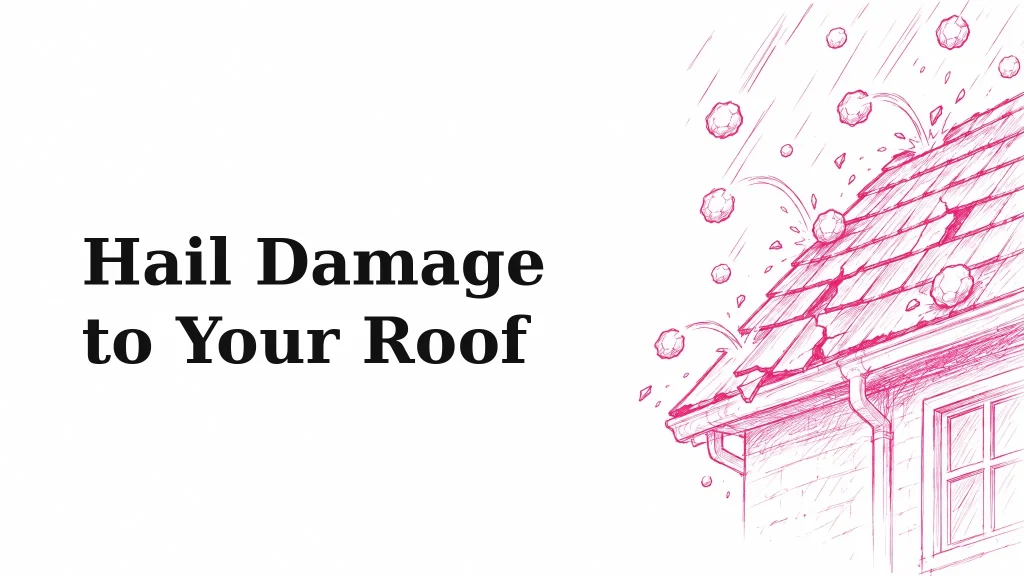
A short, sharp hailstorm can feel dramatic while it’s happening. Then it stops, and you’re left wondering whether it actually did anything.
The honest answer for most UK homes is: probably not much. But it’s still worth checking properly rather than guessing. Severe hail is genuinely rare here.
When it does hit, it can crack tiles, dent metal flashing and leave skylights with hairline cracks. Those cracks often don’t show up as a leak for weeks.
This guide covers what hail actually does to a UK roof. It explains what repairs cost, and how to make an insurance claim that doesn’t get knocked back on a technicality.
Yes, but less often and less severely than in much of continental Europe or the US. The Met Office classifies hail as “severe” once stones reach around 2cm across. Anything 5cm or more counts as very large.
Research from the Met Office, Newcastle University and the University of Bristol, published in 2025, modelled how hailstorms are likely to change across Europe as the climate warms.
Dr Elizabeth Kendon of the Met Office summed up the UK picture plainly: the risk of hail here remains low into the future.
That holds even as some of the surrounding science points to fewer but potentially larger hailstones over the long term in parts of Europe.
That’s not a reason to ignore hail entirely. It’s a reason to treat it the way this guide does: a real but occasional risk. Worth a proper check after a bad storm, not something to panic about every spring shower.
Hail is low-frequency, high-consequence for a UK roof. Most storms leave nothing worse than a bit of noise. The ones that don’t are worth taking seriously.
Hail doesn’t affect every roofing material the same way. What you should look for, and how urgently, depends on what your roof is actually made of.
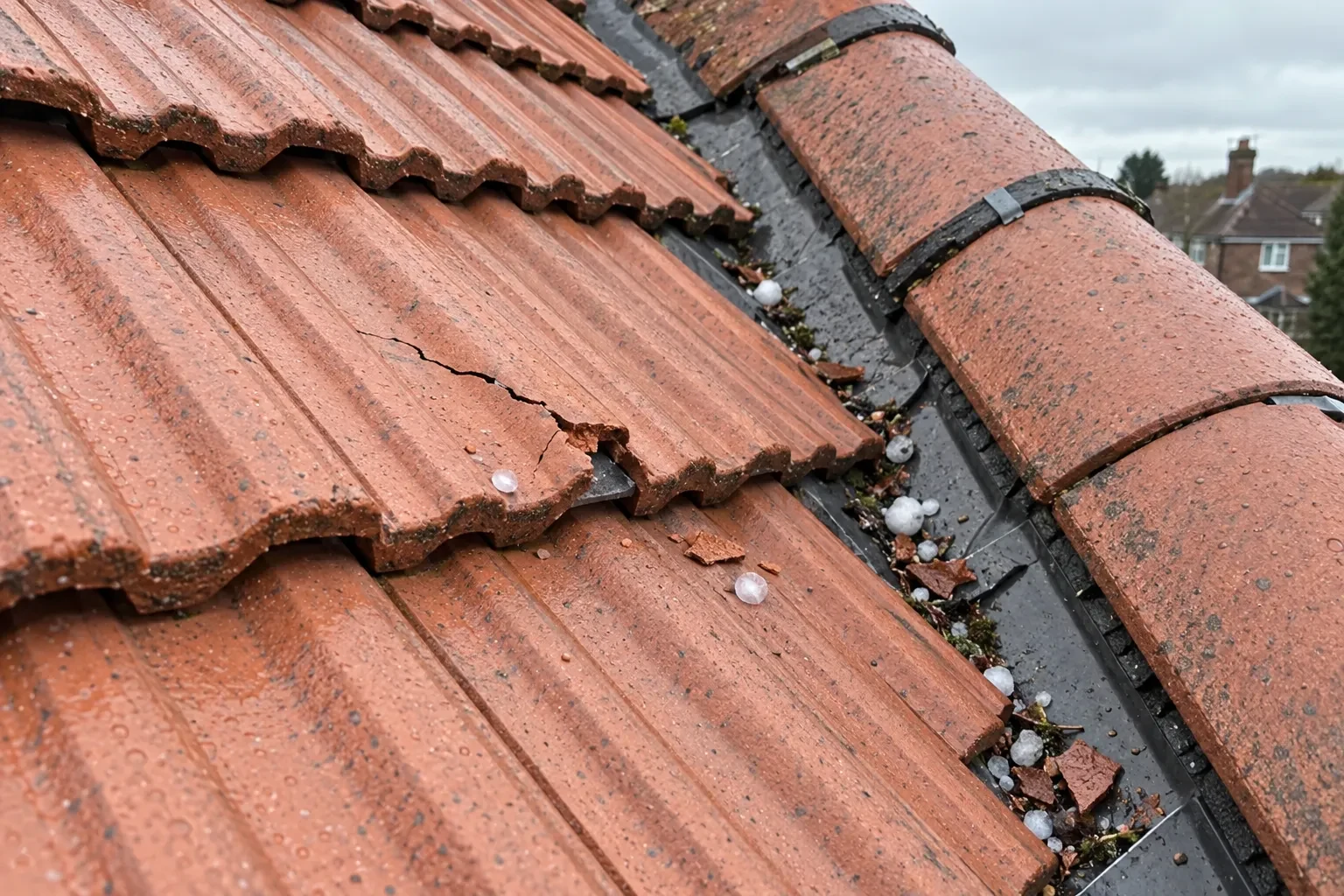
Most Berkshire homes have concrete or clay tiled roofs. Tiles are generally tough against hail. A direct, repeated hit from larger stones can still chip the surface or crack a tile outright, especially on older, more brittle clay.
A single cracked tile rarely causes an immediate leak. But it’s a weak point that worsens with every frost that follows.
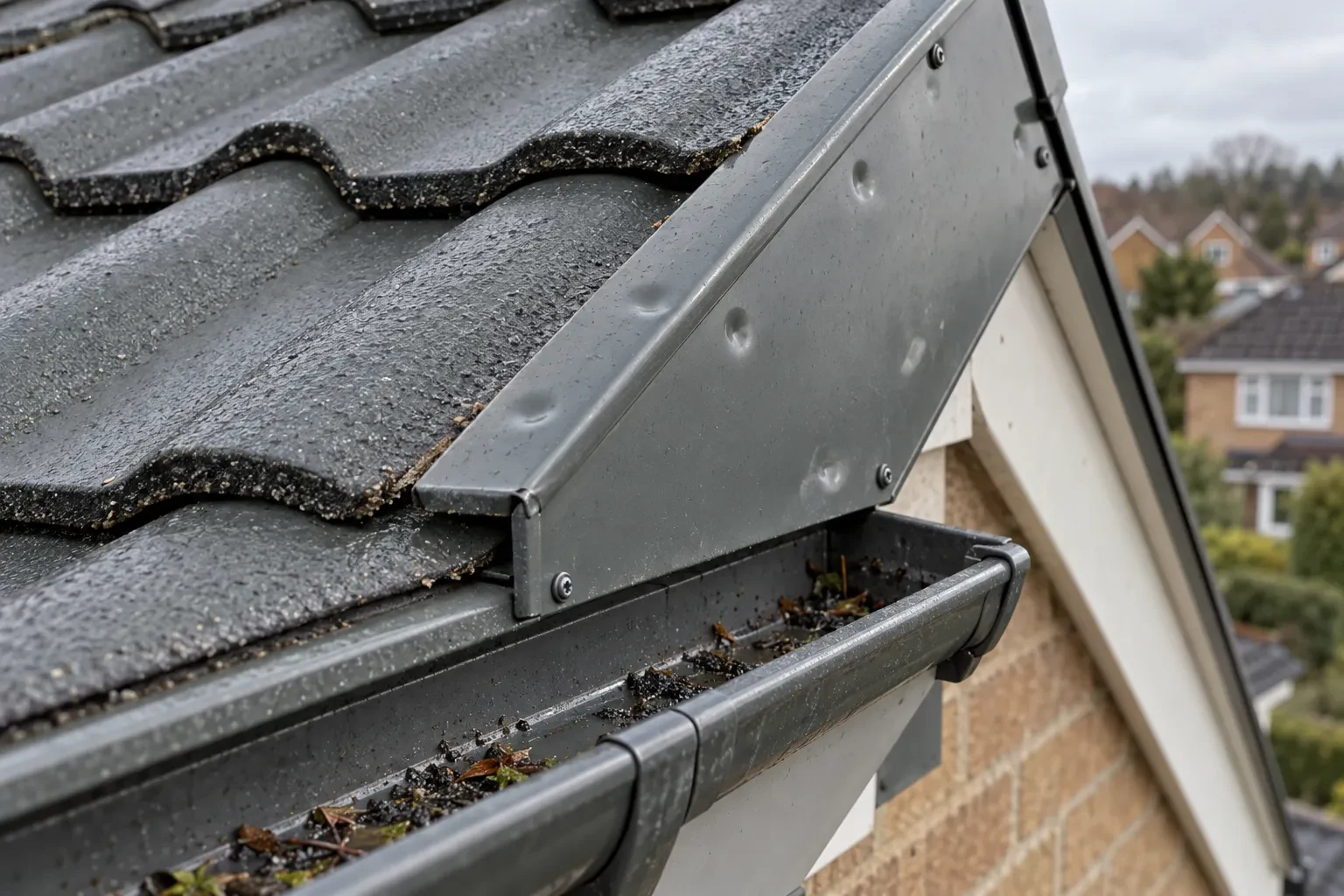
Metal is more visibly affected by hail than tile, even when the damage is purely cosmetic. Dents show up clearly on standing-seam roofs, flat-roof trims and lead or aluminium flashing around chimneys and valleys.
Cosmetic dents rarely compromise weatherproofing on their own. A dent that’s split or cracked the metal is a different matter, and needs checking properly.
Felt and EPDM rubber membranes can bruise or, in a severe storm, puncture under a large hailstone’s impact. Bruising isn’t always visible to an untrained eye straight after a storm.
It can soften the membrane in that spot. That weak point is often where a leak eventually starts, sometimes months later.
Glass and polycarbonate are the most vulnerable materials on a roof. A glancing hit can leave a hairline crack that’s barely visible from the ground.
That crack lets water in during the next heavy rain. If your home has a conservatory, roof lantern or skylights, these are the first places worth checking after any hailstorm with stones bigger than a garden pea.
You don’t need to get on the roof to do a sensible first check. Most hail damage leaves at least one visible clue from ground level or from a window.
If you spot any of these, don’t climb up to look closer yourself. Roof work after a storm often means a wet, unstable surface.
A proper inspection is exactly what a free roof inspection is for. It’s also worth reading what a roof inspection report actually needs to cover if you think you’ll be making a claim.
Hail rarely strikes a roof on its own. It’s usually part of a wider storm system that also brings high winds, heavy rain or, in winter, snow and ice.
If your roof has recently come through any of that, our guides to storm damage roof repair and snow and ice damage cover the other weather risks worth ruling out at the same time.
Costs vary a lot depending on what’s actually damaged and how much of the roof is affected. These are typical UK ranges for the repairs hail most often causes.
| Repair | Typical UK cost |
| Replacing a handful of cracked tiles (5-10 tiles) | £150-£350 |
| Tile replacement, larger area (per m²) | £100-£140 |
| Emergency call-out (before any repair work) | £150-£300 |
| Professional roof inspection | £150-£400 |
| Average roof repair overall (UK, 2026) | around £650 |
These figures are in line with MyJobQuote’s 2026 UK roof maintenance pricing data, drawn from real quotes given by UK tradespeople. Prices tend to run higher in London and the South East.
Most single-incident hail damage, a handful of cracked tiles or a dented flashing section, sits at the lower end of these ranges.
Costs climb fast if hail has cracked a skylight or split a membrane. They climb further still if the damage wasn’t caught for weeks and water has already reached the structure underneath.
Hail damage claims have a few quirks that catch people out. It’s worth knowing the rules before you ring your insurer.
Most UK home insurance policies cover storm damage. Hail is usually folded into that same “storm” definition rather than having its own category.
The Association of British Insurers defines a storm as winds of at least 55mph, rainfall of 25mm an hour or more, or snow settling 30cm deep in 24 hours.
Critically, hail on its own typically only counts as storm damage if it has caused damage to hard surfaces or broken glass. A hailstorm with no wind and no visible impact damage can fall outside that definition entirely.
That’s worth knowing before you assume a claim is automatic.
It’s also worth going in with realistic expectations. FCA data cited by Which? shows that only 32% of storm-related claims made in 2024 resulted in a payout.
Which?’s own review of 133 policy documents from 67 insurers found that one in five had a storm definition it considered potentially unfair. None of that means don’t claim. It means document everything properly and know what you’re entitled to before you call.
Weather-related claims are also genuinely rising. The Association of British Insurers recorded £1.2 billion in weather-related property claims across 2025, a 14% increase on 2024. Storm damage to homes specifically reached £244 million, up 32% year on year, with the average storm payout rising to £2,450.
A claim stands the best chance when the damage is clearly recorded, reported quickly, and backed by an independent inspection, not when it’s left until the next renewal and described from memory.
For the detail on excesses, wear-and-tear exclusions and what a typical policy will and won’t pay for, our guide to whether home insurance covers roof repairs goes into this in full.
A single chipped tile with no crack through to the underlay, and no leak inside, can usually wait for a routine inspection. It doesn’t need an emergency call-out.
Anything involving a cracked skylight, a split membrane, a leak that’s already appeared on a ceiling, or dented flashing around a chimney needs a proper look sooner rather than later. Water finds the smallest gap.
A problem that’s cheap to fix within days can become a much bigger job once it’s had weeks to work its way into timber or plasterboard.
If you’re ever unsure whether what you’re looking at is cosmetic or structural, that’s exactly the judgement call a trained inspection is for. It’s not something to guess at from a ladder.
We’re a verified member of the Confederation of Roofing Contractors. That means our work is held to an independently checked standard, not just our own word for it.
Every repair we carry out also comes with an insurance-backed guarantee. The guarantee on your roof still stands even if something happened to us as a business.
If hail damage turns out to be more extensive than a few tiles, perhaps a cracked skylight on an older roof that’s due a wider upgrade, we offer FCA-regulated finance options so a bigger job doesn’t have to be an all-at-once cost.
Metal roofing and flashing are among the materials hail affects most visibly. If that’s what’s on your home, our guide to keeping a metal roof in good condition is worth a read too.
Usually yes, as part of standard storm cover, but most policies only count hail as storm damage if it has caused damage to a hard surface or broken glass. Hail with no visible impact damage may not meet that definition.
Look for dents in metal flashing or gutters, tile debris collecting in gutters, chipped or cracked tiles visible with binoculars, new cracks in skylights, or a damp patch appearing on a ceiling in the days after a storm.
A handful of cracked tiles typically costs £150-£350 to replace. Larger areas run at roughly £100-£140 per square metre. An emergency call-out before any repair work usually costs £150-£300, and the average UK roof repair overall is around £650.
Yes. Felt and rubber membranes can bruise or puncture under a large hailstone’s impact, and bruising in particular isn’t always visible straight away. It can still create a weak point that leaks later.
For a single chipped tile with no leak, it’s often more sensible to get it repaired and keep an eye on it. A small claim can affect your no-claims history. For anything involving broken glass, a leak, or multiple tiles, a claim is usually worth pursuing.
As soon as possible. Most insurers have 24-hour emergency claims lines, and reporting promptly, with photographs and a professional inspection report, gives a claim the best chance of being accepted.
If you’ve had a hailstorm come through and you’re not sure whether it’s done any real damage, a proper inspection settles it either way. We cover Windsor, Reading, Slough, Bracknell, Maidenhead and the wider Berkshire area.
Get in touch and we’ll take a proper look.