(+44) 7900 515 552
20 Nov 2026
 insurance backed guaranteeinsurance backed guarantee
Frost is not a rare event on a UK roof. The Met Office recorded 130 days of air frost across the UK in 2025, with frost turning up on every single day in January. For a roof that is already a little tired, a hard freeze is often what finally finds the weak spot.
Snow and ice rarely cause a dramatic failure on their own. What they do is take an existing problem, a loose tile, a blocked gutter, a bit of worn mortar, and turn it into a leak, a crack or a sagging length of guttering almost overnight.
This guide covers what actually happens to a roof in cold weather, what it costs to put right, and when it is worth calling someone out rather than waiting for a thaw.
Cold weather attacks a roof in three distinct ways, and most winter call-outs come down to one of them. Knowing which one you are dealing with makes it easier to explain the problem to a roofer and to judge how urgent it is.
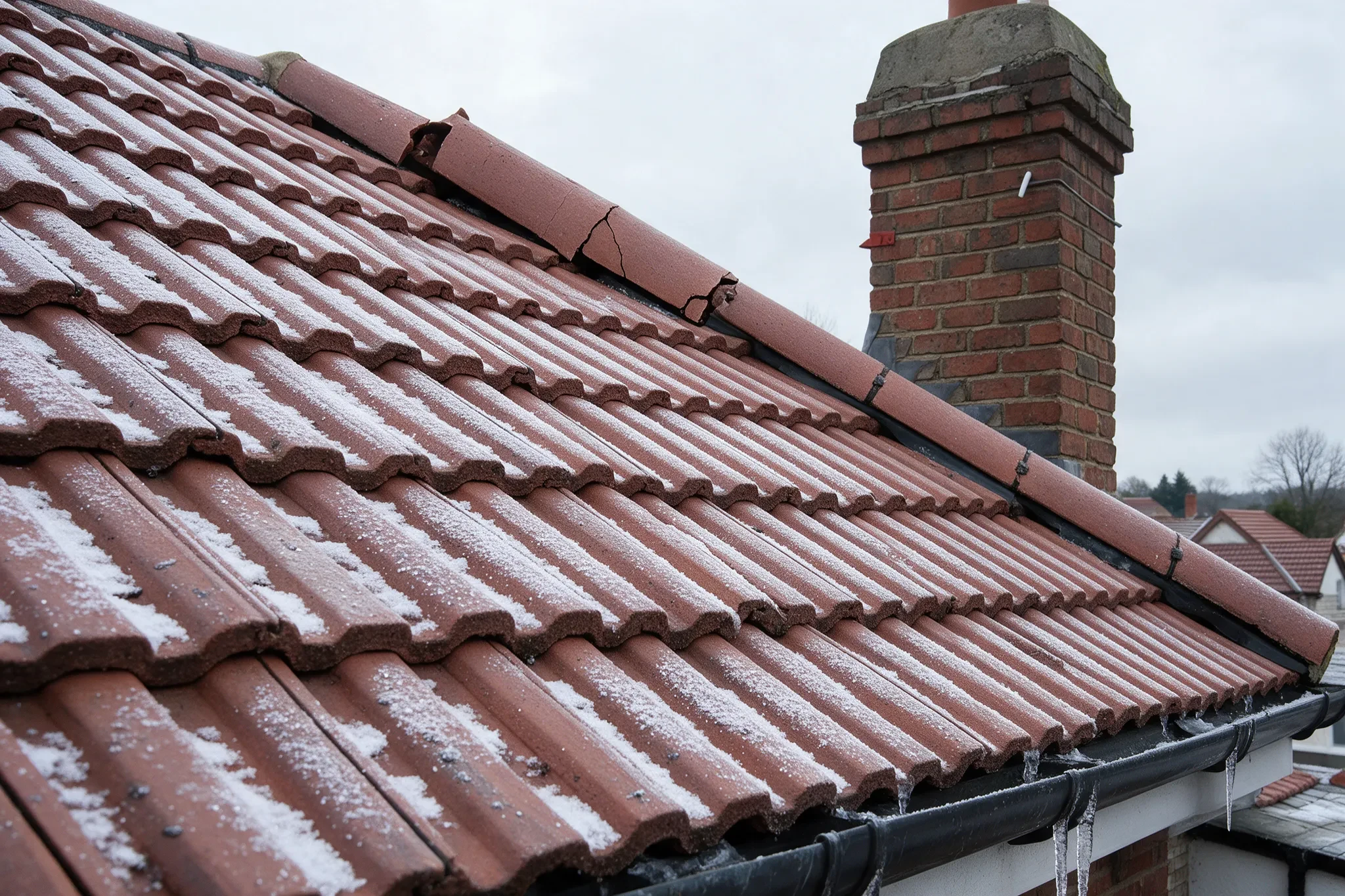
Freeze-thaw, sometimes called frost attack, happens when water soaks into a porous material such as a tile, a ridge mortar bed or a chimney stack, then freezes. Water expands by roughly nine per cent as it turns to ice, and that expansion puts real stress on whatever is holding it.
LABC Warranty’s own guidance on frost attack describes this as the repeated action of rainwater freezing and thawing, which eventually causes the material to spall, meaning it flakes, cracks or breaks away.
Ridge and hip tiles bedded in traditional mortar are especially exposed, since the mortar sits directly in the weather and holds water against itself. We have covered ridge tile failure and dry ridge systems in detail in our guide to ridge tile repair, including why BS 5534 pushed the industry toward mechanical fixing rather than relying on mortar alone.
UK roofs are designed with snow load in mind, so a normal covering of snow is not usually a structural worry on its own. The real risk comes from snow that sits, melts a little, and refreezes, particularly on flat roofs or anywhere with poor drainage, since standing meltwater has nowhere to go once it turns back to ice.
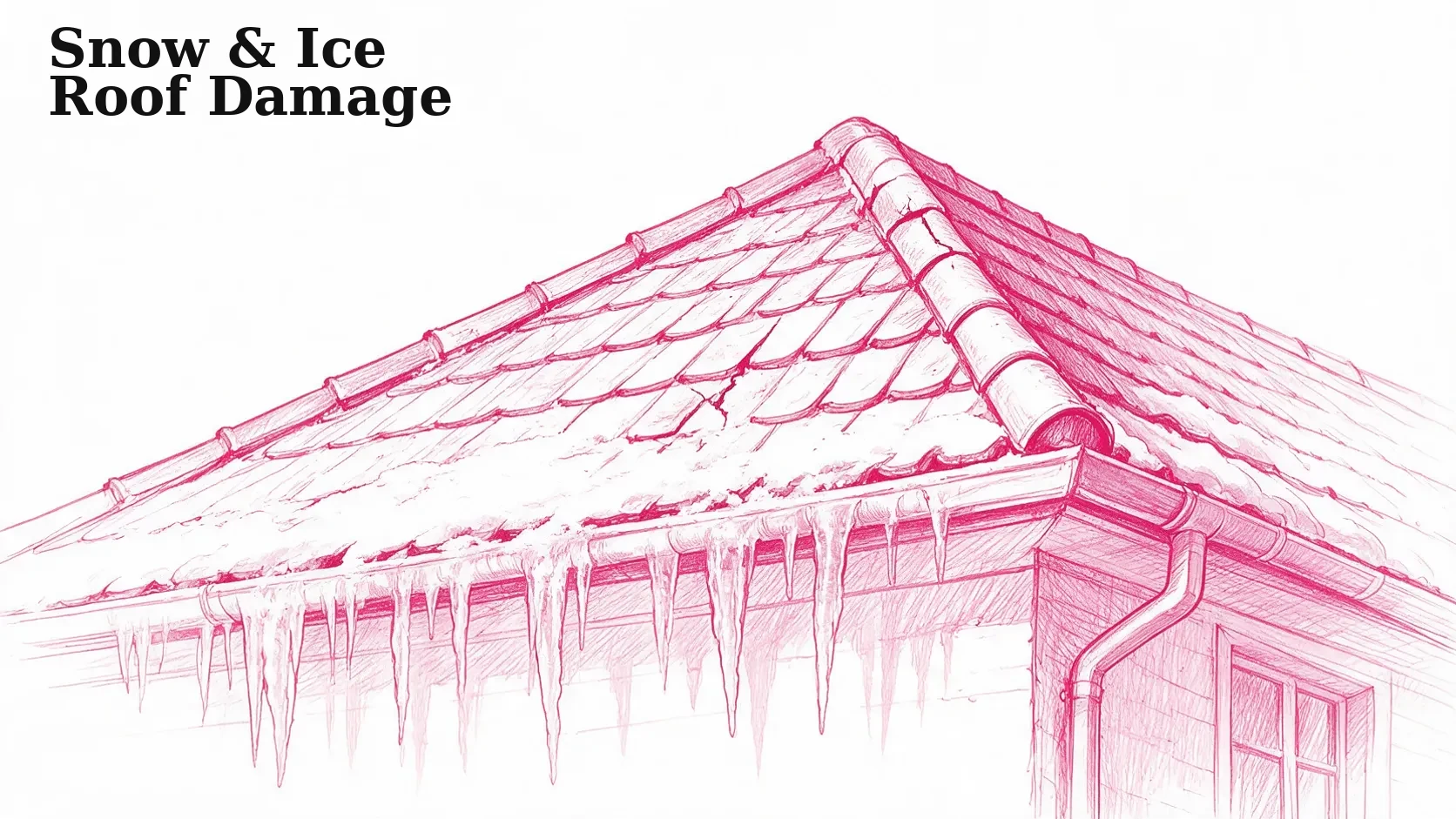
Warm air escaping from a loft can melt snow on the upper part of a roof even while the air outside stays below freezing. That water runs down, reaches the colder edge of the roof, and refreezes at the gutter line, building up into a ridge of ice that blocks the gutter and forces water back up under the tiles or felt.
A gutter already clogged with autumn leaves makes this worse, since debris gives the ice something to grip and build around.
Most winter roof problems announce themselves before they turn into a full leak, if you know where to look. After any sharp frost or snowfall, it is worth a quick check for:
A roof usually gives more than one warning before it leaks properly. Catching the first sign, a cracked tile or a line of icicles along the gutter, is what keeps a repair small instead of letting it become a bigger job.
According to MyJobQuote’s own cost data, the average roof leak repair in the UK comes to around £375 and takes one to three days, with most jobs falling somewhere between £220 and £550. Cold-weather damage tends to show up as one of a handful of specific jobs, each with its own rough price band:
| Job | Typical cost | Why it happens in cold weather |
| Slipped or cracked tiles | £150 – £300 | Usually the first failure point once frost gets into a tile or its fixing |
| Ridge tile repair | £250 – £600 | Mortar bedding fails under repeated freeze-thaw cycling |
| Flashing repair | £200 – £500 | Lead or flashing shifts or splits as it expands and contracts with the cold |
| Valley repair | £400 – £800 | Ice and trapped debris block the channel, forcing water under the tiles either side |
| Full leak repair (average) | £375 | Typical turnaround of one to three days once a roofer is on site |
| Emergency call-out | £100 – £300 on top of the job cost | More over weekends and bank holidays |
Labour on its own runs to roughly £35 to £45 an hour, or £280 to £360 a day for one roofer. London and the South East typically sit 20 to 30 per cent above prices elsewhere in the country.
A straightforward slipped tile and a cracked valley are very different jobs, so it is always worth getting a roofer to look before assuming the worst.
The steps below are the same ones we would talk a customer through on the phone during a cold snap, in the order that keeps everyone safe and gets the right fix booked in.
Most UK buildings insurance policies do cover storm, snow and frost damage to a roof, but cover is rarely unconditional. As we cover in full in our guide to whether home insurance covers roof repairs, insurers generally expect the roof to have been in a reasonable state of repair beforehand, and they expect you to report and address damage promptly rather than letting a small leak sit over winter.
An insurer’s first question after a claim is rarely about the weather. It is almost always about how quickly the damage was spotted, reported and dealt with.
A lot of winter call-outs are preventable with a bit of attention in October or November, before the first proper frost arrives.
A gutter full of autumn leaves is exactly what gives an ice dam something to form around. Clearing gutters before the cold weather arrives, and keeping them clear through winter where access allows, removes one of the easiest problems to prevent. Our guides to why box gutters leak and whether gutter guards actually work cover this in more depth if blocked guttering is a recurring problem on your roof.
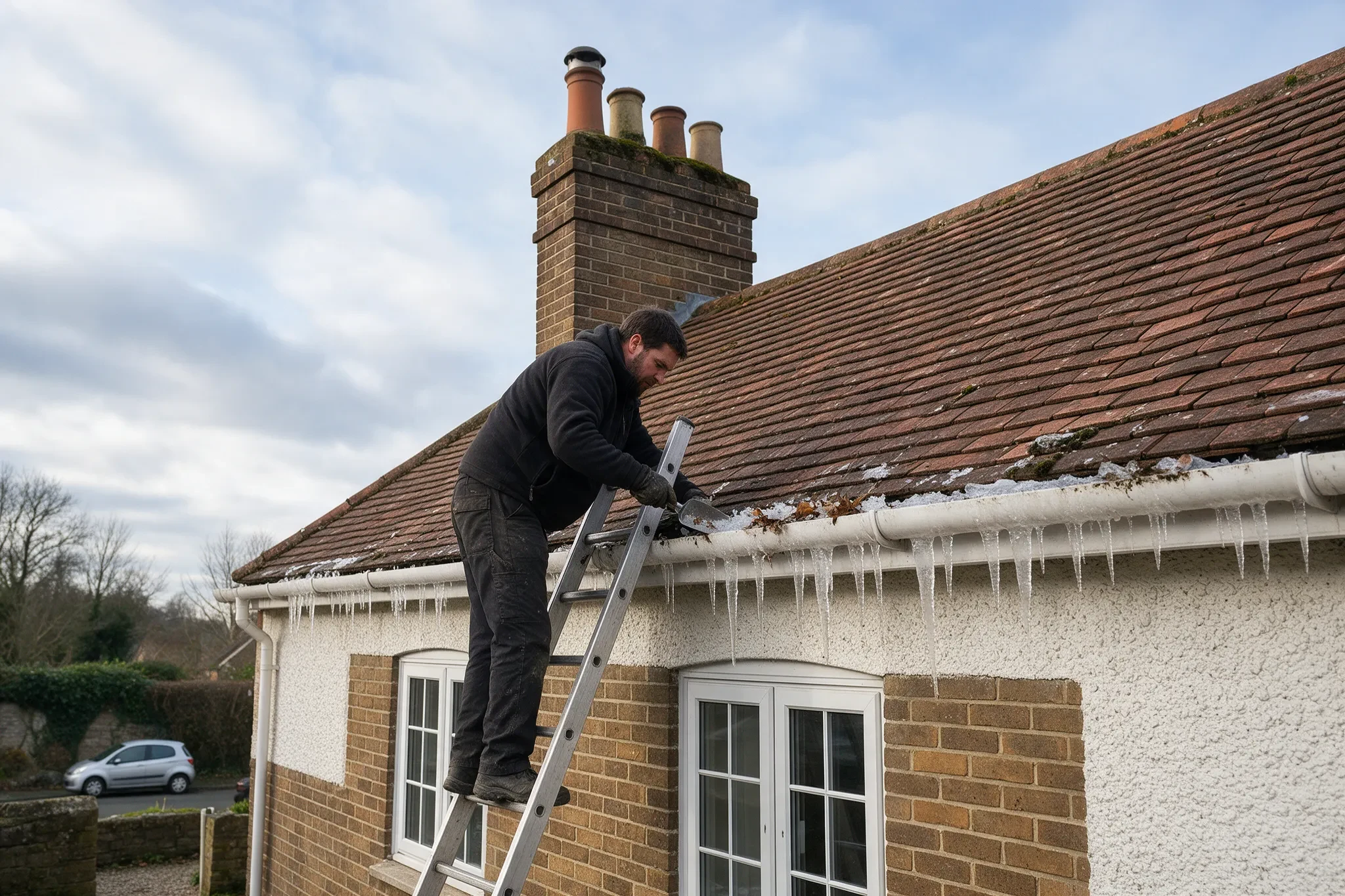
A tile that is already loose or slightly lifted has nowhere good to go once water gets underneath it and freezes. A late-autumn check, or a professional inspection if you cannot safely get a look yourself, catches these before the cold turns a five-minute fix into a full repair.
A loft that is too warm relative to the roof above it is part of what drives ice damming in the first place, since it is the heat escaping upward that melts snow on the roof before it refreezes at the eaves.
You do not need to turn this into a full insulation project to get the benefit. Just make sure loft vents and eaves are not blocked by stored boxes or insulation pushed too far into the eaves.
A cold-weather call-out is not the moment to take a chance on an unknown contractor. We are verified members of the Confederation of Roofing Contractors, and every job we carry out comes with an insurance-backed guarantee.
That guarantee matters more in winter than at any other time of year, since a poor emergency repair can fail again within weeks. If a bigger job, such as a full re-roof after prolonged freeze-thaw damage, comes out of a winter inspection, our FCA-regulated finance partner means it does not have to be paid for in one go.
Our guide to choosing a roofing contractor covers the checks worth making before you let anyone onto your roof. Our explainer on insurance-backed guarantees sets out exactly what that protection covers if a contractor ever stops trading.
Snow itself rarely damages a roof outright, since UK roofs are built with snow load in mind. The damage usually comes from meltwater refreezing, from ice building up in gutters, or from existing weak spots such as loose tiles or worn mortar failing once frost gets into them.
Look for tiles that are cracked, lifted or missing, icicles along the gutter line, damp patches on ceilings near chimneys or valleys, and any musty smell or visible frost inside the loft. Any one of these is worth a proper inspection.
Not always, but it should not be left through a stretch of freezing weather. A single cracked tile with no active leak can usually wait for a scheduled repair, while a tile that has slipped completely or is letting water through should be looked at as soon as it is safe to do so.
Most cold-weather repairs fall between £150 and £800 depending on the job, with an average leak repair across all causes coming in around £375. Ridge tile and flashing work tend to sit in the middle of that range, while valley repairs are usually the most expensive single job.
We would strongly advise against it. A roof is dangerous enough in normal conditions, and ice turns a slipped foot into a serious fall. Ground-level checks and loft inspections are safe to do yourself; anything that involves getting onto the roof itself is a job for a professional with the right access equipment.
Often, yes, if the gutter was in reasonable condition beforehand and the damage is reported promptly. As covered above, insurers generally look at the state of the roof before the damage and how quickly it was dealt with, so our full guide on insurance cover is worth reading before you call your insurer.
Storm damage usually means wind and heavy rain forcing tiles off or driving water into gaps, and tends to happen suddenly during a single event. Snow and ice damage is more often a slower process, where cold weather exploits an existing weakness over days or weeks, which is why prevention in autumn makes such a difference.
If a recent cold spell has left you with a cracked tile, an ice-choked gutter, or water coming through somewhere it should not be, get in touch and we will get someone out to take a proper look.