(+44) 7900 515 552
18 Nov 2026
 insurance backed guaranteeinsurance backed guarantee
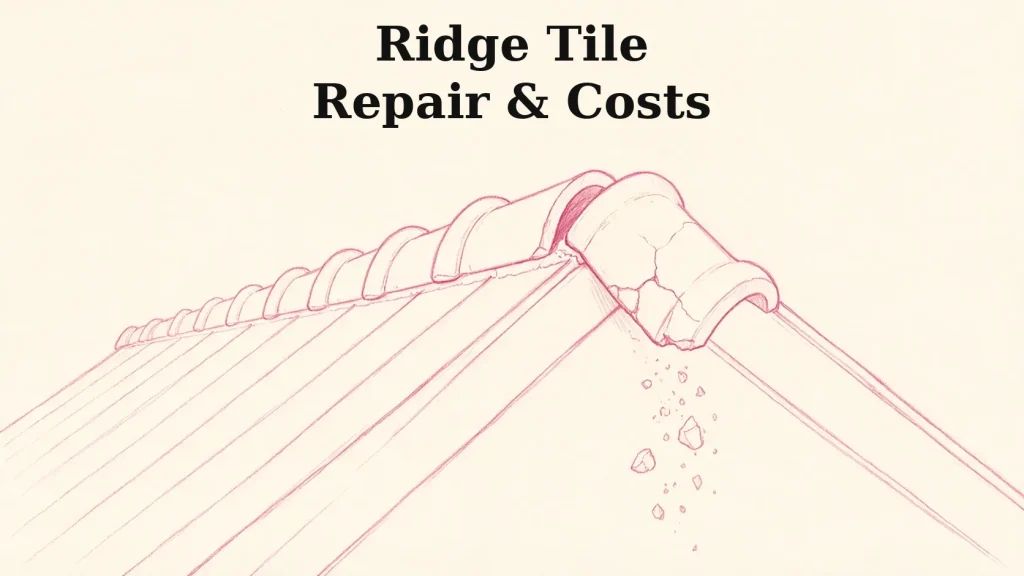
A ridge tile on the garden path, or a visible gap along the roofline from the street, is usually the first sign anything’s wrong.
It’s rarely an emergency in the way a storm-torn roof covering is. It’s also not something to leave. A loose ridge tile is one gust away from becoming a falling tile, and the gap it leaves lets water straight into the roof structure underneath.
This guide covers why ridge tiles fail, what repairing or replacing them actually costs in the UK, and the decision that matters more than most homeowners realise: whether to re-bed the old tiles in fresh mortar, or move to a mechanically fixed dry ridge system.
Ridge tiles sit at the highest, most exposed point of the roof, bridging the two sloping surfaces where they meet. On most UK homes built before the mid-2010s, they’re held in place by nothing more than a bed of sand-and-cement mortar.
That mortar is doing a permanent structural job with a lifespan nobody designed it for.
Mortar bedding typically lasts 15 to 25 years before it starts to crack and crumble, depending on exposure. Once it goes, the tile above it has nothing holding it down except its own weight.
A strong gust can lift and shift a tile that’s lost its bedding. Repeated wind loading over a few winters will usually finish the job, which is why ridge failures tend to cluster after a stormy season rather than appearing one at a time out of nowhere.
Water gets into hairline cracks in old mortar, then freezes and expands. Do that enough times over a British winter and the mortar breaks apart from the inside, long before anyone looking up from the garden would notice anything wrong.
Flying debris, a stray football, or a bird landing awkwardly can crack an already-weakened tile outright. A tile in good condition rarely breaks this way on its own; it’s usually a sign the mortar around it was already on its way out.
None of these signs mean the roof is about to fail. All of them mean it’s worth getting a roofer to look before the next storm rather than after it.
A full ridge inspection is also worth adding to the list at your next roof check if the property is over 20 years old and the ridge has never been touched. Catching degraded mortar before a tile actually comes loose is far cheaper than an emergency call-out after one does, and it avoids the few weeks of exposed roof in between.
Costs scale with the number of tiles affected, and with whether scaffolding or tower access is needed, which it usually is on anything above a single-storey extension roof.
| Job | Typical UK cost | Typical duration |
|---|---|---|
| Small repair (1 to 3 tiles) | £120 to £275 | 2 to 3 hours |
| Medium repair (4 to 6 tiles) | £325 to £400 | Around 4 hours |
| Large repair (7 to 10 tiles) | £425 to £550 | 5 to 6 hours |
| Repointing existing ridge (per 10m) | £200 to £300 | 2 to 4 hours |
| Full ridge replacement, terrace (5-7m) | £400 to £500 | Half a day |
| Full ridge replacement, detached (12-15m) | £750 to £1,000 | Up to a day |
| Dry ridge system, whole roof | £900 to £1,900 | 1 to 2 days |
Labour makes up most of a repair bill, typically 60 to 70% of the total, according to MyJobQuote’s ridge tile cost data. UK roofers generally charge £200 to £275 a day, often working in pairs for anything involving scaffolding.
Material cost on its own is modest. A single replacement ridge tile runs from around £4 to £13 depending on the profile and whether it’s clay, concrete or a slate-effect finish, so a small repair’s cost is almost entirely labour and access.
Scaffolding or a tower is the line item most homeowners forget to budget for. On a straightforward semi-detached house it typically adds £150 to £300 on top of the repair itself, more on a taller or terraced property. Our guide to scaffolding costs breaks this down further.
That’s exactly why it’s worth asking whether a ridge repair can be bundled in with other roof work already booked on the same scaffold hire, such as gutter clearance or a general roof inspection. Splitting the cost of access across two jobs is often the single biggest saving available.
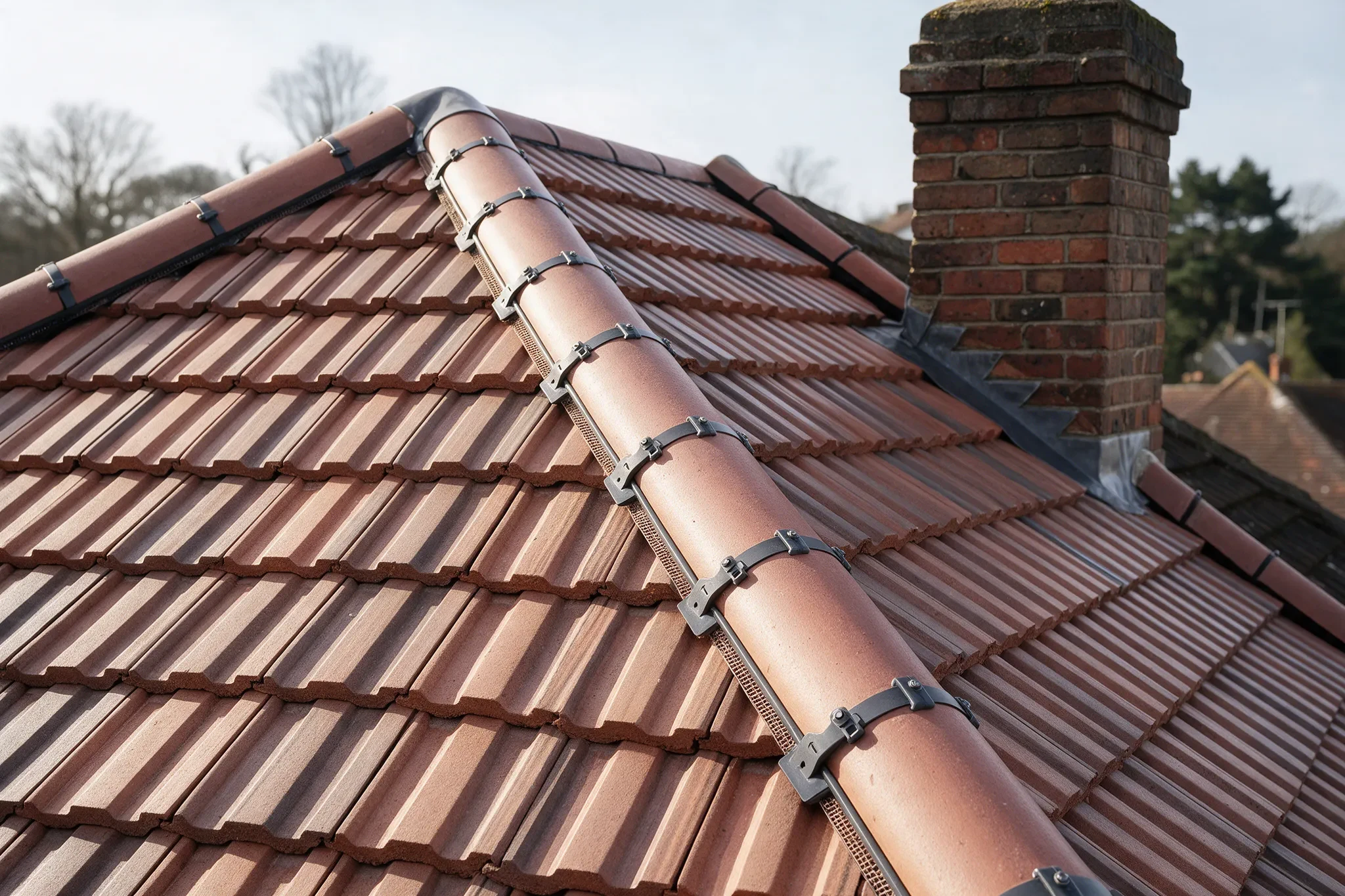
This is the decision that actually changes how long the work lasts, not just what it costs today.
A dry ridge system holds the tiles in place with mechanical fixings, clamps, unions and brackets, rather than mortar. There’s no curing time and no risk of a frost-damaged joint the following winter.
Most kits also include a ventilation strip along the ridge line, which helps the roof space breathe and can reduce condensation in the loft. A full dry ridge installation on an average semi-detached roof runs from around £900 to £1,600, per MyJobQuote’s dry ridge cost guide.
Since the 2014 revision of British Standard BS 5534, no reliance can be placed on mortar strength alone to hold ridge and hip tiles in place. New and replacement ridge work must be mechanically fixed.
That’s according to LABC Warranty’s technical update on roof tiling, which traces the change to years of insurance claims for ridge and hip tiles dislodged in high wind, most of them linked to mortar bedding that had failed quietly over time with nobody checking it.
Mortar can still be used on refurbishment work today. Current good practice pairs it with mechanical fixings rather than relying on it alone, which is exactly what the standard now requires on any ridge being worked on.
For a small, localised repair on an otherwise sound ridge, re-bedding a handful of tiles in fresh mortar is a reasonable and considerably cheaper fix. It’s still common practice for that scale of job, and nothing about it is a bodge if it’s done properly.
Where it stops making sense is when the whole ridge is reaching the end of its life. Patching old mortar with more mortar buys a few more years at best. A dry ridge system, by contrast, is one you shouldn’t need to think about again for a decade or more.
If a single tile is new and was damaged by debris or impact, repairing or swapping that one tile is usually enough. If the mortar itself is the problem rather than the tile, the calculation changes.
If one ridge tile has come loose because the mortar failed, the mortar either side of it is very likely close behind. Replacing the whole ridge properly, once, tends to work out cheaper than three separate call-outs over three winters.
Older tiles removed for a re-bed often crack simply from being lifted, since the fixing points become brittle with age. A roofer who finds this mid-job should flag it before continuing, rather than forcing tiles back into place.
That’s one of several reasons it’s worth being on site, or asking for photos, when ridge work is carried out on your home. A good contractor will show you what they found, not just tell you the job is done.
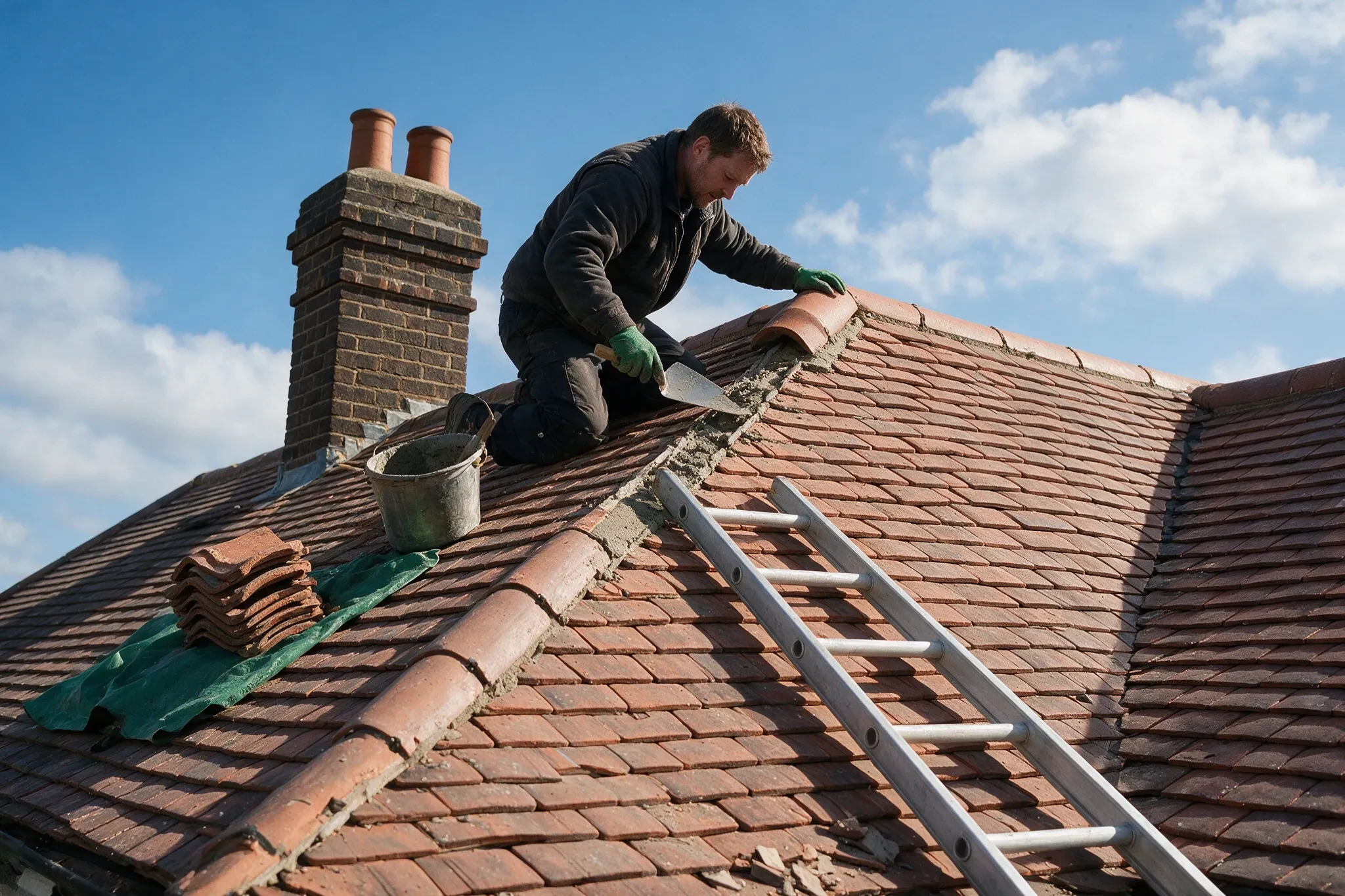
Skipping the inspection step underneath the damaged tiles is the most common shortcut on a rushed job. It’s exactly where hidden rot or a soaked batten goes unnoticed until it causes a much bigger repair later.
Often, if the damage was sudden and identifiable, such as a specific storm or impact from debris. Insurers are generally far less willing to pay out for gradual deterioration from old, crumbling mortar, which most policies treat as wear and tear rather than an insurable event.
That distinction broadly matches Checkatrade’s ridge tile cost guide, which flags wind, rain, age and freeze-thaw as the usual causes of failure rather than a single sudden event. If a storm is the obvious cause, photograph the damage and the date as soon as it’s safe to do so, before any repair work starts, since that’s what an insurer will ask for first.
For the wider picture on what’s typically covered and what isn’t, our guide to home insurance and roof damage goes through the common exclusions in more detail.
Ridge work is height work with structural consequences if it’s done badly, so the contractor matters as much as the materials. All Custom Roofing is a verified Confederation of Roofing Contractors member, and every repair is backed by an insurance-backed guarantee, so the cover on the work doesn’t disappear if the company that did it ever did.
For a job of any size, it’s worth asking exactly what the quote includes: scaffolding, waste removal, and whether mortar or a dry ridge system is being used, and why. On a full ridge replacement bundled with wider roof work, FCA-regulated finance options can also spread the cost rather than it landing as one lump sum.
Our full guide to choosing a roofing contractor covers the questions worth asking and the red flags worth walking away from, for ridge work or anything else on the roof.
It’s not recommended. Ridge work means working at height on a sloped, unstable surface, and a poorly re-bedded tile can fail again within months. The cost of a professional repair is modest compared with the risk.
A small repair of a few tiles typically takes 2 to 4 hours once access is set up. A full ridge replacement on an average home is usually finished within a day.
Often, if the damage was sudden, such as storm damage or impact from debris. Gradual failure from old, crumbling mortar is generally treated as wear and tear and isn’t covered, which is one reason to act before it gets that far.
Usually yes, for anything beyond a single-storey roof. Most roofers won’t carry out ridge work from a ladder alone, both for safety and because it’s hard to do the job properly that way.
For a small repair on an otherwise sound ridge, mortar is still a reasonable, cheaper option. For a whole ridge reaching the end of its life, a dry ridge system typically lasts longer and is now the standard approach under BS 5534.
If more than one has come loose over a short period, the mortar bedding along the whole ridge is likely failing rather than each tile being an isolated fault. It’s worth having the whole ridge assessed rather than fixing tiles one at a time.
A good roofer will match the profile and, where possible, the colour of your existing tiles. On an older roof where the exact tile is discontinued, a close match is used and the difference is rarely noticeable once weathered.
It depends on how exposed the gap is. A small, stable crack can often wait a few weeks. A missing tile or a visible gap is better dealt with before the next band of winter weather, not after it.
If you’ve spotted a loose or missing ridge tile, or you’d simply rather get the whole ridge checked before winter, get in touch for a straightforward quote.