(+44) 7900 515 552
23 Oct 2026
 insurance backed guaranteeinsurance backed guarantee
You’ve checked and your roof replacement doesn’t need planning permission. Job done, right? Not quite.
Planning permission and Building Regulations are two completely separate legal systems. Most re-roofing work in the UK has to satisfy the second one even when it sails straight through the first.
Skip it, and nothing stops the work happening. The roof goes on, the scaffolding comes down, and everyone moves on with their lives.
The problem surfaces years later, usually at the worst possible moment: when a buyer’s solicitor asks for the completion certificate during a house sale, and there isn’t one.
Planning permission asks whether you’re allowed to change how your roof looks. Building Regulations ask whether the roof itself is safe, warm enough, and properly built. A roof can clear one and still fail the other.
It’s an easy pair to confuse, because both involve local councils and can apply to the same job. But they ask different questions, enforced by different teams, with different paperwork at the end.
If you want the planning side covered in full, including conservation areas, listed buildings, and the permitted development limits for roof height and projection, we’ve written a full guide to planning permission for roof replacement.
This article deals only with Building Regulations, which is the part most homeowners don’t realise still applies once planning is sorted.
| Planning Permission | Building Regulations | |
| What it checks | How the roof looks from outside: height, projection, materials, visual impact on the area | Whether the roof is structurally safe, fire-safe, and thermally efficient |
| Who enforces it | The council’s planning department | Building Control (council-employed or an approved inspector) or a competent person scheme |
| Usually needed for | Changes to height, shape, or appearance; listed buildings; conservation areas | Most re-coverings affecting 50% or more of the roof, or any change to insulation or structure |
| The paperwork you keep | A planning decision notice (if an application was made) | A completion certificate or self-certification notice |
Building Regulations introduced a specific rule for “thermal elements” in April 2006. That covers anything forming part of a building’s heated envelope, including the roof.
Since then, re-roofing has fallen squarely inside Building Control’s remit for most homes, not just extensions and new builds.
There’s no single national percentage written into the regulations themselves. In practice, most Building Control teams use a similar working rule.
Horsham District Council’s own guidance for re-roofing projects puts it plainly: approval is generally needed once you’re re-roofing 50% or more of the roof area, or if you’re changing the insulation or ventilation, whatever the area involved.
Stay under that 50% threshold, keep the structure unchanged, and replace the covering like-for-like, and you’re unlikely to need to involve Building Control at all.
Go over it, and the whole roof is treated as a thermal element that needs to meet current standards, not just the bit that’s visibly failing.
According to the Planning Portal’s own guidance on re-roofing, a straight swap of the same material in the same way is the safest ground. The moment the covering material changes, such as slate to tile, approval is likely needed.
Weight matters too. If the new covering is significantly heavier or lighter than what’s coming off, the roof structure itself may need checking or strengthening before anyone signs off on the job.
The Planning Portal’s guidance specifically recommends a structural engineer or surveyor’s input at that point, not a guess.
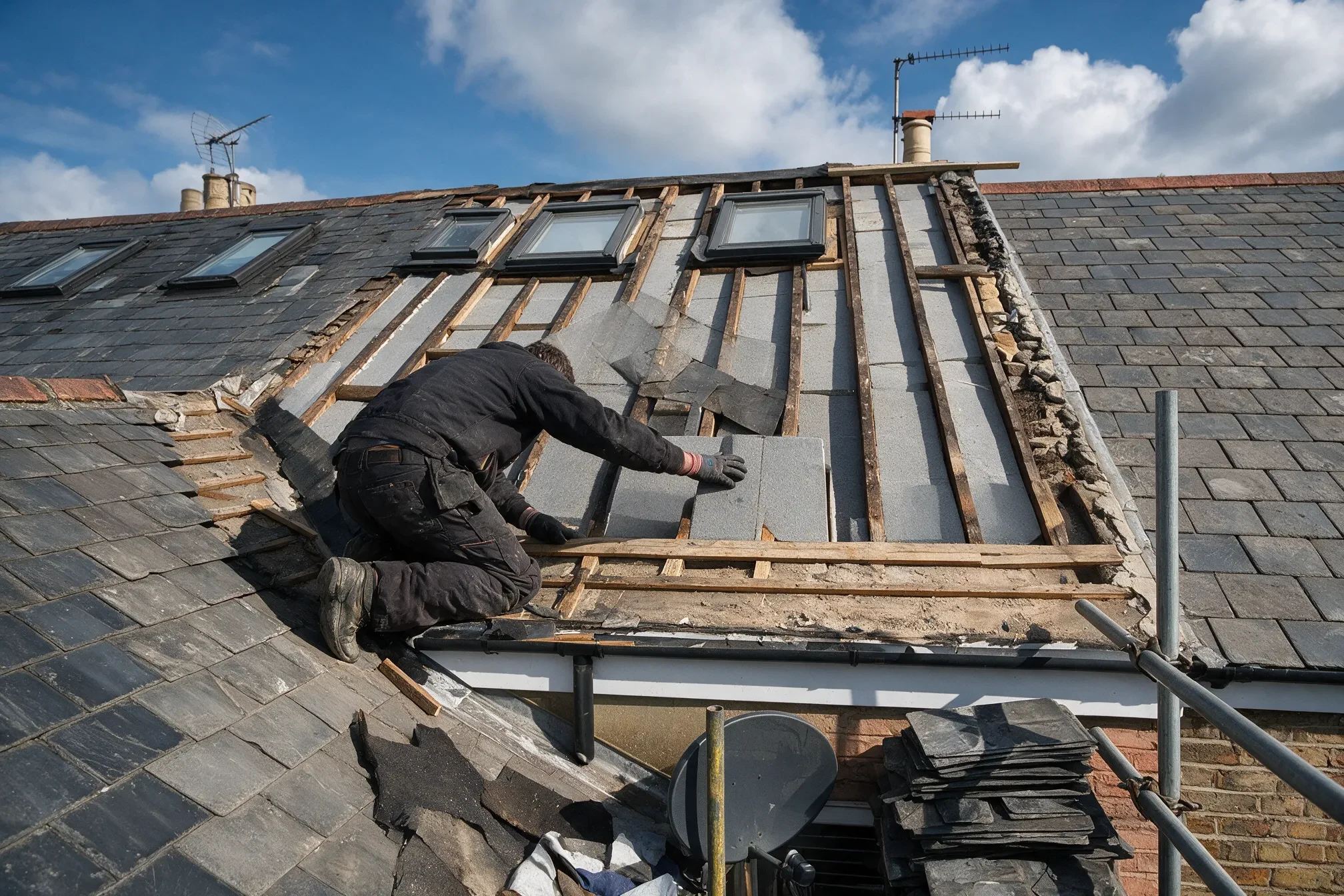
This is the part that catches people out, even once they’ve correctly worked out the 50% question. Because a roof counts as a thermal element, re-covering it isn’t just a structural and fire-safety matter.
It triggers Part L of the Building Regulations too, which deals with energy efficiency.
In practice, this means the insulation goes in at the same time as the new covering, following one of two standard approaches.
A warm roof adds rigid insulation boards above the deck, under the new covering. A cold roof keeps the insulation between the rafters or joists, with at least 50mm of ventilated space above it to stop condensation building up.
If you’re already weighing up insulation and EPC implications on a roof job, our guide to roof insulation and your EPC rating goes into the warm roof versus cold roof decision in more detail.
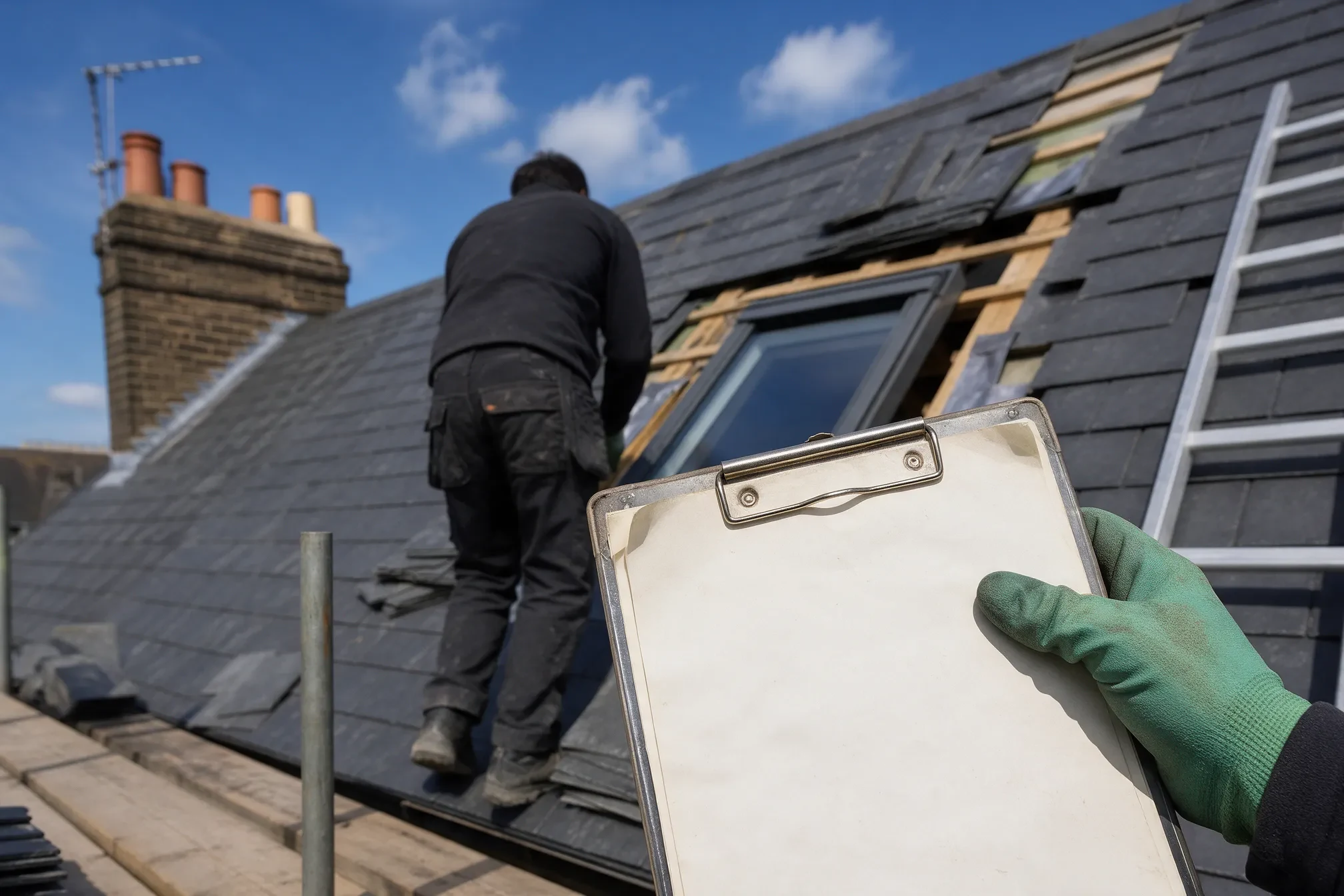
There are two legitimate routes to a compliant, certified roof replacement. A decent roofer should be steering you towards one of them without you having to ask.
This is exactly where membership of a trade body earns its keep rather than just looking good on a van.
All Custom Roofing is a verified member of the Confederation of Roofing Contractors, and every job carries our own insurance-backed guarantee on top of whichever compliance route applies.
A roofer with nothing to hide handles the paperwork as a matter of course, not as an upsell.
Fees are set by each local authority rather than fixed nationally, so the figures below are one real example, not a universal price.
Horsham District Council’s own 2026 building control fee schedule gives a useful benchmark for what a homeowner might actually be charged.
| Route | Example fee (Horsham District Council, 2026) |
| Building notice for re-roofing or renewal of a thermal element | £285 |
| Retrospective regularisation of work already done | £427.50 |
| Competent person self-certification (e.g. CompetentRoofer, NAPIT) | Usually included in the roofer’s quote rather than charged separately |
Notice the pattern there. Doing it properly from the start, either through the council or through a self-certifying roofer, costs roughly a third of sorting it out after the fact.
That gap is before you even account for the stress of a stalled house sale.
Nothing happens immediately, which is exactly the trap. The roof keeps the rain out whether or not it’s been signed off.
There’s no obvious moment where the lack of a certificate becomes a problem. It just sits there, waiting for one specific future event.
None of this means a rushed re-roof is automatically unsafe. It means there’s no independent record proving it isn’t, and that absence is what costs you money and time later.
The Home Owners Alliance, a UK consumer group for homeowners, puts the usual fix plainly. A conveyancing solicitor arranges an indemnity insurance policy, protecting against the cost of putting right unauthorised work.
It typically costs a few hundred pounds depending on the property’s value. It’s a workaround, not a solution, and it only works if nobody has already approached the council about the missing certificate.
If the roof’s already done and there’s no paperwork to show for it, you’re not automatically stuck. Councils offer a retrospective process called regularisation.
This effectively asks Building Control to inspect and certify work after the fact. It’s not simple.
Because the roof wasn’t inspected as it was built, parts of the structure may need to be opened up again so the inspector can actually see what’s there. That can mean removing sections of covering or lining that have since gone back on.
Most councils will only consider regularisation for work done within roughly the last 10 to 15 years, though this varies. It’s worth asking your own local authority directly rather than assuming a cut-off.
The Horsham fee table above gives a sense of the extra cost this route carries compared with doing it right first time.
None of this is complicated once somebody actually explains it. That’s exactly why it’s worth asking the question before you book a roofer rather than after.
A straightforward conversation at quote stage settles it: which route applies, who’s handling the paperwork, and what you’ll be left holding once the scaffolding comes down.
Our guide to what to expect when getting a new roof quote covers the other questions worth asking at the same stage.
And if you’re still working out which roofer to trust with any of this, our full guide to choosing a roofing contractor covers exactly the checks, including trade body membership and compliance routes, that separate a roofer who handles this properly from one who hopes you won’t ask.
It also matters for resale value in its own right. Our guide on whether a new roof adds value when you sell covers how surveys and buyers actually treat recent roof work.
A clean Building Regulations paper trail is a quiet but real part of that picture.
Usually not, provided you’re replacing less than 50% of the roof area, using the same material, and not altering the structure, insulation, or ventilation. Go beyond that threshold and it’s generally treated as notifiable work.
Planning permission is about how the roof looks and whether it changes the property’s height, shape, or impact on the surrounding area. Building Regulations are about whether the roof is structurally safe, fire-safe, and thermally efficient. A roof can need one, both, or neither, depending on the work.
It varies by council, but Horsham District Council’s 2026 fee schedule charges £285 for a building notice covering re-roofing or renewal of a thermal element. Using a competent person scheme roofer usually folds this into the quoted price rather than charging it separately.
Your buyer’s solicitor will likely flag it. The usual fix is an indemnity insurance policy arranged through conveyancing, protecting against the cost of the work being non-compliant. It can delay a sale and is a workaround rather than a replacement for having the certificate.
Yes, if they’re registered with a government-approved competent person scheme such as CompetentRoofer (run by the National Federation of Roofing Contractors) or NAPIT. Registered installers can self-certify re-roofing work without a separate Building Control application.
There’s no fixed national cut-off, and it varies by council, but most will consider regularisation for work done within roughly the last 10 to 15 years. Check directly with your local Building Control team rather than assuming a timeframe.