(+44) 7900 515 552
19 Oct 2026
 insurance backed guaranteeinsurance backed guarantee

If you’ve got a damp patch on a bedroom ceiling that keeps coming back, or a stain creeping down the brickwork below your roofline, there’s a good chance the culprit isn’t the roof covering itself.
It’s the gutter you can’t see.
Box gutters sit built into the roof structure rather than hanging off the eaves, which is exactly why they cause so much quiet trouble. You can’t glance up from the garden and spot a problem the way you can with a standard gutter.
By the time water shows up inside the house, it’s often been getting in for months.
This guide explains what a box gutter actually is, why they fail more often than ordinary guttering, and what the warning signs look like. If you’re trying to work out whether yours needs a quick patch or a full replacement, this should give you a clear starting point.
A standard gutter hangs from the fascia board at the edge of the roof. It’s easy to see, clean and replace.
A box gutter is built into the structure of the roof itself, so it’s part of the building rather than something bolted on afterwards.
You’ll typically find one in a few places: running behind a parapet wall on a flat-roofed extension, sitting in the valley where two roof slopes meet, or formed into the top of the wall on certain house styles built between the 1950s and 1970s.
That last type has a specific name worth knowing if your house dates from that era: Finlock guttering. It’s a precast concrete gutter section that also doubles as a lintel over the upstairs windows.
Finlock was popular with local authority and private housebuilders after the war, and it’s still common across a lot of Berkshire’s post-war housing stock.
A box gutter isn’t a separate component you can simply unscrew and swap. It’s built into the roof, which is exactly why problems with it tend to be structural rather than cosmetic.
Three things make box gutters more leak-prone than a hanging gutter: they’re harder to inspect, they’re often lined with a material that perishes over time, and the original design doesn’t always cope well with modern rainfall.
Historic England’s own guidance on rainwater systems makes the inspection point plainly. For “valley, box or parapet gutters, a visual inspection from ground level may not suffice,” and high-level access is usually needed to assess them properly.
That’s a big part of why problems go unnoticed until water is already inside the building. The same guidance notes that leaks commonly stem from “inappropriate layout or detailing,” or a system that’s simply undersized for the volume of water it has to shift.
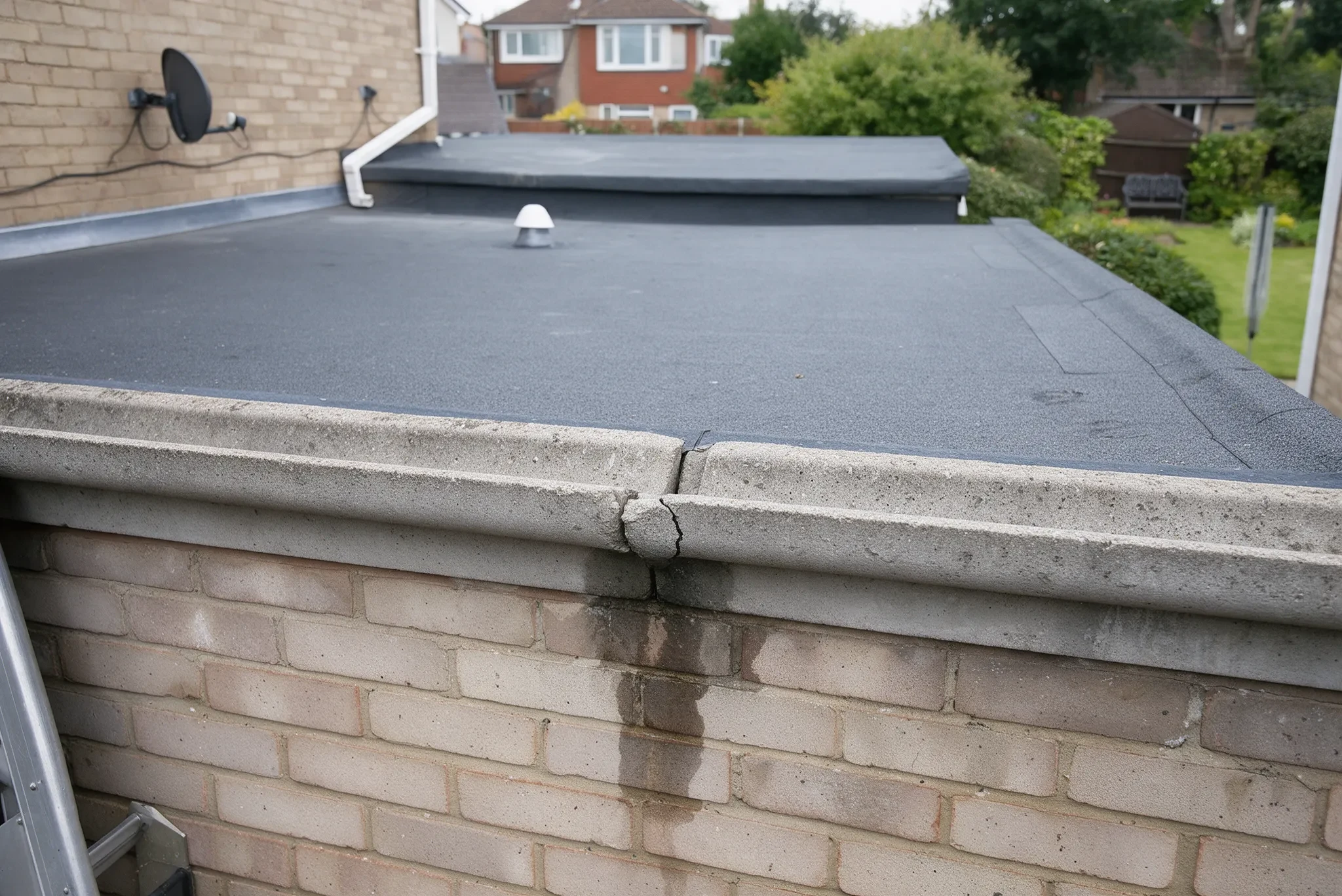
If your house has Finlock guttering, the weak point is almost always the joints between the precast concrete sections, not the concrete itself.
The Royal Institution of Chartered Surveyors’ own building defects reference for Finlock gutters is direct about this. It states that “leakage through Finlock gutter joints has caused serious deterioration in numerous cases,” to the point that it’s “brought this form of construction into disrepute.”
Once water gets through a failed joint, it can damage the concrete lintel the gutter sits on top of. That’s a structural element over your windows, not just a cosmetic finish.
A common fix is to fit a stainless steel lining along the full length of the gutter to stop joint leakage for good, though even that lining will eventually need replacing in turn.
Where a box gutter sits behind a parapet or in a valley rather than being Finlock-style concrete, it’s usually lined with a waterproof membrane: traditionally lead or bitumen felt, more recently GRP (fibreglass) or EPDM rubber.
All of these perish eventually. Felt and bitumen linings are the shortest-lived, and the most common cause of an older property’s box gutter starting to weep.
Because these linings sit flat or nearly flat, they’re also far more exposed to standing water and debris than a sloped, hanging gutter. Leaves, moss and grit build up faster and drain away more slowly.
That accelerates wear on the lining and increases the odds of an overflow during heavy rain.
Because you usually can’t see a box gutter leaking in real time, you’re relying on secondary signs instead. None of these are proof on their own, but together they’re a reasonable prompt to get it checked.
If you’re not sure what you’re looking at, our guide to finding where a roof leak is actually coming from covers the wider process of tracing water back to its source.
The reason this is worth taking seriously, rather than just mopping up and hoping it dries out, is where the water actually ends up.
A box gutter sits directly against roof timbers, wall plates or, in the case of Finlock, a structural concrete lintel. Water that gets past a failed joint or a perished lining doesn’t run harmlessly away. It soaks into whatever it’s touching.
Left long enough, that’s exactly the sort of slow, hidden moisture that leads to timber decay and wood-boring insect damage in roof timbers, which is a far more expensive problem than the gutter itself.
It’s also the kind of damage an insurer can push back on if it’s judged to be long-term neglect rather than a sudden, one-off event. Worth bearing in mind if you’ve noticed a recurring issue and kept putting it off.
A gutter problem that’s left alone for a few seasons rarely stays a gutter problem. By the time it’s visible inside the house, it’s usually already a timber problem too.
What your box gutter actually needs depends on how far the damage has gone, and that’s genuinely not something to guess at from the ground.
A proper inspection should tell you which of the options below applies, rather than defaulting to the most expensive one.
| Option | When it applies | Typical UK cost |
|---|---|---|
| Resealing a joint or small split | Localised leak, lining and structure otherwise sound | £60 to £150 |
| Replacing a short damaged section | One section failed, rest of the run is fine | £60 to £200 |
| New lining (GRP, EPDM or stainless steel) | Lining has perished along most of its length | £100 to £1,600, depending on length and access |
| Full Finlock or box gutter replacement | Structural damage to the concrete, lintel or timbers behind it | Around £2,400 on average for a typical run, including making good adjoining brickwork or fascia |
| Scaffolding or access equipment | Needed for most box gutter work given the location | £300 to £800 erected, or £40 to £115 a week for a tower |
Those figures are drawn from current UK tradesperson quote data and are a guide rather than a quote for your specific property.
Access is usually the biggest variable. A box gutter behind a parapet on a two-storey extension costs more to reach safely than one at single-storey height with clear access all round.
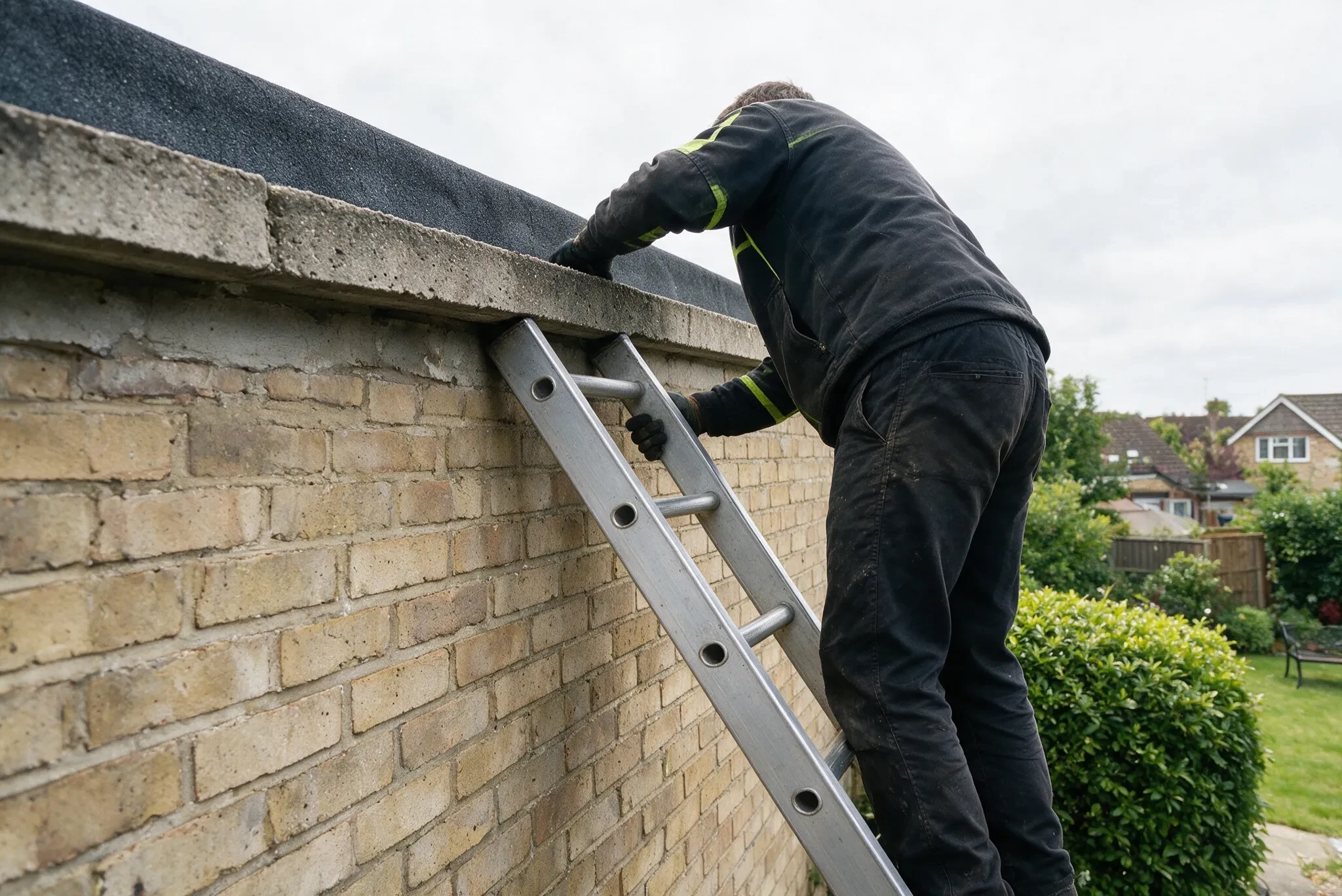
A box gutter repair done properly starts with working out why it failed, not just patching the symptom. This is roughly the sequence a competent roofer should follow:
If your gutters feed into the wider rainwater system rather than sitting in isolation, it’s worth reading our overview of how downpipes and gutters work together to shift water away from the building.
A fault further down the system can sometimes be mistaken for a box gutter problem, so it’s worth ruling that out too.
Not every box gutter issue needs an emergency call-out, but some genuinely do. Here’s a rough guide to which is which.
If you do need something sorted fast, our page on emergency gutter repairs covers what to expect from a same-day or next-day call-out.
A box gutter problem sits right at the boundary between a gutter job and a roof job, which is exactly why it’s easy for it to fall between two trades.
A gutter cleaner can clear debris and spot an obvious split. They’re not generally going to assess a Finlock lintel for structural damage, or judge whether your roof timbers have started to suffer underneath.
We’re a Confederation of Roofing Contractors member, and every repair we carry out on a box or Finlock gutter is covered by our insurance-backed guarantee.
That matters here specifically because the real risk with this type of gutter isn’t the gutter itself. It’s what sits behind it.
We’d rather tell you honestly that a section is sound than invent work, and equally we won’t pretend a structural issue is a five-minute fix.
A box gutter is a gutter built into the structure of the roof rather than hung from the fascia. You’ll find them behind parapet walls, in valleys where two roof slopes meet, and as Finlock concrete sections on many houses built in the 1950s and 60s.
If your house was built roughly between the 1950s and 1970s and the gutter sits flush along the top of the wall rather than hanging below the roofline, it may well be Finlock. A roofer can confirm this on an inspection.
It depends on what’s failed. A single leaking joint or a worn section of lining can usually be repaired or relined. Structural damage to the concrete or the timbers beneath it usually means replacement. An inspection is the only reliable way to tell which applies to yours.
This usually means the original repair addressed a symptom rather than the cause, such as resealing one joint on a Finlock run where several others are also failing, or patching a lining that’s perished along most of its length.
It depends on the cause and how long it’s gone on. Sudden, accidental damage is more likely to be covered than a leak that’s been visible and ignored for a long period, which insurers can treat as gradual deterioration. Check your policy wording, or ask your insurer directly.
Simple joint resealing typically runs £60 to £150. Relining a longer section can run from £100 up to around £1,600 depending on length and access. A full Finlock or box gutter replacement, including making good the surrounding brickwork, averages around £2,400. Access equipment is usually extra.