
 (+44) 7900 515 552
16 Oct 2026
 insurance backed guaranteeinsurance backed guarantee
Autumn 2025 was the UK’s wettest season of the year so far, with the Met Office recording 403.4mm of rain nationally, 20% above the 1991 to 2020 average. Storm Claudia alone dropped close to a month’s worth of rain on parts of England and Wales in under a week.
All of that water has to go somewhere. If your gutters are packed with wet leaves when it falls, it won’t be going down the downpipe. It’ll be going over the edge, down your wall, or worse, finding its way under your roof covering.
That’s not a one-off story either. The Association of British Insurers recorded £573 million in weather-related home insurance claims in 2023, a 36% jump on the year before and the highest figure on record, with flooding and burst pipes making up the bulk of it. Water that isn’t managed properly around a home, blocked gutters included, is part of that wider picture.
Gutter guards promise to stop that happening by keeping leaves and debris out in the first place. Whether they’re worth fitting, which type actually works, and what they won’t fix, is a fair question worth a straight answer.
A gutter has one job: carry rainwater off your roof and into the downpipe, away from the house. Our guide to downpipes and gutters covers how that system is meant to work when it’s running properly.
When a gutter is blocked, water backs up instead of draining, and that causes problems well beyond a soggy flower bed below.
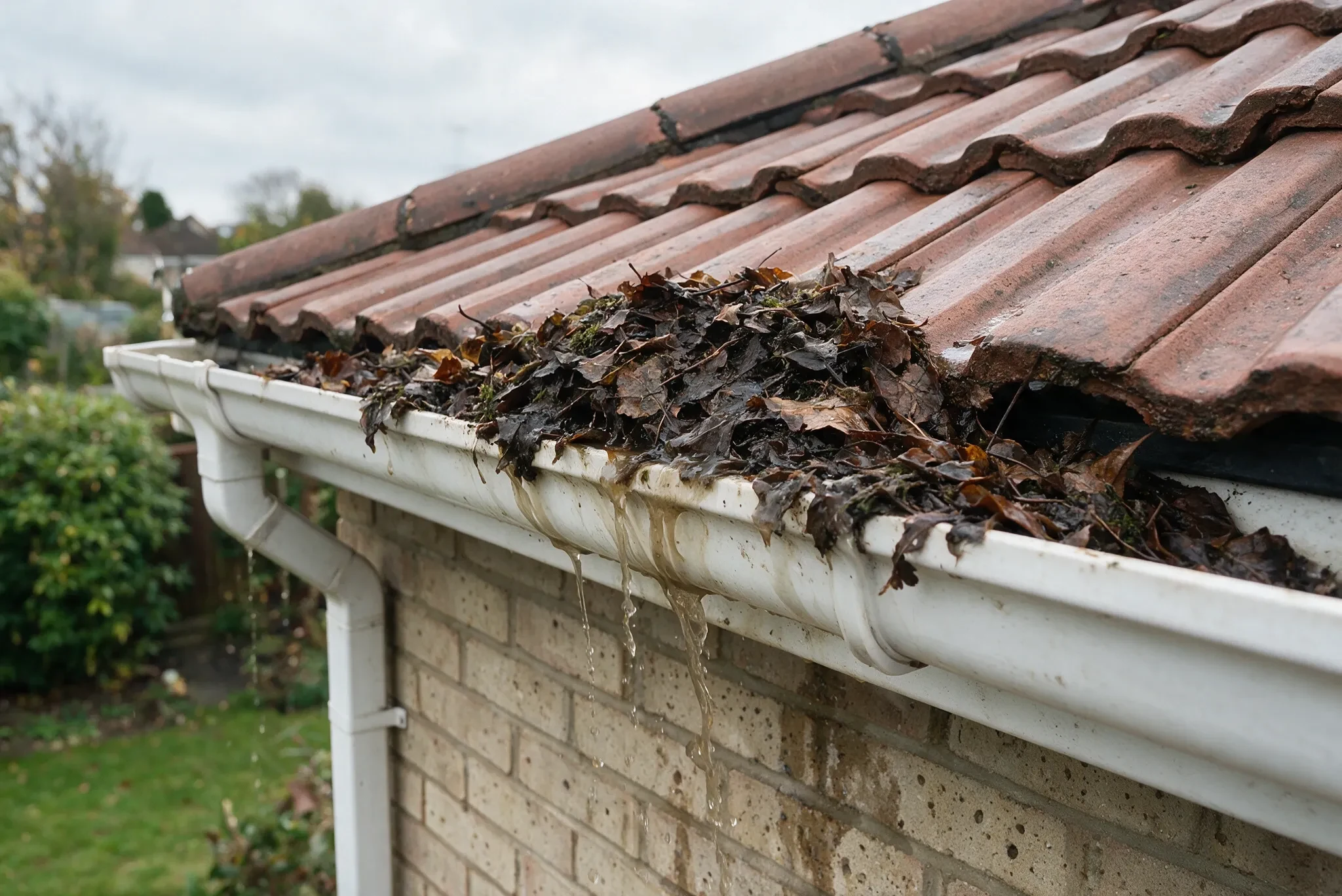
Water that can’t drain sits against the fascia board, the timber the gutter is fixed to. Given enough time, that timber softens and rots, the brackets holding the gutter start to fail, and the whole run can sag or pull away from the roofline.
Overflowing water also runs back under the lowest course of tiles or slates, past the eaves and into the roof timbers themselves. By the time a stain shows up on a bedroom ceiling, that damage has usually been building for months.
A blocked gutter rarely causes a dramatic leak overnight. It causes a slow one, hidden in the roof timbers, that only shows up once the damage is expensive to put right.
In winter, standing water in a blocked gutter freezes. Ice expands as it forms, which can crack plastic guttering outright and force joints apart, turning a cleaning job into a repair one. Our guide to repairing roof gutters covers what that typically involves.
Replacing rotten fascia isn’t cheap once access is factored in. The Federation of Master Builders puts uPVC fascia board at around £9.60 per metre in materials alone, timber at £6, and aluminium at £17, before labour, scaffolding, or any rot found once the old boards come off.
Scaffolding alone can run from around £200 for one side of a bungalow to £2,600 to wrap all four sides of a two-storey detached home, per the same guide. A £15 brush guard starts to look like good value against that kind of bill.
Yes, broadly, but with real limits worth knowing before you spend the money. The basic principle is sound: stop leaves and debris getting into the gutter, and you stop them blocking it.
As Glen Peskett of Saxton Blades told Ideal Home, gutter guards are “an easy and effective trick” that relies on “a basic principle: stop the leaves from getting in, in the first place.” That’s a fair summary, but the type you fit changes how well it works in practice.
Flat mesh guards clip or screw onto the top of the gutter and let water through small holes while keeping larger debris out. They’re widely available and straightforward for a professional to fit cleanly along a full run.
Their main weakness is fine debris. Pine needles, seed pods, and silt from moss and algae can still work through the mesh over several seasons, so they reduce cleaning frequency rather than remove the need for it altogether.
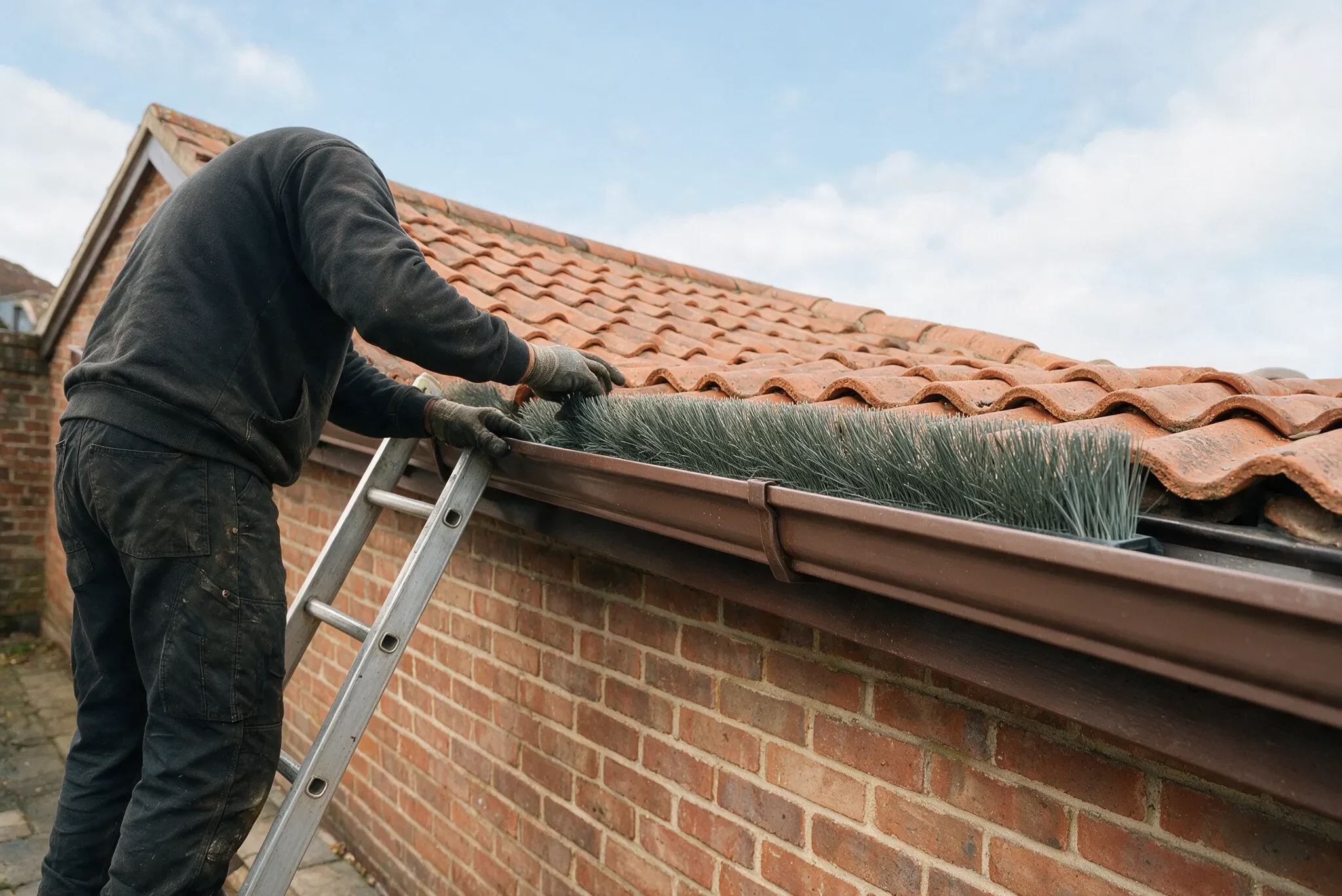
A brush guard, often sold as a “hedgehog”, is a cylindrical bristle insert that sits inside the gutter channel. Debris collects on top of the bristles rather than settling in the water, and rain drains through underneath.
They’re usually the cheapest option to buy and the easiest to fit without removing existing brackets, which is why many tradespeople suggest them as a starting point. Debris sitting on top still needs clearing off periodically, just less often than an unguarded gutter.
Rather than covering the whole run, an outlet guard sits inside the downpipe opening and stops larger debris reaching the pipe itself, where a blockage is far harder to clear. They’re a sensible, low-cost addition alongside a full gutter guard, since no single guard type keeps out everything.
| Guard type | How it works | Typical DIY cost | Best for |
| Flat mesh | Perforated cover clips over the gutter top | From around £12 per metre length | Most roofs with moderate tree cover |
| Brush (“hedgehog”) | Bristle insert sits inside the channel | From around £17 per metre length | Quick retrofits, lighter debris |
| Outlet/downpipe guard | Cage or balloon sits in the downpipe opening | From around £3 to £6 per unit | Backup protection on any gutter type |
| Professional supply and fit (any type) | Guard plus an existing gutter clear and check | Roughly £200 to £450 for a typical semi-detached house | Awkward access, or gutters already showing problems |
The DIY figures come from Ideal Home’s own product comparison, and the professional fitting range is drawn from real UK tradesperson quotes collected by MyJobQuote, where quotes ranged from around £200 to £450 depending on property size, guard type, and whether clearing the existing gutters was included.
A terraced house on an open street with little tree cover has very different needs to a detached home under mature oaks or conifers. More overhanging trees generally means more frequent clearing whatever guard is fitted, so it’s worth being realistic about your own garden rather than picking the cheapest option on principle.
Roof pitch and gutter profile matter too. A steeply pitched roof sheds water fast in heavy rain, which can overwhelm a guard with very fine mesh, so a professional installer will usually match the guard’s hole size to how your roof actually drains rather than fitting whatever’s cheapest to buy.
Honesty matters more here than a sales pitch, so three things are worth knowing before you spend the money.
Treat gutter guards as cutting your cleaning from twice a year to once, not as a reason to never check your gutters again.
Fitting gutter guards yourself is realistic on a single-storey extension or garage. On a full two-storey house, it means working at height on a ladder, repeatedly, moving it along the whole run.
That’s not a small risk to take on casually. The Work at Height Regulations 2005 apply to anyone controlling this kind of work, homeowner included, and falls from height remain one of the most common causes of serious injury on and around UK homes.
A professional visit also does more than clip guards on. Here’s what a proper job actually involves, start to finish:
Guards are prevention. If you’re already seeing any of the following, you likely need a clear-out or repair first, guard or no guard.
If a run is actively pulling away from the house or overflowing into the structure itself, that’s not a wait-and-see job. See our guide to emergency gutter repairs for what to do next.
A gutter clean or a guard fit is often all that’s needed. But if water has been getting into the roof structure for a while, the fascia, felt, or timber underneath may already need a roofer’s eye, not a cleaner’s.
That’s where it helps to use a contractor who stands behind the whole roof, not just the gutter. We’re verified members of the Confederation of Roofing Contractors, and every job we complete carries an insurance-backed guarantee, so if something’s missed later, it’s covered, not an argument.
Autumn and early winter is also a sensible time to book a wider roof check anyway, not just a gutter clear-out, since the two problems often turn up together once the leaves are down and the weather turns.
A roofer on site for a gutter job will also look at the felt or underlay at the eaves, and the state of the roof timbers from inside the loft. A gutter cleaner typically won’t check either.
No. They cut down what gets in significantly, but fine silt, moss spores, and small seeds can still pass through most types over several seasons. Expect less frequent cleaning, not none at all.
On a single-storey extension or garage, yes, with reasonable care. On a full two-storey house, it means repeated ladder work along the whole run, which is where the real risk sits, and where bringing in a professional is usually the safer, quicker option.
Once a year is a sensible minimum, ideally after autumn once most of the leaves have come down. Guards buy you time between cleans, not immunity from ever needing one.
Flat roofs usually drain through outlets and downpipes rather than a long gutter run, so the same guard types don’t always apply in the same way. Our guide to flat roof drainage systems covers what does work on that setup.
Not if they’re fitted properly, by a reputable installer, without disturbing the roof covering itself. If your roof already carries an insurance-backed guarantee, it’s worth checking with whoever issued it before anyone touches the roofline, guard fitting included.
No. Fitting guards to an existing gutter doesn’t require planning permission for most UK homes, listed buildings included in most cases, since nothing structural to the building changes. It’s still sensible to check with your local conservation officer first if your property is listed, the same as for any other work to the roofline.