(+44) 7900 515 552
09 Nov 2026
 insurance backed guaranteeinsurance backed guarantee

If your house shares a wall with next door, a roof replacement can involve more than picking a contractor and a start date. Terraced and semi-detached streets across Berkshire, Surrey and Buckinghamshire often have roofs that meet.
Chimney stacks are shared, and party walls run up into the roof space itself on a lot of these older streets.
In some of these cases, UK law requires you to give your neighbour formal written notice before work starts. Miss this step and the consequences aren’t just paperwork.
This is separate from planning permission, which we’ve covered elsewhere. The Party Wall etc. Act 1996 isn’t about whether your council allows the work. It’s about your legal duty to your neighbour when work touches a wall, structure or chimney stack you both rely on.
Most straightforward re-roofs on a detached house never trigger it. Get it wrong on a terrace or a semi, though, and you can be looking at a court injunction, a stalled job, and a neighbour dispute that outlasts the roof itself.
Here’s what actually applies, what it costs, and how to build it into your timeline without any drama.
The Act defines two things that matter here. A party wall is a wall that either sits on the boundary between two properties, or sits entirely on one side but is used by both to separate their buildings.
A party structure is broader still. It covers floors, partitions or other structures that separate parts of a building approached by separate entrances, such as the wall between two flats.
For most homeowners the relevant scenario is simpler. It’s usually a shared wall between two terraced or semi-detached houses that continues up past the ceiling line and into the roof void.
If your roof work touches that wall, or a chimney stack built into it, the Act applies.
If it doesn’t touch either, it usually doesn’t.
Re-covering your own roof, on your own side of the party wall, with no work to the shared structure itself, generally sits outside the Act.
Replacing tiles, felt, battens or insulation entirely within your own roof space doesn’t usually touch anything your neighbour has a legal interest in.
The picture changes the moment work reaches the shared wall or a shared chimney stack.
Raising or repairing the parapet wall between two terraced roofs, repointing or rebuilding a party wall that projects above the roofline, or doing structural work to a chimney stack shared between two houses, all fall under the Act.
Based on government guidance and how party wall surveyors describe roofing cases in practice, notice is typically needed for:
If any of these apply to your job, notice isn’t optional. The law is clear that work can’t lawfully start until it’s been served and the required time has passed.
The test isn’t “am I replacing my roof near a neighbour.” It’s “does this specific piece of work touch a wall, structure or chimney stack we both rely on.” Most re-roofs don’t. Shared chimney stacks and party wall parapets usually do.
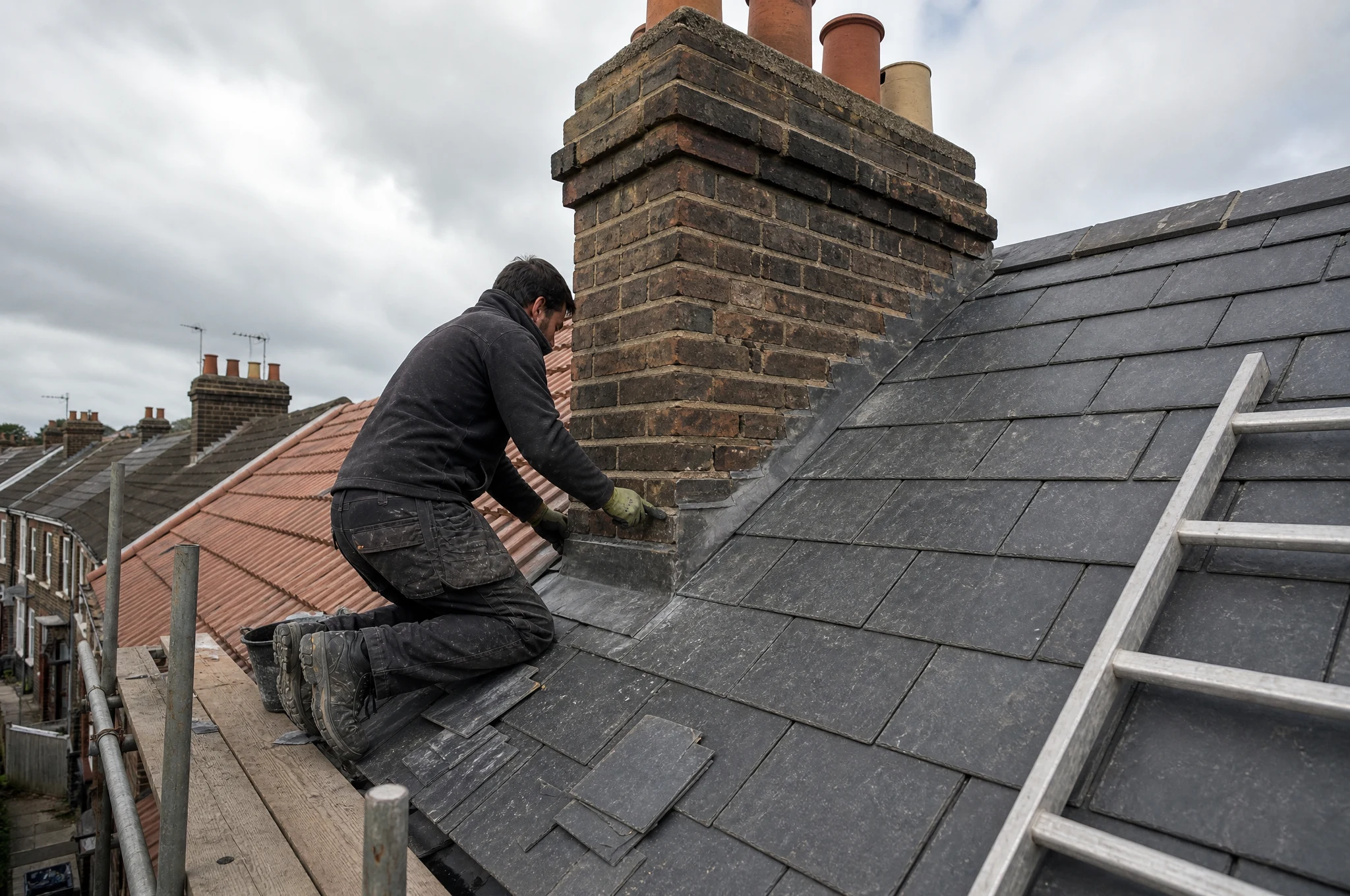
A lot of the housing stock across our patch, Victorian and Edwardian terraces in Windsor, Staines and Slough especially, was built with a single, shared chimney stack straddling the party wall between two houses.
Over a century later, that stack is often the single most likely reason a routine re-roof turns into a party wall matter. Lead flashing and pointing around a shared stack wear out roughly together, since both houses’ roofs meet at the same point.
When one neighbour goes ahead with a re-roof and the other hasn’t, the stack itself, and any repair work to it, becomes shared territory under the law even if only one side is paying for the roof.
This is exactly the situation we walk through with homeowners before quoting. Is the chimney stack shared, does the work touch it, and if so, does the two-month clock need to start before anything else is booked.
Getting this right at the quoting stage avoids a much more awkward conversation once scaffolding is already up.
If your roofer or a surveyor confirms the Act applies, the process itself is procedural rather than difficult. It just needs time built into your schedule.
Knowing the steps in advance also makes it much easier to explain the timeline to your neighbour in plain terms, rather than the notice landing on their doormat as a surprise.
None of this needs to be adversarial. Most neighbours consent once they understand what’s actually being done and see a reputable contractor is behind it.
Being upfront early, well before the two-month clock even starts, tends to head off most disputes before they begin.
As the party planning the work, you’re responsible for the surveyor costs, including your neighbour’s surveyor if they appoint their own. This is standard under the Act and shouldn’t come as a surprise partway through.
| Scenario | Typical cost |
| Single agreed surveyor, straightforward job | £900 – £1,500 |
| Single surveyor, more complex structural work | £1,500 – £2,700 |
| Two separate surveyors (one each side) | £1,800 – £5,400 |
| Average hourly rate | £90 – £450, roughly £200 typical |
| Average cost of the Award itself | Around £1,000 |
Figures above are drawn from HomeOwners Alliance and Checkatrade’s own 2026 cost guides, both independent, non-competitor sources.
The cheapest path is almost always a single, agreed surveyor acting for both sides. It’s only when a neighbour insists on their own surveyor, which is entirely their legal right, that costs roughly double.
Getting your neighbour on side early is worth real money, not just goodwill.
Starting work without serving notice, when the Act applies, isn’t a technicality you can quietly fix later. Government guidance is direct on this point.
An adjoining owner can seek a court injunction to stop the work. You can also be held liable for any damage caused to their property, even if it was accidental.
In practice, this means scaffolding coming down mid-job, a stop-work order, and legal costs on top of whatever the roof was already going to cost. It’s a genuinely expensive way to save two months.
A neighbour dispute over an unserved party wall notice has ended more re-roofing projects halfway through than bad weather ever has. The two months isn’t bureaucracy for its own sake, it’s what stands between a straightforward job and a stopped one.
There’s a knock-on effect worth knowing about too. If you sell the house later without ever having properly documented party wall consent for work that needed it, it can surface during conveyancing and slow down or complicate the sale.
Buyers’ solicitors routinely ask whether any structural work has been done to shared walls, and an unresolved party wall matter is exactly the kind of thing that can hold up an exchange.
It’s the same reasoning behind how a new roof affects a future sale. A properly documented process, and a guarantee a solicitor can independently verify, tends to matter more at resale than most homeowners expect going in.
The most common mistake isn’t ignorance of the Act, it’s leaving it too late. If your job needs a party wall notice, the two-month clock has to run before work starts, on top of however long the roofing itself will take.
A contractor who’s genuinely experienced with terraced and semi-detached properties should flag this at the quoting stage, not after scaffolding is booked. It’s worth asking directly when you’re comparing quotes and deciding who to trust with the job.
Every job we take on that involves a shared wall or chimney stack gets checked against the Act before anything is scheduled.
Where notice is needed, we build the two months into the plan from day one, rather than treating it as a delay that appears later.
Being a verified member of the Confederation of Roofing Contractors means working to a standard that expects this kind of due diligence as routine, not optional.
Our insurance-backed guarantee also matters here in a specific way. If a dispute over shared structural work ever needed resolving after the fact, a guarantee that’s independently backed, rather than just a promise from the contractor, is something your neighbour’s own surveyor can actually verify.
Party wall costs are easy to forget when you’re focused on the headline roofing price. They’re worth building into your budget from the start rather than treating as a surprise extra.
Take a typical semi-detached re-roof, where the roof itself might run to several thousand pounds depending on size, materials and access. If the job needs a straightforward, single agreed surveyor, that’s likely another £900 to £1,500 on top.
If your neighbour appoints their own surveyor, budget closer to double that figure. It’s a real cost, but a small one next to the price of the roof itself, and far smaller than the cost of a stopped job or a court injunction.
A good contractor should be able to give you a realistic total picture early on, roof cost and party wall costs together, rather than letting one surface as an afterthought once the other’s already agreed.
It’s entirely possible for a single roof job to need both a planning consideration and a party wall notice, particularly in a conservation area with older terraced housing.
Planning permission or permitted development rights are about what your council allows you to build. The Party Wall Act is a completely separate legal relationship between you and your neighbour, and clearing one doesn’t clear the other.
A loft conversion that changes the roofline in a conservation area, for example, might need both a planning check and a party wall notice if it involves building against or through a shared wall. Treat them as two separate boxes to tick, not one.
Not usually, if the work stays entirely within your own roof and doesn’t touch the shared wall, parapet or a shared chimney stack. It’s worth confirming with your contractor rather than assuming, since chimney stacks are the most common thing people miss.
Under the Act, no response within 14 days is treated as a dispute, the same as an objection. At that point a surveyor needs to be appointed to produce a Party Wall Award before work can proceed.
Yes, the notice itself can be served by the homeowner. Surveyor costs only come in if your neighbour dissents or doesn’t respond, or if the work is complex enough that a surveyor is needed to agree how it will be carried out.
At least two months, since that’s the statutory minimum for work to an existing party structure. Most people give themselves a bit more room than the legal minimum, to allow for a slow response or an unexpected dissent.
No, they’re separate legal requirements. Planning permission concerns your local council and what you’re allowed to build. The Party Wall Act concerns your legal relationship with your neighbour over a shared structure. A single roof job can need both, one, or neither, depending on the work.