(+44) 7900 515 552
23 Oct 2026
 insurance backed guaranteeinsurance backed guarantee
Nearly a quarter of UK homeowners who’ve had building work done say they’ve lost money to an unreliable trader, with the average loss running to £1,760 a time, according to figures cited in a recent House of Commons debate on rogue builders.
Roofing is exactly the kind of job where that risk is highest: it’s expensive, it’s hard to check once it’s finished, and if something goes wrong, you’re relying on the same company that did the work to come back and fix it.
That’s where a guarantee is supposed to help. But not all guarantees are equal, and the difference between a standard company guarantee and an insurance-backed guarantee (IBG) is one most homeowners never think to ask about.
Here’s what each one actually means, what protection you’re genuinely getting, and how to check before you sign anything.
A new kitchen worktop or a repainted hallway shows its faults quickly. A roof doesn’t. Poor flashing work, a badly lapped membrane, or corners cut on underlay can sit hidden for two or three winters after a full roof replacement before a leak shows up inside the house.
By that point the damage is worse and harder to trace back to the original job. It’s also one of the most expensive jobs most homeowners ever pay for on their property, often running into five figures for a full replacement.
Put those two things together, a defect that takes years to surface and a contract value that’s genuinely painful to lose, and it’s clear why the guarantee behind the work matters as much as the workmanship itself.
When a roofer gives you a guarantee, they’re promising that if something they did fails within a set period, usually because of a defect in their workmanship, they’ll come back and put it right at no extra cost.
That’s a useful promise, and a reputable roofer will always offer one in writing. The problem is what that promise is actually worth. A company guarantee is only as good as the company standing behind it.
If the business closes down, whether through liquidation, retirement, or simply folding quietly, the guarantee closes down with it. You’re left holding a piece of paper with no one on the other end of it.
A guarantee that disappears the moment the company does isn’t really a guarantee at all – it’s a hope that the business stays open long enough for you to never need it.
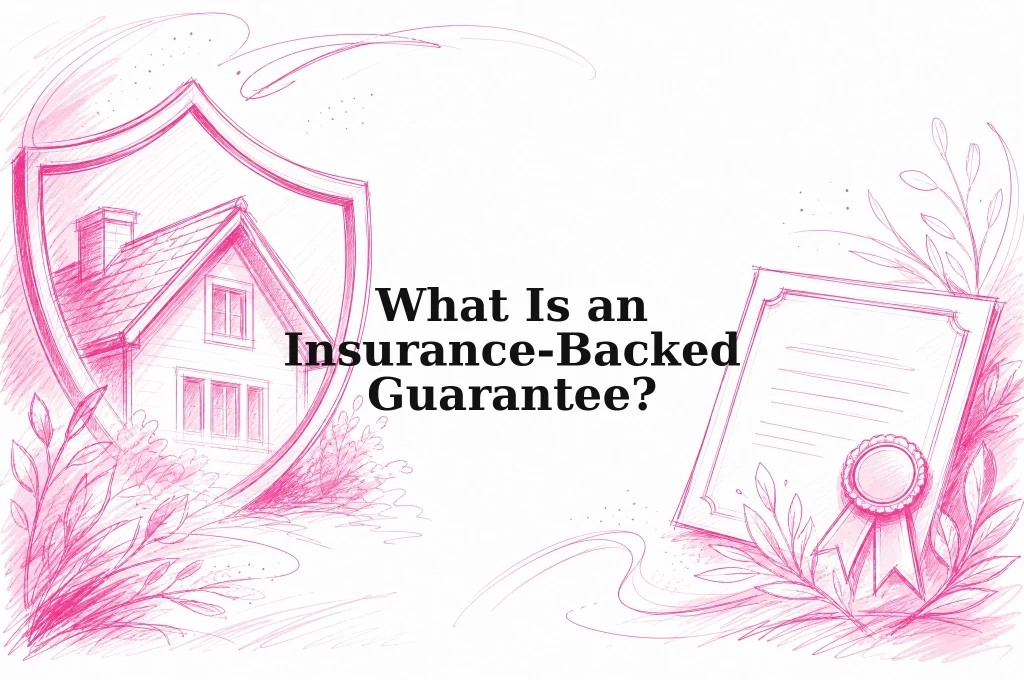
An insurance-backed guarantee is a separate insurance policy that sits alongside the roofer’s own company guarantee. It doesn’t replace it.
Instead, it steps in specifically for the scenario a company guarantee can’t cover: the installer going out of business during the guarantee period.
If your roofer is still trading and something goes wrong, you contact them directly, exactly as you would with any standard guarantee. The insurance element only activates once the company has genuinely dissolved.
That includes liquidation, receivership, administration, bankruptcy, retirement, or the death of the business’s principals. At that point, instead of a worthless guarantee, you have a live insurance policy that honours the original terms.
Confederation of Roofing Contractors (CORC) guarantees, the scheme All Custom Roofing uses, typically run for 10 years on roofing work and cover the full value of the completed contract, up to £250,000. Solar PV installations are the one exception, covered for 2 years rather than 10.
It’s worth being honest about the limits, because a guarantee that overpromises is worse than one that’s upfront. CORC’s insurance-backed guarantees don’t cover repair work, only new installations qualify, along with paint or resins.
They also only cover work carried out by the registered CORC member itself, not other tradespeople who may have worked on the same roof.
| Question | Company guarantee | Insurance-backed guarantee |
|---|---|---|
| Who’s actually promising the fix? | The roofing company itself | An insurer, separate from the roofer |
| Still valid if the roofer closes down? | No | Yes, for the remaining term |
| Typical duration | Varies by roofer, often 1-25 years | 10 years for roofing work |
| Covers repairs as well as new work? | Depends on the roofer’s own terms | New work only |
| Transferable if you sell the property? | Depends on the roofer’s own terms | Yes, fully transferable |
| Cost to the homeowner | Usually included in the quote | Paid for by the installer, not the customer |
All Custom Roofing is a verified member of the Confederation of Roofing Contractors, which is what allows us to offer CORC’s insurance-backed guarantees on qualifying jobs in the first place.
Membership isn’t automatic. CORC only issues these guarantees to vetted trade members, and limited companies need at least two years of trading history and have to pass credit and application checks before they qualify.
There’s a detail worth knowing here too: CORC itself is FCA-registered as an insurance broker (reference number 968078) to arrange these guarantees.
That’s the same kind of regulatory backing behind our finance partner, Phoenix Financial Consultants, who are FCA regulated (subject to status) for any customer choosing to spread the cost of their roof. Two separate parts of the job, both sitting behind proper regulation rather than just a company’s word.
Once a job’s complete and paid in full, we send CORC the customer’s name and address, the completion date, the full contract value including VAT, a description of the work, and a copy of the company guarantee we’ve already issued.
CORC then issues the insurance-backed guarantee, typically within 24 hours, and it’s sent directly to the customer alongside our own paperwork.
Not every guarantee that claims to be “insurance-backed” actually is one in the sense described above. A few things are worth checking before you take the claim at face value.

Whether you go with us or anyone else, ask these questions before signing anything – the same checks are worth running alongside our full guide to choosing a roofer. A roofer with nothing to hide will answer all of them without hesitation, and the answers are worth writing down alongside your quote.
Citizens Advice gives the same core advice for any home improvement job: get the guarantee in writing, check how long it lasts and what it covers.
Specifically look for one that’s insurance-backed, so it survives the contractor going bust.
It’s worth being clear that an insurance-backed guarantee and your own buildings insurance cover two different things. A guarantee protects you against defects in the roofer’s own workmanship.
Buildings insurance covers damage from an external event, a storm, a fallen branch, or a fire, regardless of who originally fitted the roof.
If a storm damages a roof that’s still within its guarantee period, the first question is usually whether the damage stems from a defect in the original work or from the storm itself.
A roofer with a genuine insurance-backed guarantee has every reason to be straightforward about which one applies, since the guarantee terms are fixed and independently verifiable rather than something they can quietly reinterpret.
The process is more straightforward than people expect, and it follows the same order every time.
Keep your policy documents somewhere durable, not just in an email that might get lost or deleted over a 10-year period.
A photo of the paperwork stored alongside your other property documents, or a printed copy with your boiler and appliance guarantees, is a sensible habit.
An insurance-backed guarantee is the main one, but it’s not the only layer of protection available when you’re paying for a large home improvement job.
Citizens Advice points out that paying by credit card for anything between £100 and £30,000 gives you Section 75 protection under the Consumer Credit Act.
That means your card provider is jointly liable if the work isn’t completed or turns out to be faulty, giving you a second route to a refund beyond the guarantee itself.
Avoid paying the full amount upfront. If a deposit is requested, Citizens Advice recommends capping it at around 25%.
Check whether the contractor holds deposit insurance or uses an FCA-registered escrow arrangement, so your money is protected even before the job starts.
None of these protections cost you anything extra to ask about – the only cost is not asking, and finding out too late that the guarantee you were promised was never worth the paper it was printed on.
No. It’s entirely optional, and any roofer can choose not to offer one. It’s a genuine mark of a business investing in its own trustworthiness rather than something you’re automatically entitled to.
No. The installer requests and pays for it once the job is complete and paid in full. It doesn’t add to your quote.
CORC’s insurance-backed guarantees only cover new installation work, not repairs. If you’re having a section of your roof repaired rather than fully replaced, ask your roofer directly what protection applies to that specific job.
It transfers automatically to the new owner for whatever’s left of the 10-year term, which is worth mentioning to buyers if you’re selling a property with recent roofing work done.
Go to the trade body’s own website and search its member directory directly, rather than relying on a logo shown on the roofer’s van or quote. CORC publishes its member list online for exactly this reason.
A guarantee is only worth what stands behind it. Before you commit to any roofing job, ask specifically whether the guarantee on offer is insurance-backed, and get the answer in writing.
It’s a two-minute question that can save you thousands if the worst happens.