(+44) 7900 515 552
21 Oct 2026
 insurance backed guaranteeinsurance backed guarantee
Most roof replacements in the UK don’t need planning permission at all. But three situations change that answer completely: if your new roof will sit higher or project further than the old one, if your home sits inside a conservation area, or if it’s listed. Berkshire has plenty of all three.
The Royal Borough of Windsor and Maidenhead alone has 27 designated conservation areas, covering large parts of Windsor town centre, Eton, Datchet, Old Windsor and Maidenhead. Get the permission question wrong on a property like this and you’re not just risking a planning headache – in the worst case, it’s a criminal offence.
It’s an easy question to get wrong by assumption rather than carelessness. A homeowner might reasonably think “I’m just replacing what’s already there” covers them.
But the property could sit inside a conservation area boundary drawn decades before they bought it, or a previous owner’s loft conversion may have already used up the permitted development allowance on the roof.
Re-covering a roof with the same or a very similar material, at the same height and pitch, is normally “permitted development” – meaning it’s automatically allowed without a planning application. This covers the majority of straightforward like-for-like replacements.
What changes the answer is any alteration that affects the roof’s external appearance: raising the ridge height, adding a dormer, extending the roofline, or swapping to a visibly different material. Once any of those is on the table, it’s worth checking before work starts, not after.
Government planning guidance sets specific limits on what counts as permitted development for a roof, rather than leaving it to interpretation. Any alteration must not project more than 150mm from the plane of the existing roof slope, and must not exceed the height of the existing roof.
There’s a separate rule for windows: if you’re adding a side-facing window as part of the work, it has to be obscure-glazed. If it opens, the bottom of the opening needs to sit at least 1.7 metres above the floor.
These limits exist specifically to stop permitted development being used to sneak through changes that would normally need proper scrutiny.
The 150mm and height limits aren’t guidelines – they’re the exact test a planning officer will apply if a neighbour complains or the council spot-checks. Measure against them properly, not by eye.
Permitted development rights don’t apply automatically to every property. You’ll need full planning permission if any of the following applies to yours:
If none of these apply and you’re doing a genuine like-for-like re-roof, you’re very likely in permitted development territory. The Planning Portal’s own roof guidance is worth a five-minute read before you commission anything, and your local planning authority will confirm your specific situation for free if you’re not certain.
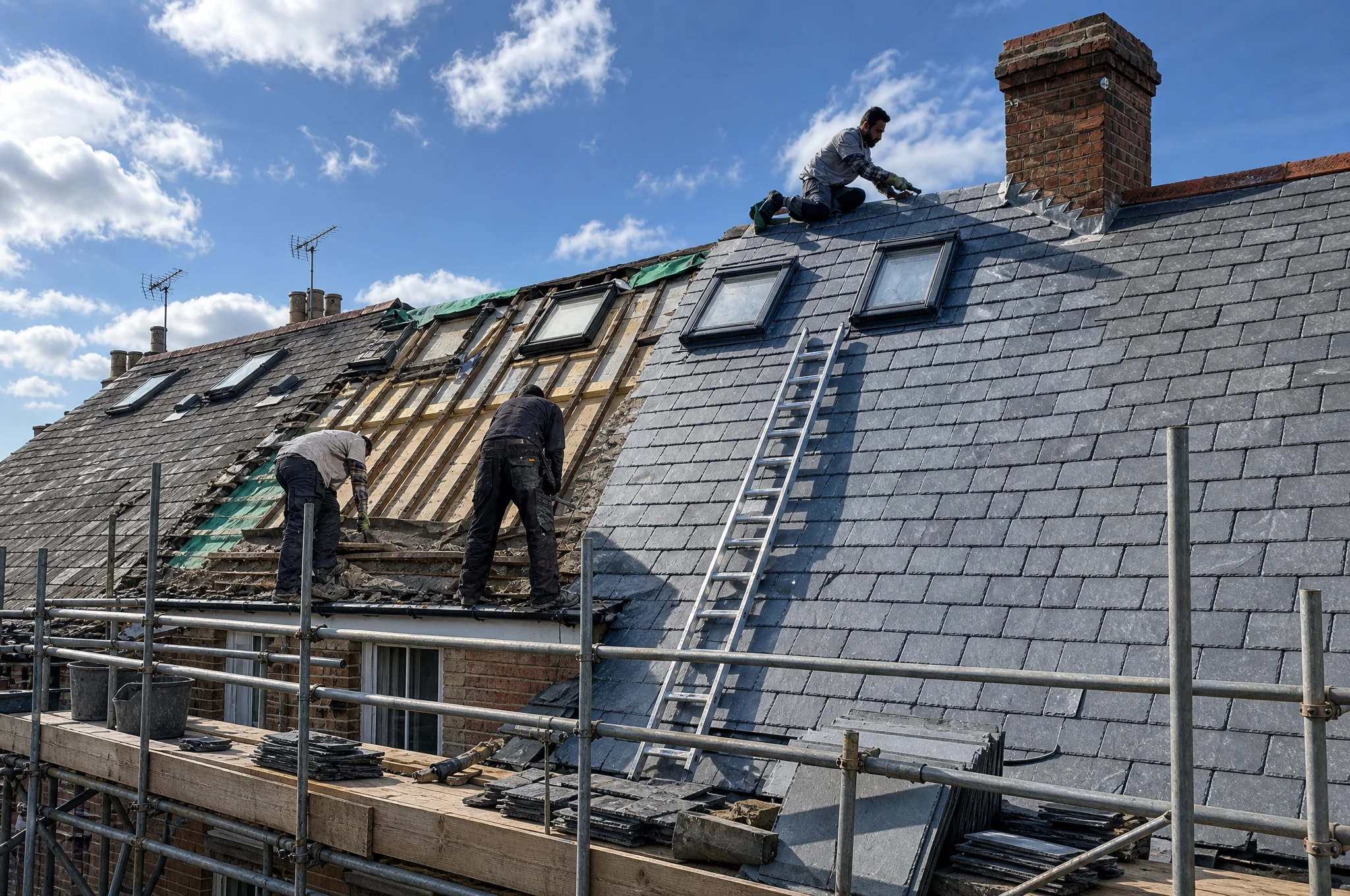
It’s also worth flagging that solar panels sit under their own separate set of permitted development rules, distinct from the re-roofing limits above. If a solar installation is part of the same project, that’s a second set of conditions to check rather than something covered by the roof-covering allowance.
Two checks take a few minutes each and settle most of this before you get quotes. Neither costs anything, and both are worth doing before a contractor sets foot on site, not after.
If either check comes back positive, the next call is to your council’s conservation officer, not straight to a roofer for quotes. They’ll tell you what consent is needed before any material is ordered or scaffolding booked.
Conservation area status changes the rules even without any height or projection change. These properties are classed as “Article 2(3) land,” and the permitted development rights that apply to an ordinary house are more restricted.
Work that would be permitted development anywhere else – inserting new windows or doors, or altering guttering and downpipes as part of a re-roof – can require planning permission in a conservation area, purely because of where the property sits, not what’s being done to it.
A council can go further and issue an Article 4 Direction, which removes additional permitted development rights beyond the standard conservation area restrictions. It doesn’t ban the work outright – it means a planning application is required where one wouldn’t otherwise be needed.
There’s one piece of good news here: no fee is payable for a planning application that’s only needed because of an Article 4 Direction. Councils have to notify affected property owners when a direction is issued, but it’s still worth checking directly with your local authority rather than assuming you’d have been told.
If you’re in the Windsor or Maidenhead area, that means checking whether your property sits inside one of the borough’s 27 conservation areas. Windsor town centre, Inner Windsor, Eton, Old Windsor and Datchet are among the largest, but there are smaller pockets throughout the borough that catch people out.
Planning Aid’s guidance on conservation area permitted development covers the general principles clearly if you want the full picture.
Listed status is a different, stricter regime again, and it applies to more homes than most owners realise. England has over 370,000 entries on the National Heritage List for England, and one listing can cover a whole terrace, not just a single house.
Roughly 91.7% of listed buildings are Grade II – “of special interest” – with Grade II* (particularly important buildings, about 5.8%) and Grade I (exceptional interest, around 2.5%) making up the rest. Most listed homes people actually live in are Grade II, but the consent rules are strict regardless of grade.
Listed Building Consent is required for any work that alters or extends a listed building in a way that affects its character or appearance – and a re-roof, by definition, usually does. This isn’t limited to visible changes from the street; alterations that affect the building’s special interest internally can require consent too.
Carrying out unauthorised work to a listed building is a criminal offence. Councils can require work to be reversed even after it’s finished, and an unauthorised alteration can make a property genuinely difficult to sell later.
The process itself is more straightforward than the stakes suggest. If your property might be listed or you’re not sure of its grade, here’s the order to work through it in:
Historic England’s own guidance on Listed Building Consent is the clearest starting point, and their listed building grades explainer is useful if you’re not sure what you’re dealing with.
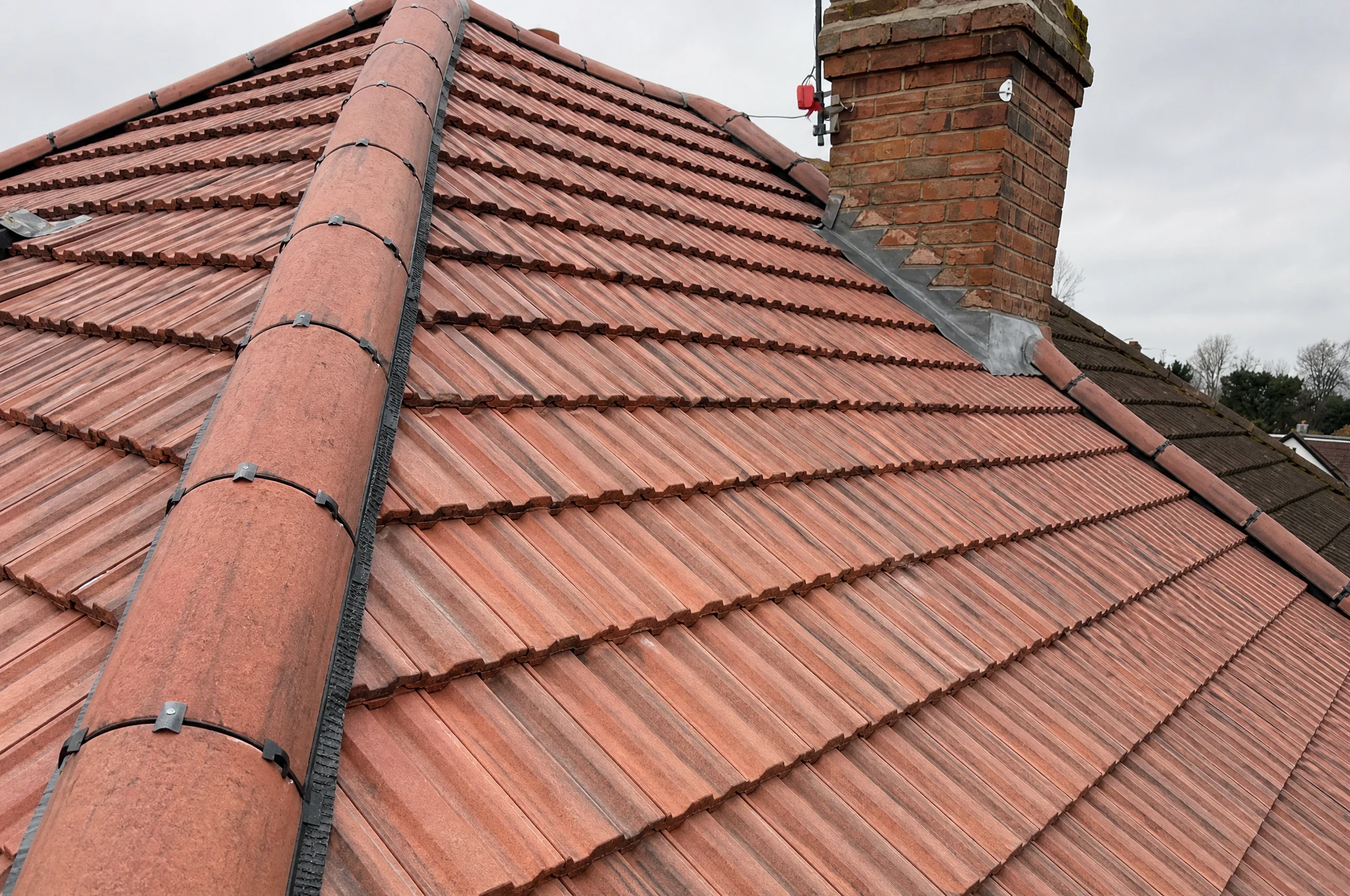
Even where permission isn’t the sticking point, material choice usually is. A listed or conservation-area property will typically need a genuine like-for-like match – reclaimed clay tiles rather than concrete, natural slate rather than a synthetic substitute – and that has real cost and lead-time implications worth knowing about before you budget.
| Property type | Permission usually needed? | Material flexibility | Typical extra time to budget |
|---|---|---|---|
| Standard house, no designations | No, if like-for-like and within height/projection limits | High – modern equivalents generally accepted | None beyond normal scheduling |
| Conservation area | Sometimes – depends on the specific work and any Article 4 Direction | Moderate – council may ask for a sympathetic match, not necessarily identical | A few weeks, if a planning application is needed |
| Listed building | Yes, for almost any re-roof – Listed Building Consent required | Low – genuine like-for-like match usually expected, sometimes reclaimed material | Several weeks to a few months for consent and sourcing matching materials |
In practice, “sympathetic” material choices on a protected property tend to come up in the same few places: natural slate rather than a synthetic look-alike, and traditional clay pantiles rather than a concrete profile that mimics them.
Conservation-style rooflights – low-profile, set flush with the roof plane – are usually expected over a standard projecting skylight. Rainwater goods matter too: cast iron or cast-aluminium guttering in a traditional profile is often expected over modern plastic, even on work that’s otherwise routine.
Where an exact match to the existing tile or slate isn’t available new, reclaimed material is often the answer, sourced from a specialist reclamation yard rather than a standard builders’ merchant. That’s worth factoring into both budget and lead time from the first conversation, not discovered halfway through a quote.
None of this means a listed or conservation-area re-roof isn’t worth doing properly. It just means the timeline and material budget need to account for consent and sourcing, not just the roofing work itself.
Our guide to choosing the right roofing material covers the options in more depth, and our roof replacement timeline guide explains what a standard project involves once permission isn’t a factor.
Skipping the permission check doesn’t just risk a fine. For a listed building, unauthorised work is a criminal offence, and the council can insist the work is reversed – meaning tiles come back off a roof you’ve just paid to replace.
Even in a conservation area without listed status, unauthorised work can trigger an enforcement notice, and any missing consent has to be disclosed when you come to sell. Buyers’ solicitors ask about this specifically on period and conservation-area properties, so an undocumented alteration can hold up a sale years later.
There’s a practical insurance angle too. Missing Listed Building Consent is common enough as a sale-time problem that specific indemnity insurance products exist just to cover it.
That’s a strong signal of how often this catches people out, and how much simpler it is to get consent properly at the start than to insure against the gap later.
All Custom Roofing is a verified member of the Confederation of Roofing Contractors, and every job we quote on a listed or conservation-area property gets flagged before any work is scheduled, not after. If consent hasn’t been sorted yet, we’ll tell you plainly rather than quietly assuming someone else has checked.
If you’re weighing up cost alongside all this, our roof repair and replacement cost guide and our guide to new roof financing options are both worth reading alongside this one – and our guide to choosing a roofing contractor covers what else is worth checking before you commit to anyone for a job like this.
If you’re not sure where your property stands, get in touch before you get quotes – it’s a five-minute question for us to help you work through, and it can save a genuinely expensive mistake.