(+44) 7900 515 552
23 Oct 2026
 insurance backed guaranteeinsurance backed guarantee
Roofing now has an unwanted title: according to Checkatrade’s 2025 UK Home Improvement Index, roofers have overtaken cowboy builders as the UK’s least trusted trade. The same report puts UK homeowners’ annual losses to rogue traders at £1.4 billion, and shows Checkatrade rejecting more roofers from its own platform than ever — 2,365 declined in 2024, nearly double the 1,219 rejected the year before (Checkatrade UK Home Improvement Index, 2025).
Separately, Citizens Advice found that a quarter of homeowners had a problem with their most recent repair or improvement job, with 1.7 million people losing money and a median loss of £750 — one in ten lost more than £5,000. Home repairs generated almost 37,000 complaints to the Citizens Advice Consumer Service in 2025 alone, roughly 710 a week (Citizens Advice, July 2026).
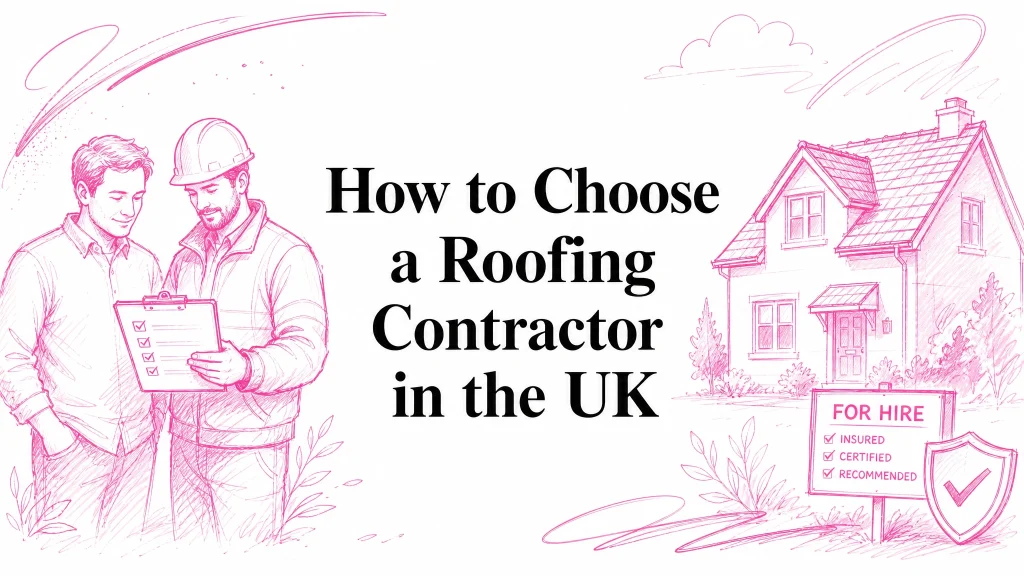
None of that is meant to scare you off getting your roof done. It’s meant to make the point that vetting a roofer properly isn’t a box-ticking formality, it’s the single biggest factor in whether the job goes well. This is the checklist we’d want a friend or family member to use before they let anyone up a ladder.
Roofing has three features that make it an easier trade to fake than most others. First, most of the work happens above eye level, so a poor job is genuinely hard for a homeowner to inspect — you can’t easily climb up and check the flashing or the underlay yourself.
Second, roof problems are often urgent: a leak during a storm creates pressure to hire whoever can turn up fastest, which is exactly the moment people skip checks they’d normally make.
Third, the entry barrier to calling yourself a “roofer” is low — unlike a Gas Safe engineer or an electrician, there’s no single legal licence required to trade as a roofing contractor in the UK, so trade body membership is one of the few genuine filters available to a homeowner.
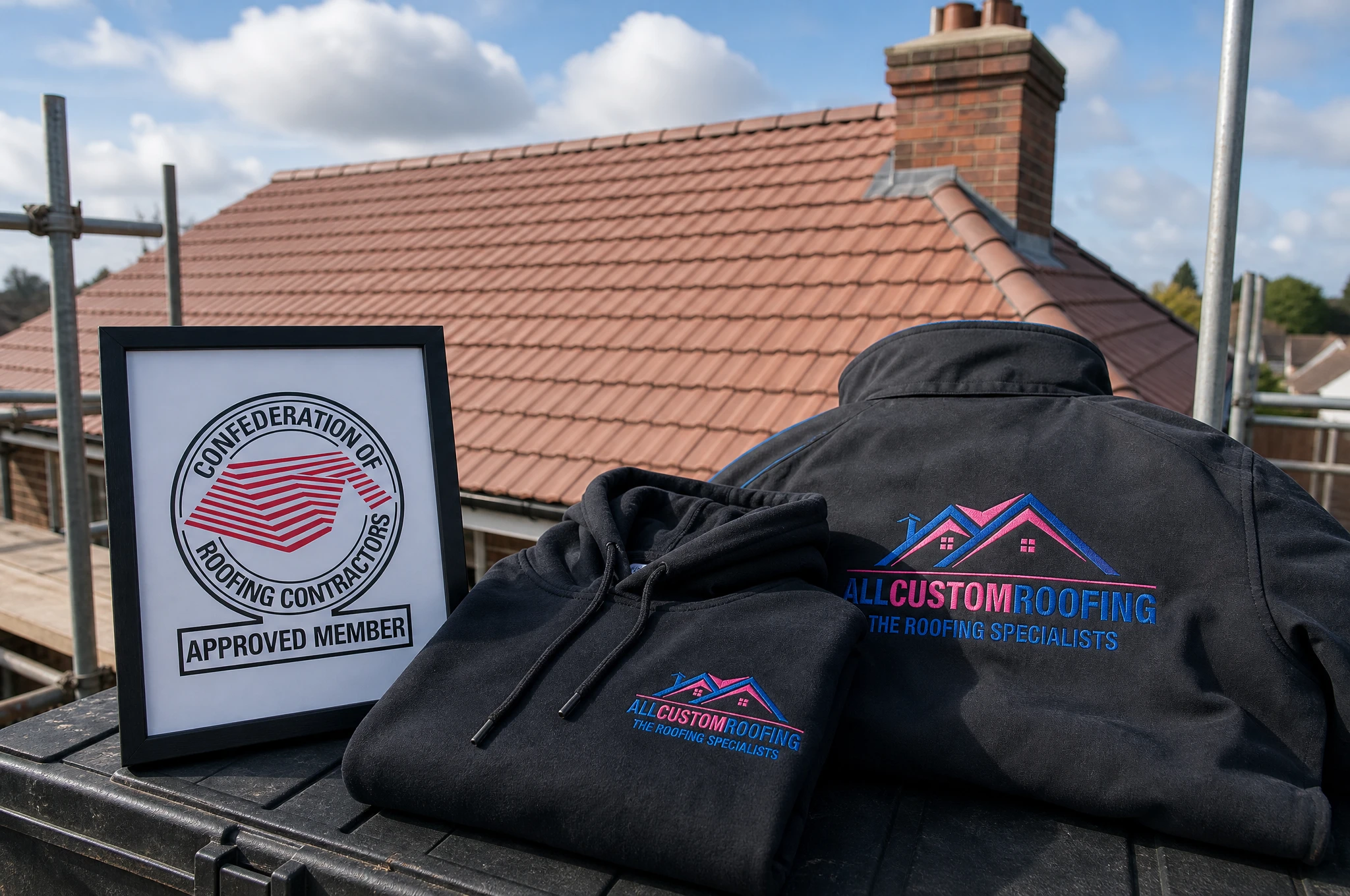
Anyone can put a logo on their van. What matters is whether it’s checkable. The Confederation of Roofing Contractors (CORC) vets and lists its members, and you can verify membership directly on their site rather than taking a company’s word for it (CORC). All Custom Roofing is a verified CORC member — you don’t need to take that on trust either; it’s checkable in the same way.
Trade body membership matters for a practical reason beyond reputation: reputable bodies require members to carry proper insurance and, in many cases, to offer insurance-backed guarantees on completed work — which brings us to the next point.
Almost every roofer will offer some kind of guarantee on their work. The question that actually matters is what happens to that guarantee if the company stops trading.
A standard company guarantee is only a promise from the business itself. If that business closes down, dissolves, or simply disappears — which happens more often in construction than most trades — the guarantee is worthless, because there’s no one left to honour it.
An insurance-backed guarantee (IBG) is different. It runs alongside the company guarantee but is underwritten by an insurer, so if the installer dissolves during the guarantee period, you can still make a claim. Cover typically runs for 10 years, and the process requires you to first attempt to contact the installer; if they’re no longer trading, the insurance claim route becomes available under the policy terms (CORC, insurance-backed guarantee FAQs).
A standard guarantee is only as good as the company’s word. An insurance-backed guarantee still pays out even if the company doesn’t exist any more.
Ask directly: “Is this guarantee insurance-backed, and can I see the policy documents?” A legitimate contractor will have an answer ready. A hesitant one is a red flag in itself.
| Guarantee type | Who stands behind it | What happens if the company closes |
|---|---|---|
| Standard company guarantee | The roofing company itself | Guarantee becomes worthless — no one left to honour it |
| Insurance-backed guarantee (IBG) | An independent insurer, alongside the company | You can still claim on the policy for up to 10 years |
Three quotes is the usual advice, and it’s sound. But the point isn’t just price comparison — it’s that a written quote forces a contractor to commit to specifics: the exact materials (including the lead code, tile type, or membrane brand), the scope of work, a start date, and a total price rather than a “day rate plus materials” estimate that can balloon.
If you want a sense-check on whether a quote is realistic before you compare it against others, our guide to roof repair costs in the UK sets out typical price ranges.
Be wary of a quote that’s dramatically lower than the others. It’s rarely because that contractor is simply more efficient. More often it means thinner materials, no scaffolding allowance, cash-in-hand with no paperwork, or a plan to add “unexpected” costs once the job is underway and the roof is already stripped off.
Photos on a website are easy to source from anywhere. A contractor who’s proud of their work will happily point you to a finished job in your own area, or share a portfolio with enough detail (address, date, scope) that you could verify it if you wanted to. If a business has been trading locally for any length of time, this should be an easy ask, not an awkward one.
A modest deposit to secure materials and a start date is normal. A demand for 50% or more before any work has started is not, and it’s one of the most common features of rogue trader complaints — the deposit is taken, and either the work never starts or the contractor disappears partway through.
If a large upfront payment is unavoidable (a bespoke or high-value material order, for instance), ask whether that payment is itself protected, and get the reason for it in writing.
A trader who knocks on your door claiming to have “noticed a problem” with your roof while working nearby, or who pressures you to sign today because the price is “only good for today,” is using a well-documented tactic associated with rogue trading, not a genuine coincidence. A legitimate local roofer with a real reputation doesn’t need to create artificial urgency to win your business.
Spreading the cost of a new roof or a large repair is entirely sensible and increasingly common, but the finance itself needs to be properly regulated. Consumer credit agreements in the UK fall under the Financial Conduct Authority’s oversight, and a legitimate finance partner will be authorised and registered with the FCA — you can check the Financial Services Register yourself.
You should also get a clear statutory right to a cooling-off period (typically 14 days) to cancel the agreement, and a representative APR disclosed upfront rather than buried in the small print.
All Custom Roofing works with an FCA-regulated finance partner for exactly this reason — see our guide on financing a new roof for how that works in practice. If a contractor offers you “finance” that isn’t through a named, checkable FCA-regulated lender, treat that as a serious red flag, not a convenience.
None of this requires hiring an investigator. Before you commit to a quote, it’s worth spending five minutes doing what a careful buyer would do for any significant purchase:
None of these checks are about being difficult. A contractor who does good work and stands behind it will never be bothered by a homeowner doing basic due diligence — if anything, it tends to be the ones with something to hide who push back on it.
If you’re checking a contractor against this list, these are the signals that should make you stop and reconsider, not proceed with caution:
Even one or two of these on their own aren’t necessarily disqualifying. Several together are a clear signal to walk away.
If a rogue trader has left you with an active leak or unsafe partial repair while you sort out a proper fix, treat that as urgent in its own right — see our guide on emergency roof repairs for what to do in the meantime.
If you’re reading this after the fact rather than before, you’re not alone — Citizens Advice’s figures put the number of homeowners affected by repair problems in the high millions. Report the trader to your local Trading Standards service via the Citizens Advice consumer helpline, and if you paid by credit card for any part of the job over £100, you may have protection under Section 75 of the Consumer Credit Act, which is worth pursuing with your card provider regardless of who the finance was actually with.
Before you sign anything, you should be able to answer, with confidence, all of the following: who exactly is doing the work and are they who they say they are; what happens to your guarantee if that company isn’t trading in five years; what’s included in the price and what could realistically add to it; when the work starts and roughly how long it will take (our guide on how long a roof replacement takes covers realistic timeframes); and what your rights are if something goes wrong.
The statistics are stark, but the underlying advice isn’t complicated: verify trade body membership rather than trusting a logo, ask specifically whether a guarantee is insurance-backed, get everything in writing, be suspicious of anything that creates urgency or demands cash upfront, and check that any finance offered is FCA-regulated. A legitimate roofer will welcome every one of these questions, because they’ve got nothing to hide from them.