
 (+44) 7900 515 552
16 Oct 2026
 insurance backed guaranteeinsurance backed guarantee
If water is coming through the ceiling somewhere near a chimney breast, you can save yourself a lot of guesswork: in the overwhelming majority of cases, the roof itself isn’t the problem. The flashing around the chimney is.
Flashing is the strip of lead (or, increasingly, a cheaper substitute) that seals the join between the chimney stack and the roof covering. It’s not glued or nailed to the tiles beneath it, it’s dressed and lapped so that water runs over every joint rather than through it. That makes it brilliant at keeping a roof watertight for decades. It also makes it the first thing to fail when it’s disturbed, aged, or was never installed properly in the first place.
This guide walks through why flashing fails, how to tell a flashing leak from something more serious, what a repair actually costs in the UK, and how to find someone who’ll fix it properly rather than papering over it with a tube of sealant.
A chimney stack punches straight through the roof plane, which means every roof around it has to change direction at least four times: at the front (the apron), up both sides (the stepped flashing), and across the back (the back gutter or “soaker”). Each of those transitions is a physical joint, and every joint is a place water can find its way in if the detailing isn’t right.
Compare that to the rest of a pitched roof, where tiles or slates simply overlap each other in a continuous, unbroken pattern running downhill. There’s no joint to fail. That’s the whole reason chimneys, valleys, and skylights account for a disproportionate share of roof leaks compared with the plain tiled areas around them — they’re where the roof has seams.
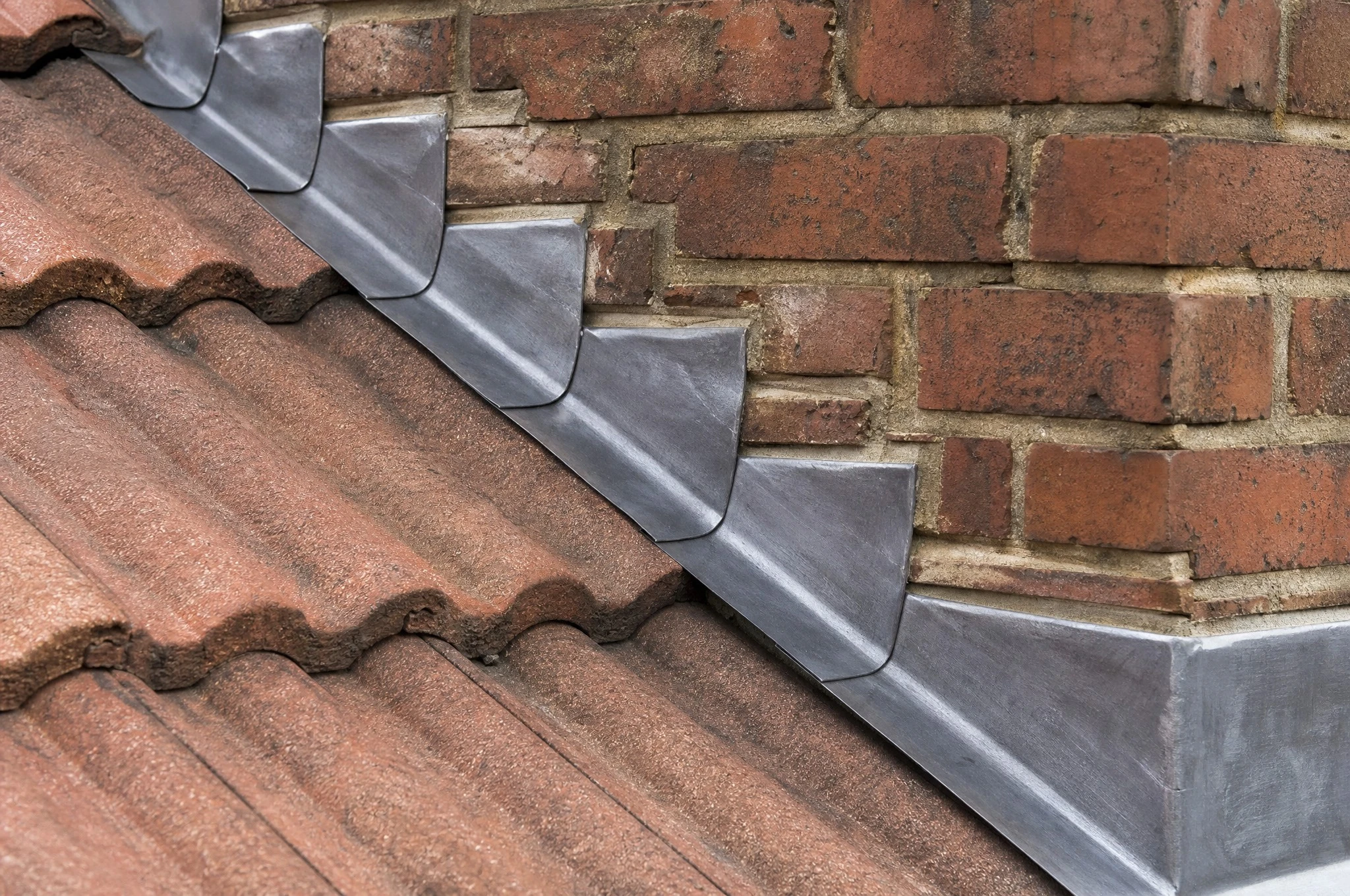
A properly installed lead flashing system around a chimney has several distinct parts, and it’s worth knowing the names because a contractor who uses them correctly is usually one who knows what they’re doing:
The apron sits at the front (downhill) face of the chimney, dressed over the top course of tiles below it.
Stepped flashing runs up both sides of the stack, cut and dressed into the mortar joints of the brickwork course by course so each piece overlaps the one below it, following the pitch of the roof.
The back gutter (sometimes called a soaker or saddle) sits behind the chimney, channelling water that runs down the stack’s rear face out to either side rather than letting it pool and force its way under the tiles.
Lead is used because it’s soft enough to dress tightly into brick joints and roof contours by hand, and because, done well, it lasts a genuinely long time — properly installed lead flashing typically lasts 60 to 100-plus years, with plenty of UK buildings still relying on their original leadwork after a century (Lead Sheet Training Academy). The lead itself is rarely the weak point. What fails first is almost always the pointing that holds it into the brickwork, or the lead having been dressed too thin, too tight, or with too few joints to allow for expansion in the first place.
Chimneys aren’t the only place flashing does this job — valleys, vent pipes, and where a roof meets a wall all rely on the same principle. Our full guide to metal roof flashing covers those other types if you want the wider picture.
Chimneys have more joints than almost anywhere else on a roof — four separate transitions where water can get in. That’s the whole reason they’re the single most common place a roof actually leaks.
A few tell-tale signs point specifically at flashing rather than a wider roof problem:
If you want a second opinion on whether what you’re seeing is genuinely a flashing issue or something else, our guide on how to find a roof leak covers the wider diagnostic process, and a free roof inspection will settle it properly without you going anywhere near a ladder.
Prices vary with access, the amount of lead needed, and whether scaffolding is required, but Checkatrade’s current UK cost data gives a reliable range:
| Job | Without scaffolding | With scaffolding |
| Patch repair to existing flashing | ~£250 | £550–£650 (avg. £600) |
| Full replacement, all four sides | £450–£600 (avg. £525) | £800–£1,200 (avg. £1,000) |
Source: Checkatrade, chimney flashing repair cost guide
A few things push the price up or down within those ranges:
Access. A single-storey extension roof with easy ladder access costs far less to work on than a chimney on a three-storey Victorian terrace.
Repair vs full replacement. If only one section (say, the back gutter) has failed, a partial repair is cheaper than re-flashing the whole stack, but it’s a false economy if the rest of the lead is the same age and close to failing too.
Tile disturbance. Flashing work often means lifting the surrounding tiles, and any that crack in the process need replacing — budget from around £170 for five tiles.
Scaffolding. This typically adds £300–£400 on its own, separate from the labour and materials for the flashing itself. On a job requiring scaffolding anyway (a full re-roof, for example), it makes sense to have the flashing inspected and replaced at the same time rather than paying for access twice.
Genuinely: don’t attempt this yourself. Checkatrade’s own guidance is blunt about the two real risks — a fall from height, and a roof fire from improperly heated lead during welding or dressing. Both are entirely avoidable with a competent tradesperson and neither is worth risking to save a few hundred pounds.
If the lead itself is sound and only the pointing or one section has failed, a patch repair is a legitimate, cost-effective fix. But it’s worth asking your contractor two questions before you agree to a patch: how old is the rest of the lead, and is it the same gauge and installation as the section that’s failed? If the answer is “the same age, same installation, roughly 30-plus years old,” you’re very likely to be back dealing with the next section failing within a few years. In that case, a full re-flash — while a bigger job upfront — is usually the better long-term value, particularly if scaffolding is already up for other work.
Our guide on roofing repairs vs roof replacement covers this same repair-or-replace logic in more depth if you’re weighing it up for the wider roof, not just the chimney.
A properly executed chimney flashing repair should:
Because flashing sits above eye level, most homeowners never actually inspect the finished work closely — which is exactly why a rushed or badly executed repair can go unnoticed for a full winter before it fails again. A few things are worth checking, or asking your contractor to photograph, before they leave site:
If in doubt, a second contractor or an independent inspection can usually assess finished leadwork from the loft or with a simple visual check from ground level, without needing to get back up on the roof.
Flashing sits above eye level, so a bad repair can go unnoticed for a full winter before it fails again. Ask your contractor to photograph the finished leadwork before they leave site — it’s the easiest way to check the job without getting back up on the roof yourself.
Flashing failure is exactly the kind of defect that doesn’t show up for months, sometimes years, after the work is done. A poor repair can look fine on the day and let water in again the first time you get sustained, wind-driven rain from an unusual direction. That’s precisely why the guarantee behind the work matters as much as the work itself.
All Custom Roofing is a verified member of the Confederation of Roofing Contractors (CORC), and jobs are backed by an insurance-backed guarantee, not just a company promise. The distinction is worth understanding: a standard workmanship guarantee is only as good as the company that issued it. An insurance-backed guarantee runs alongside it, and it’s what protects you if the company that did the work is no longer trading when a defect shows up — the guarantee is underwritten by an insurer, not just a business that might not exist in five years’ time (CORC, insurance-backed guarantee FAQs). On leadwork specifically, where a fault can take a winter of driving rain to reveal itself, that’s not a small detail.
If the cost of a full re-flash alongside other roof work is a concern, it’s also worth knowing this doesn’t have to be paid in one go — see our guide on financing a new roof for how FCA-regulated finance options work.
Active water coming through the ceiling during a storm isn’t a “get three quotes over the next fortnight” situation. If you’ve got water actively entering the property, treat it as urgent: move anything valuable out from under the affected area, catch what you can, and get a temporary fix booked immediately rather than waiting for a full repair slot. Our emergency roof repairs guide covers what to do in the meantime.
A leak that shows up near a chimney is, more often than not, a flashing problem rather than a roof problem, and it’s one of the most predictable, well-understood repairs in roofing — provided whoever does it actually cuts the lead into the brickwork properly rather than relying on sealant. Get it diagnosed early, ask what gauge lead is being used and whether it’s a patch or a full re-flash, and make sure whatever guarantee you’re given would still mean something if the company that gave it to you weren’t around in five years.