(+44) 7900 515 552
23 Oct 2026
 insurance backed guaranteeinsurance backed guarantee
Once you’ve decided to go ahead with a new roof, the question stops being “should I do this” and becomes something far more practical: how long is my house going to be under scaffolding, and what does that actually mean for day-to-day life.
The honest answer is that timeframes vary more than most quotes will tell you upfront, because they depend on the size of the roof, the material going on it, the weather during the job, and what your roofer finds once the old covering comes off. This guide sets out realistic timeframes for UK homes, what extends them, and what a well-run job should actually look like day by day.
As a general guide for a full re-roof under reasonable conditions:
| House type | Typical timeframe |
|---|---|
| Terraced | 2–3 days |
| Bungalow | 2–4 days |
| Semi-detached | 3–5 days |
| Detached | 5–7 working days |
These are working days actively on the roof, not calendar days from enquiry to completion – booking, scaffolding, and material lead times all sit outside this window, which is worth factoring in when you’re planning around the work.
If you know (or can estimate) the roof area in square metres, that’s actually a more reliable guide than house type alone, since a large bungalow can easily have more roof area than a small terraced house:
The covering going on matters almost as much as the size of the roof:
If you’re weighing up tile options as well as timing, our guide to how tiled roofs are constructed covers the material side in more detail.
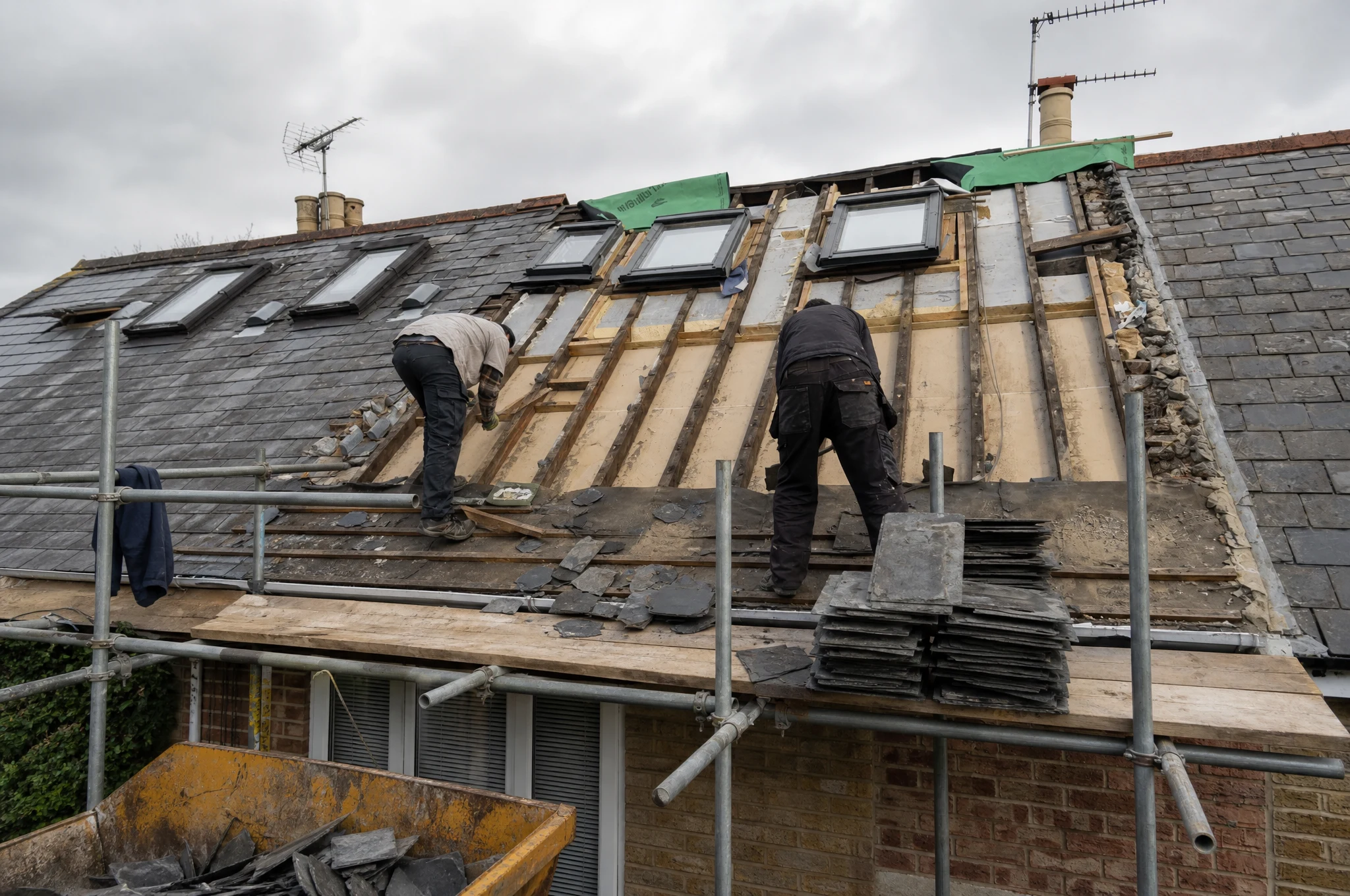
A straightforward semi-detached re-roof (concrete tiles, no major surprises) usually breaks down roughly like this:
Dismantling the scaffolding at the end is quicker than putting it up: typically 2–4 hours for a straightforward residential job.
Rain, high winds, and frost can all stop roofing work outright, both for safety (working at height in wind or on wet, frozen surfaces) and for the integrity of the job (some membranes and adhesives need dry, above-freezing conditions to bond properly). May to September is generally the most reliable window for UK re-roofing, though reputable roofers work through the rest of the year too – it just means building in a little more schedule flexibility.
This is, in practice, the single biggest source of timeline slippage, and it’s not a sign of a bad contractor – it’s a sign of a roof that’s been covered up for decades. Rotten rafters, damaged or undersized battens, and water-damaged loft insulation are commonly only visible once the tiles and felt are stripped back. A good roofer will flag this as a possibility before work starts, quote a provisional allowance or day rate for remedial timber work, and show you what they’ve found (ideally with photos) rather than just adding time and cost without explanation.
Structural surprises under the old covering, not the tiling itself, are the single biggest reason a re-roof runs longer than quoted.
If your property is listed, or in a conservation area with roof-specific restrictions, you may need listed building consent before any work starts – and this sits entirely outside the roofing timeline itself. Heritage approval can add roughly 2 to 8 weeks of paperwork before a single tile is lifted, depending on your local planning authority’s workload and whether the proposed materials match the existing roof exactly. If you’re not sure whether your property is affected, check with your local planning authority or Historic England before booking any work – a roofer starting without the right consent in place can create serious problems for you as the homeowner, regardless of who’s actually doing the physical work.
A roof with straightforward access on a standard street gets scaffolding up quickly. A property with a narrow side return, a shared boundary, overhead cables, or a steep or unusual roof shape can extend scaffolding time significantly, and may need permits if any part of the structure needs to sit on a public footpath.
Most straightforward roof replacements – like-for-like material, same roof shape, no increase in height – fall under permitted development and don’t need planning permission at all, which is why the vast majority of re-roofs in this guide’s timeframes go ahead without any planning delay. It’s a different picture if you’re changing material (say, from concrete tile to slate, or adding solar-reflective coatings that alter the roof’s appearance materially), increasing the roof’s height, or the property sits in a conservation area with its own Article 4 restrictions on permitted development rights. If any of that applies, check with your local planning authority before booking a start date – this is a separate process from listed building consent and can run in parallel with it, but both sit outside the roofer’s control and outside the working-day timeframes above.
It helps to see the size and material factors combined rather than in isolation. A detached property with a 120m² roof, being covered in concrete tiles, sits at the upper end of both the “detached” (5–7 days) and “over 100m²” (5–7+ days) ranges, and concrete tiles alone would typically need 3–5 days on a simpler roof. In practice, expect the larger figure to apply: budget for a full working week on the roof itself, plus scaffolding up (up to a full day for a structure this size) and down (half a day) either side. A realistic total booking, door to door, is 6 to 8 working days – with the caveat that this assumes no significant timber decay is found once the old covering comes off.
Both, to an extent. The physical work itself doesn’t take meaningfully longer in winter provided conditions are dry, but reliability drops: short daylight hours limit the working window each day, and a wet or frosty spell can pause work entirely for days at a time in a way that rarely happens in July. The bigger seasonal effect is on booking, not installation speed – spring and early autumn are the busiest periods for reputable roofers, so lead times to get started stretch out, sometimes by several weeks. If your roof isn’t in urgent need of replacement, booking in a genuinely quieter month (typically deep winter or the height of summer holidays) can mean a shorter wait to get started, even if the on-roof timeline itself is unchanged.
However well a job is planned, there’s inevitably a period where your old covering is off and the new one isn’t fully on yet. Ask your contractor directly how they handle this: a professional team works in manageable sections rather than stripping the entire roof at once, and keeps waterproof tarpaulins on site to cover any exposed area if the weather turns unexpectedly overnight or mid-shift. This is a fair, reasonable question to ask at quote stage, and a contractor’s answer tells you a lot about how they run a site – see our guide on choosing a roofing contractor for the rest of the questions worth asking before you book.
If you’re still deciding whether you need a full re-roof or whether a repair will do, timeline is a legitimate factor to weigh alongside cost: a targeted repair might be done in a single day with no scaffolding at all, while a full replacement is a multi-day project with the disruption that comes with it. Our guide on roofing repairs vs roof replacement and the signs you need a roof replacement both go into that decision in more depth. If cost, rather than timing, is what’s holding you back from the full replacement your roof actually needs, our guide on financing a new roof covers how spreading the cost works through an FCA-regulated finance partner.
A repair can often be done in a day with no scaffolding; a full replacement is a multi-day job. Weigh timeline alongside cost when deciding between the two.
For a straightforward job with no major structural surprises, expect 2–3 days for a terraced house, 3–5 for a semi, and 5–7 for a detached property, plus scaffolding up and down either side of that window. Weather and what’s found under the old covering are the two things most likely to shift that timeline, and a roofer who’s upfront about both before work starts, rather than after, is one worth trusting with the job. All Custom Roofing is a verified CORC member with an insurance-backed guarantee on completed work – ask us for a realistic, honest timeline for your specific roof before you book.