
 (+44) 7900 515 552
16 Oct 2026
 insurance backed guaranteeinsurance backed guarantee
If you’re reading this, there’s a fair chance your conservatory has become the room nobody uses properly. In summer it feels like a greenhouse. In winter it drops cold so quickly that you shut the door and forget about it. Around Windsor and across Berkshire, that pattern is common, especially on older conservatories attached to 1980s, 1990s, and early 2000s homes.
The good news is that the problem usually starts at roof level, which means it can often be solved there too. The right roof can turn a space that only works for a few weeks of the year into somewhere you sit, work, eat, or let the kids use without constantly fiddling with blinds, heaters, or fans. Among the main conservatory roof options, each comes with a different balance of light, insulation, noise, upkeep, and cost.
Most homeowners don’t complain that their conservatory looks bad. They complain that it doesn’t work.
On a bright Berkshire afternoon, older roofs can trap heat fast. Then in colder weather, the same room loses warmth just as quickly. You end up with a space that looks useful from the garden but feels awkward to live in. That is usually the point where people start looking seriously at replacement conservatory roof options rather than trying another temporary fix.
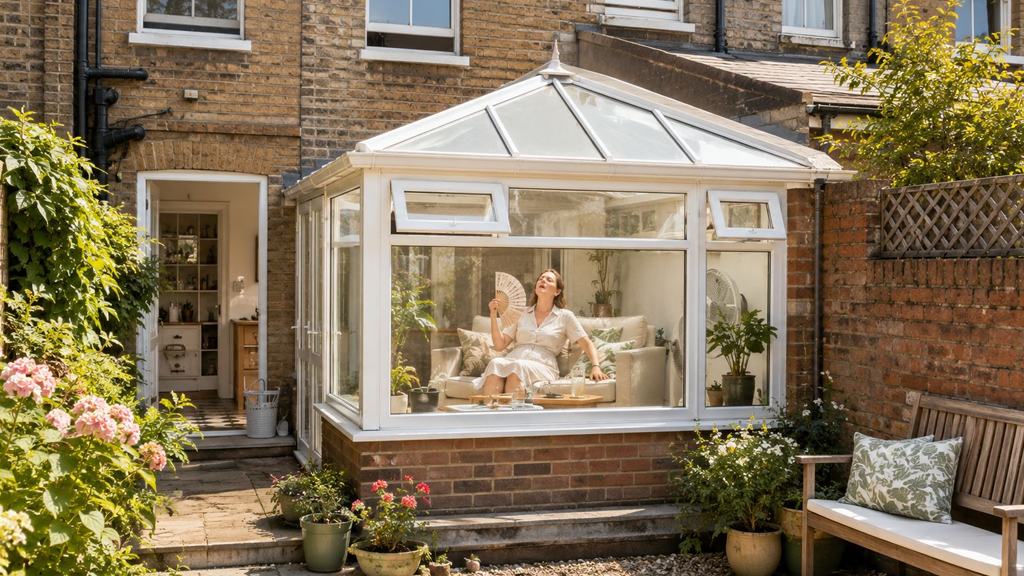
Walls and doors play a part, but the roof usually dictates how the room behaves through the year. In local weather, that means coping with direct summer sun, steady rain, winter frost, and wind-driven weather that finds every weak point in tired seals and flashings.
If you’re trying to improve comfort without jumping straight into a full extension, start with the top of the structure. Roof performance affects:
A good replacement roof doesn’t just make the conservatory warmer. It makes the temperature more stable. That’s the primary difference. You stop reacting to the weather every day.
For homeowners already thinking more broadly about heat retention, energy-efficient roofing approaches for modern homes are worth a look as well, because the same basic principle applies across the house. Better thermal performance gives you a room you can use without constantly compensating for the roof above it.
Before comparing details, it helps to separate the main roof types by what they’re good at. Most choices come down to glass, polycarbonate, or solid tiled systems. Then there are a couple of specialist variations such as hybrid roofs and lantern-style designs.
| Roof type | Best known for | Main drawback |
|---|---|---|
| Glass | Light and sky views | Can still swing between hot and cold |
| Polycarbonate | Lower upfront cost and light weight | Weaker insulation and more noise |
| Solid/tiled | Strong thermal performance and room-like feel | Highest upfront spend and added structural demands |
| Hybrid | Mix of insulation and retained light | Depends heavily on design quality |
| Lantern | Architectural look with central light feature | Better for specific layouts than all conservatories |
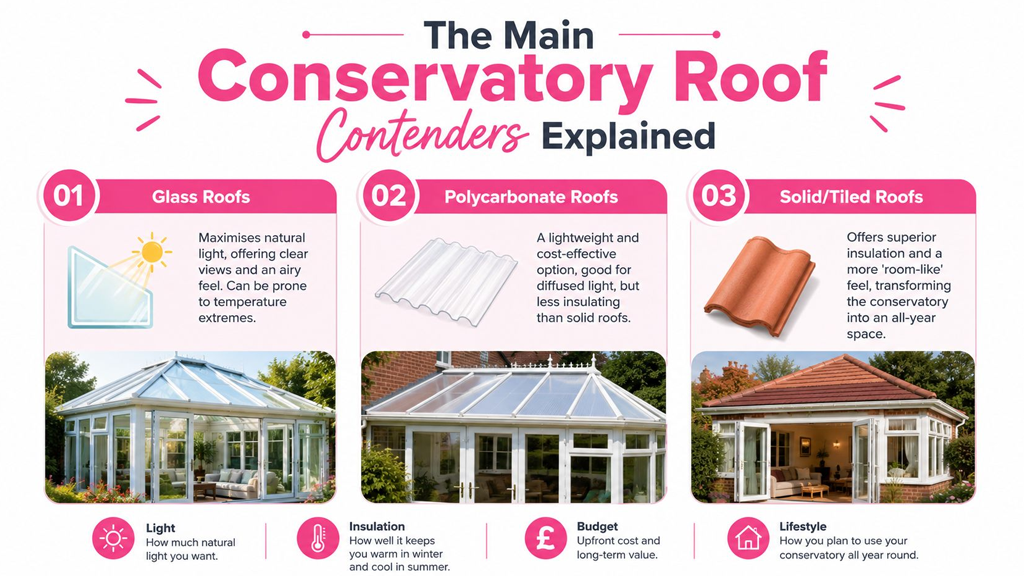
Glass suits homeowners who don’t want to lose that open, bright conservatory feel. It keeps the visual connection to the garden and usually looks sharper than ageing polycarbonate. On period properties around Windsor and on newer homes in places like Bracknell and Maidenhead, it often works well where natural light matters more than creating a fully extension-like room.
Polycarbonate remains the budget-led option. It’s lightweight, fairly straightforward, and often suits existing frames with less structural change. If the goal is to replace a failing roof at the lowest likely initial cost, polycarbonate still has a place.
That said, it tends to be the option people move away from rather than towards when comfort is the priority.
Solid roofs change the character of the space more than any other option. Instead of feeling like you’re sitting under a translucent canopy, the room feels closer to the rest of the house. That matters for detached homes, semis, and bungalows across Berkshire where homeowners want the conservatory to function like a proper dining room, office, or snug.
A key measure here is the U-value, which tells you how much heat passes through a building element. Lower is better. According to Glass House Architecture’s guide to conservatory roof types, solid tiled conservatory roofs are around 0.18 W/m²K, compared with around 2.5 to 3.0 W/m²K for polycarbonate and around 1.6 W/m²K for standard double-glazed glass.
Lower U-values usually mean a room that behaves less like a conservatory and more like a normal part of the house.
If you’re interested in insulated roofing systems more generally, composite panel roofing is worth understanding because it helps explain why layered roof construction changes comfort so much.
A Windsor homeowner usually notices the same pattern first. The room is bright enough on a spring morning, then too hot by mid-afternoon, noisy in a shower, and barely worth using on a cold January evening. That is where the material choice stops being a brochure decision and becomes a practical one.
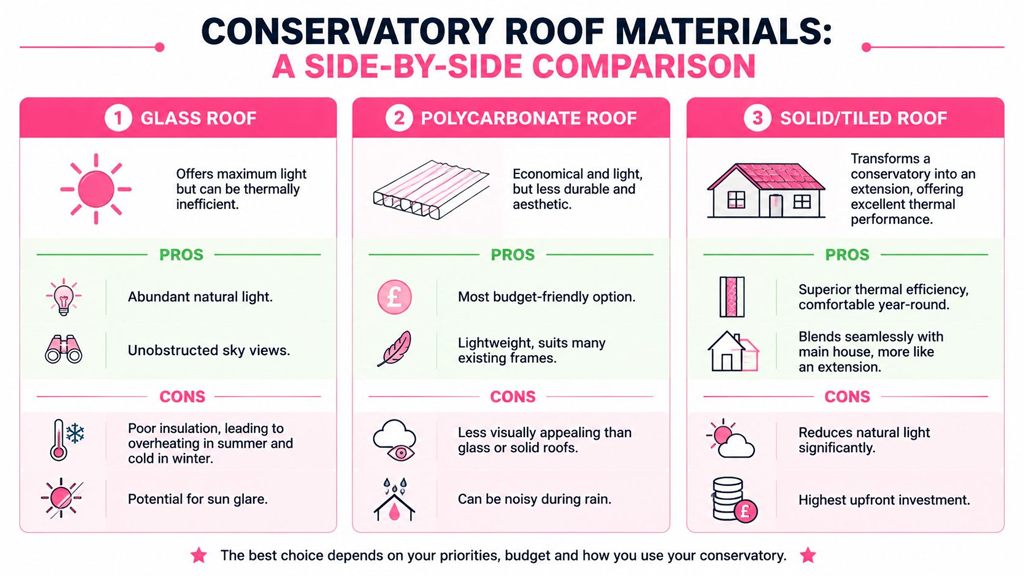
Glass gives you the closest thing to the classic conservatory look while improving comfort over older polycarbonate. On detached and newer estate homes around Berkshire, it often suits properties where owners still want that open, garden-room feel. The trade-off is that you still live with a glazed roof. Solar gain, glare, and heat loss are reduced, not removed.
Polycarbonate is usually the lightest and simplest option to fit onto an existing frame. That matters if the base, dwarf walls, or window frames are not ideal candidates for heavier loads. It can still make sense as a lower-cost replacement where the aim is to keep the structure going rather than turn it into a year-round room.
Solid tiled roofs change the room most. They suit homeowners who want the conservatory to feel more like a proper extension, especially on Windsor and Berkshire properties with tiled main roofs where visual match matters. They also introduce the biggest practical question many guides gloss over. Weight.
This is the part I would never skip on a survey.
A solid roof can put far more demand on the existing conservatory than glass or polycarbonate. Sometimes the original frames are strong enough with upgrades. Sometimes the window frames need strengthening, the ring beam needs changing, or the foundations need checking before anyone should sign off the job. On older conservatories, especially ones built as light garden rooms rather than permanent living space, that can be the difference between a sensible upgrade and an expensive mistake.
Glass and polycarbonate usually ask less of the existing structure. That does not mean every old frame is automatically sound, but the reinforcement work is often more manageable.
Rain noise is where homeowners often change their minds. Polycarbonate is usually the noisiest in bad weather, which matters if the room backs onto the garden and gets regular use as a home office, dining room, or evening sitting space. Glass is quieter than ageing polycarbonate, but it still lets weather noise through more than a well-insulated solid system.
Maintenance is less dramatic, but it affects how the roof feels to own over time. Glass looks sharper than polycarbonate, though dirt, leaf staining, and bird mess show up quickly. Polycarbonate can become tired-looking as it ages. Solid roofs hide external grime better, but they bring their own maintenance points around guttering, flashings, and making sure ventilation and insulation were installed properly from the start.
Material choice changes how well the conservatory belongs to the house.
On Victorian and Edwardian homes in Windsor, a full solid tiled conversion can look right if the pitch, tile, and fascia details are handled carefully. Done poorly, it can look heavy and out of proportion. On 1980s and 1990s homes, a solid roof often blends in well because the existing conservatory already reads as an add-on that owners want to upgrade into usable living space. Glass tends to suit properties where preserving light and a more traditional conservatory character matters more than extension-like performance.
If you are comparing materials beyond just the conservatory, this guide to choosing the right roofing material for your home gives useful wider context.
| Criteria | Glass | Polycarbonate | Solid/tiled |
|---|---|---|---|
| Load on existing structure | Moderate | Lowest | Highest |
| Light levels | High | High but more diffused | Lowest |
| Rain noise | Mid-range | Highest | Lowest |
| Comfort across seasons | Mid-range | Weakest | Strongest |
| Visual fit with tiled Berkshire homes | Good in the right design | Often weakest | Usually strongest |
| Likelihood of extra structural checks | Moderate | Lower | Highest |
The right choice depends on what you want the room to become, and whether the existing conservatory can support that plan.
A common Windsor scenario goes like this. The conservatory has been usable for years, then one cold winter or one run of hot summer afternoons makes the room feel like wasted square footage. At that point, the cheapest quote stops looking like the best value.
Cost needs looking at in two parts. First is the install price. Second is what the roof lets you do with the room over the next ten or fifteen years, especially on Berkshire homes where conservatories often sit off the kitchen and end up as everyday family space rather than occasional seating.
Installed prices vary by size, shape, access, and how much remedial work is needed to the existing frame. Industry pricing guidance from Checkatrade’s conservatory roof replacement cost guide and HouseholdQuotes’ conservatory roof cost guide gives a reasonable starting point for budgeting.
Typical Conservatory Roof Replacement Costs 2026
| Roof Type | Typical Price Range |
|---|---|
| Polycarbonate | Often the lowest-cost option, commonly starting in the lower thousands for smaller replacements |
| Glass | Usually priced above polycarbonate, with costs rising on larger spans and higher-spec glazing |
| Solid or tiled | Commonly several thousand pounds more than glazed options, especially once insulation, plastering, and structural work are included |
Those broad ranges matter more than a headline number from a sales page. A simple lean-to on a modern estate house in Dedworth is a different job from an older conservatory on a Victorian or Edwardian property near central Windsor, where access can be tighter and the existing structure may be less forgiving.
Polycarbonate still has a place. If the aim is to stop leaks, keep weight down, and spend as little as possible, it can be the right short-term answer.
Long-term value often shifts toward glass or a solid warm roof because the room gets used more often and with less compromise. The Energy Saving Trust’s guidance on reducing heat loss in the home supports the wider point that better insulated roof elements reduce heat loss. In practice, homeowners usually notice that through comfort first, then heating habits second.
Solid roofs can deliver the biggest change in day-to-day use, but they also carry the biggest hidden cost risk. If the base, dwarf walls, frames, or footings are not adequate, the roof quote is only part of the bill. Extra structural calculations, frame upgrades, or foundation work can change the budget quickly, and many online guides barely mention it.
This matters in Windsor and Berkshire because a lot of conservatories were built in periods when lightweight roofs were the default. Swap that for a tiled system and the room may perform better, but only if the supporting structure is up to it.
I tell homeowners to price the project in stages. Start with the roof system you want. Then allow for surveys, building control where required, ceiling finishes, lighting alterations, and possible strengthening work. That approach gives a truer picture of value than comparing roof panel prices alone.
A well-specified glass roof can sit in the middle ground. It usually keeps more natural light, looks less bulky on smaller properties, and avoids some of the weight penalty of a tiled system. On the right conservatory, that balance can make more financial sense than forcing a solid roof onto a structure that was never designed for it.
There is also the question of how the space feels to live with. A conservatory that is comfortable in January and usable in July adds practical living area, even if estate agents never put a separate figure on it.
That is often the return. Better daily use, fewer complaints about glare or cold, and less temptation to shut the door and ignore the room for half the year.
Many guides get vague, talking about comfort and style, then skipping over the bit that can stop a project in its tracks. Structure matters, and in Windsor and the wider Berkshire area, the existing base and frame often matter more than homeowners expect.
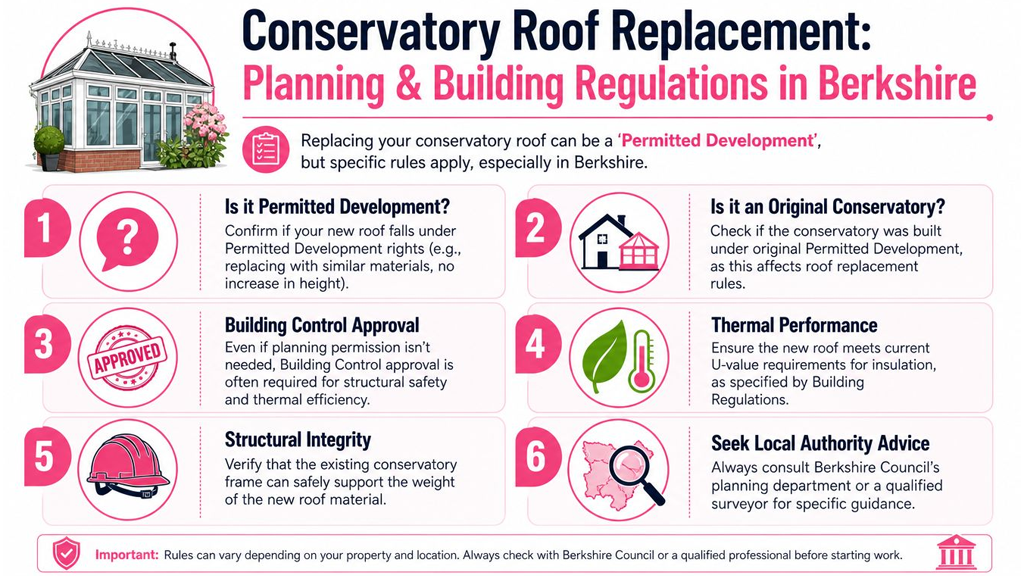
If you’re replacing like for like with another lightweight roof, the process is often more straightforward. Change that roof to a solid tiled system and the job usually becomes a building control matter because thermal performance, loading, and structural suitability all come into play.
The roof itself has to comply with current thermal standards under Part L. The structure beneath it also has to be capable of taking the load. That is where some projects run into trouble.
One local reality deserves direct attention. A 2025 Sherborne Windows article citing a UK Building Control report says 1 in 3 older conservatory foundations in Windsor and Berkshire may lack the depth needed for modern insulated tiled roofs, and those roofs can weigh up to 40% more than the original polycarbonate alternatives.
That doesn’t mean your project can’t go ahead. It means nobody should promise a solid roof before checking what the existing structure is sitting on.
A proper survey is not a box-ticking exercise. It decides whether the upgrade is sound or risky.
A careful installer should assess more than just the visible roofline.
If your project includes tiled elements, British standards still apply. BS 5534 guidance states that all single-lapped roof tiles must be mechanically fixed, and perimeter tiles need a minimum of two fixings to resist wind uplift.
In Berkshire, conservatories vary a lot. A lightweight lean-to on a modern estate home isn’t the same job as an older Victorian-style conservatory on a period property. The roof shape, original build quality, and exposure to wind and rain all change the answer.
For broader inspiration on enclosed garden rooms, some homeowners also look at layouts outside the UK market.
The best conservatory roof option depends on what you want the room to become. Not what looks good in a brochure. Not what seems cheapest at first glance. What job the room needs to do for your household.
If your budget is tight and you mainly want a basic, serviceable roof, polycarbonate can still be a valid starting point. It suits homeowners who need the lowest likely entry cost and don’t expect extension-level comfort.
If you want to keep the bright, open conservatory feel, glass is the better fit. It works best where light matters most and you’re prepared to accept that the room may still behave differently from the rest of the house in more extreme weather.
If your aim is to create a room you can use properly throughout the year, solid or tiled roofing is usually the strongest answer. It changes the room most, but it also asks for the most care in design, survey work, and installation.
A solid roof only performs well if the details are right. The same goes for flashing lines, tile fixing, structural transitions, and how the new roof meets the existing house wall.
One small but telling example is leadwork. The Roof Tile Association’s guide to fasteners and BS 5534 best practice states that only copper or stainless steel nails should be used when fixing lead flashings, and aluminium nails must not be used because they cause rapid galvanic corrosion and fixing failure.
That sounds minor until you see the damage poor detailing causes. Water doesn’t need a dramatic failure. It only needs one badly handled junction.
Good conservatory roofing isn’t just about the material. It’s about whether the installer treats it like roofing work or like a quick conversion job.
Ask yourself these questions:
A conservatory should not be the room you apologise for. With the right roof, it can become one of the most useful parts of the house.
If your conservatory in Windsor, Reading, Slough, Bracknell, Maidenhead, or a nearby Berkshire town is too hot, too cold, noisy in the rain, or underused, contact All Custom Roofing for practical advice and a clear quote. We cover Windsor, Reading, Slough, Bracknell, Maidenhead, and surrounding towns, with expert roof repairs, roof replacements, and honest guidance on whether a glass, polycarbonate, or solid conservatory roof is the right fit for your home.