
 (+44) 7900 515 552
16 Oct 2026
 insurance backed guaranteeinsurance backed guarantee
A damp patch on the ceiling rarely starts as a dramatic emergency. More often, it shows up as a faint brown mark over a kitchen extension, a drip near a dormer after heavy rain, or a musty smell in the garage that wasn’t there last week. By the time you notice it indoors, the roof problem has usually been building outside for a while.
That’s what makes flat roof repairs frustrating for Berkshire homeowners. The visible leak is often the end of the story, not the start of it. Water may have tracked under a lap, sat around a blocked outlet, or worked its way through tired flashing long before it found its way inside.
Around Windsor, Reading, Slough, Maidenhead, and the wider Berkshire area, flat roofs are common on extensions, porches, bays, garages, and small commercial units. They do a good job when they’re designed and maintained properly. When they aren’t, small defects turn into repeat call-outs.
The good news is that most flat roof problems follow familiar patterns. If you know what to look for, what usually causes failure, and when a patch is sensible versus when it’s a false economy, you can make a much better decision the first time.
The usual moment goes like this. It’s raining hard, you glance up, and there’s a fresh stain on the ceiling or a drip landing in the corner of the room. If the leak sits under a flat roof, the first instinct is often to assume the problem is directly above that spot.
Sometimes it is. Often it isn’t.
Water on a flat roof can travel sideways before it drops through the deck or around a joint. A split near a parapet, a failed detail around a pipe, or a blocked outlet at the far end of the roof can all show up indoors somewhere else. That’s why guessing from the ceiling alone leads plenty of property owners in the wrong direction.
Start with the basics:
If you need a clearer process for tracing where water is getting in, this guide on how to find a roof leak is a useful place to start.
Practical rule: Treat the leak as a roofing problem first, not a decorating problem. Repainting the ceiling before the roof is fixed just hides the evidence.
A small leak can stay small for a while, then suddenly get worse after one spell of bad weather. On a flat roof, once water gets into insulation, decking, or junctions, the repair can shift from a simple local fix to a wider opening-up job.
That doesn’t always mean replacement is needed. It does mean the right answer comes from finding the entry point, the water path, and the reason it failed, not from smearing sealant over the first crack you can see.
Most homeowners don’t need to diagnose the exact roofing system from memory, but it helps to know what failure looks like on the common flat roof types seen around Berkshire. Felt roofs, EPDM rubber, and GRP fibreglass all fail in slightly different ways. The signs are often visible from a ladder at gutter level, an upper window, or the ground with a clear line of sight.
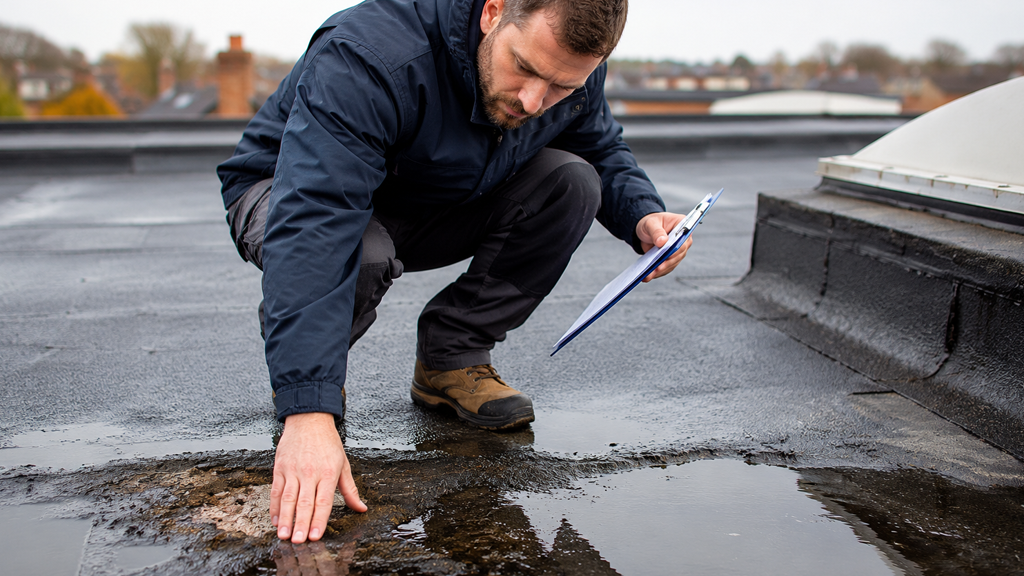
A proper flat roof inspection goes further, but you can still pick up a lot yourself before booking repairs.
Look for these common warning signs:
A felt roof often tells you it’s ageing by surface wear, splits, blisters, or granule loss. EPDM tends to show issues at seams, corners, trims, or around penetrations if the detailing starts to fail. GRP can crack if the substrate moves, or if earlier workmanship wasn’t right around joints and edges.
None of these signs should be ignored just because the room below is still dry.
Water gets into flat roofs through details and weak points more often than through the middle of the field area.
Certain areas deserve extra attention because they fail more often than the open roof surface:
If you can see sagging, widespread standing water, or signs that the roof deck itself may be affected, stop there and arrange a professional inspection. At that point, you’re beyond surface observation and into repair planning.
A flat roof rarely leaks for one simple reason. Most failures come from a combination of age, weather, movement, and drainage. That’s especially true in Berkshire, where a modest extension roof might deal with tree debris in autumn, repeated rain through winter, and hot sun on dark surfaces in summer.
The biggest repeat offender is poor drainage. The Met Office notes that parts of the UK now experience wetter winters and more intense rainfall events than in the past, increasing the likelihood of standing water and leaks on low-slope roofs. On a pitched roof, water sheds fast. On a flat roof, even a minor drainage defect can keep water on the surface long enough to expose every weakness.
That matters because ponding doesn’t just look untidy. It puts extra stress on seams, exposes edges and flashings to longer wet periods, and finds small imperfections you’d never notice in dry weather.
Some of the most frequent causes are straightforward:
Then there’s workmanship. A flat roof can look neat on day one and still be set up to fail if edges, outlets, or upstands weren’t detailed properly. Cheap repairs often repeat the same mistake by treating the visible split and ignoring the reason it opened.
Garage roofs and rear extensions often suffer because they’re out of sight and easy to neglect. They’re also more likely to collect leaves from nearby trees and to have awkward tie-ins where the flat roof meets the main house wall.
A small domestic flat roof gives you less margin for error than many owners realise. One blocked outlet, one poorly bonded patch, or one low corner can keep generating the same leak every time heavy rain comes through.
If a flat roof leaks in the same place after it’s already been repaired, the first question shouldn’t be “what patch was used?” It should be “what’s still causing water to sit or track here?”
That’s the difference between a short-lived fix and a repair that holds.
Not every leaking flat roof needs stripping off. Equally, not every leak should be “sorted” with a quick patch. The right option depends on the membrane type, how localised the defect is, whether moisture has got beneath the surface, and whether the roof is still structurally sound.
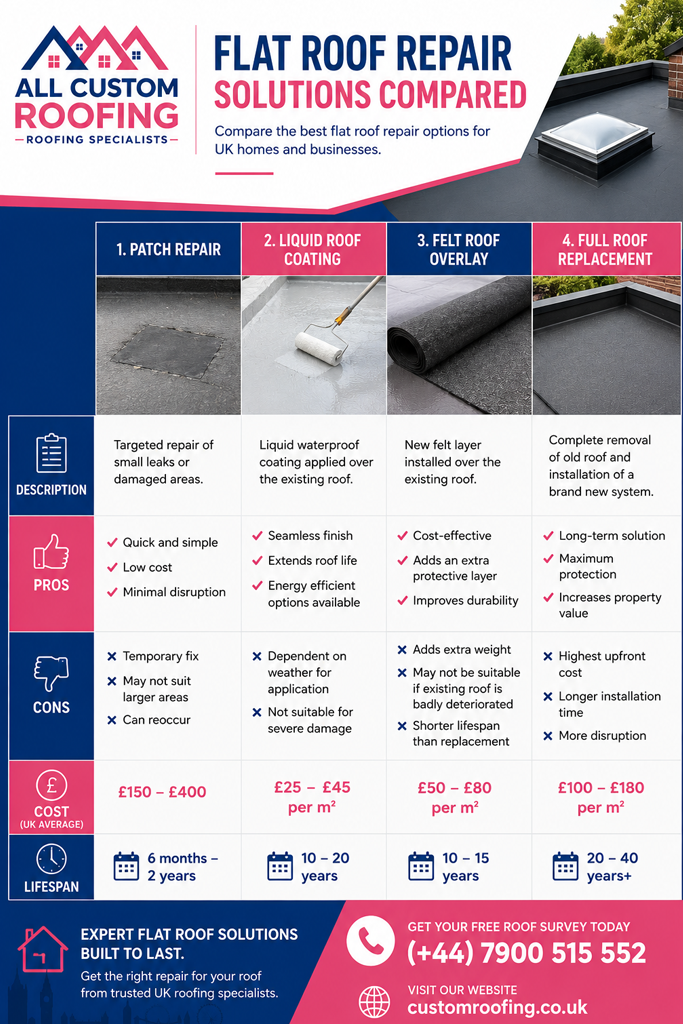
| Repair Type | Best For | Typical Lifespan (UK) | Estimated Cost |
|---|---|---|---|
| Spot patch repair | A single split, puncture, or failed detail on an otherwise sound roof | Varies by roof condition, material, and workmanship | Lower cost than wider repair options |
| Liquid coating overlay | An ageing roof surface where the substrate remains suitable and dry | Can extend service life when correctly specified | Mid-range compared with a small patch or full replacement |
| Partial roof replacement | One section with concentrated failure or wet substrate | Longer-term than repeated patching in the same area | Significant cost, but less than replacing the whole roof |
| Full roof replacement | Widespread failure, saturated roof build-up, or multiple underlying issues | Longest service life of the options listed | Highest cost |
A spot patch repair works when the problem is very local. A puncture under a dropped tool, a split in one flashing corner, or an isolated seam fault can often be repaired successfully if the surrounding roof is still in decent condition.
A liquid coating overlay can make sense where the existing surface is weathered but basically stable. It isn’t a magic fix for wet insulation, trapped moisture, or bad falls. It works best when the preparation is right and the roof beneath is suitable to receive it.
A partial replacement is often the sensible middle ground. If one low area, one edge, or one section around a parapet has failed badly, opening up that area and rebuilding it properly can be far better value than endlessly revisiting it.
A full replacement becomes the practical answer when defects are spread across the roof, previous repairs have piled up, or the substrate below has deteriorated. At that point, patching can cost less today but more overall.
Material choice isn’t interchangeable. UK roofing guidance notes that using the wrong patch or sealant on membranes like felt, EPDM, or PVC can lead to repair failure due to chemical reactions or poor adhesion. In plain English, the repair fails because the products don’t properly bond or don’t move together once the weather changes.
That’s why a contractor should identify the existing roof covering before recommending a repair system. Felt needs one approach. EPDM another. PVC and other single-ply systems have their own rules. One-size-fits-all products are often where repeat leaks begin.
If you want a clearer idea of how different systems behave in the first place, this guide to the best roofing materials for flat roofs is worth reading.
The false economies are predictable:
For local homeowners, one practical option among others is asking a flat roofing contractor such as All Custom Roofing to inspect whether the roof needs patching, recovery, or replacement rather than assuming the cheapest visible fix is the right one.
Cost is usually the question people ask first, but on flat roofs it’s the wrong question to ask in isolation. The better question is: what level of repair does this roof need? A simple patch, a partial strip, and a full rebuild are three very different jobs.
In Berkshire, final cost usually moves based on these factors:
A localised repair can often be handled quickly once the roof is dry enough to work on. A broader repair involving opening up wet areas, replacing sections of deck, or rebuilding details will take longer because the roof needs to be exposed, dried, and reinstated properly.
One UK-facing roofing guide states that removing the old roof material can account for roughly half of the total project cost for a full replacement. That’s one reason homeowners often explore repair or overlay routes first.
The logic is easy to understand. Strip-out means more labour, more waste handling, more disposal, and more time before the new weatherproof layer is fully built back. If the existing roof is dry and structurally sound, a less invasive option can make financial sense. If it isn’t, trying to avoid strip-out can become a very expensive delay.
Rather than chasing broad national averages, it helps to think in bands:
| Scenario | Budget expectation |
|---|---|
| Isolated minor leak repair | Lower-cost end of the scale if the defect is genuinely local |
| Sectional repair with some opening up | Mid-range, especially if decking or edges need attention |
| Overlay or surface recovery | Higher than a simple repair, lower than full replacement when suitable |
| Full strip and replacement | Highest overall cost because labour and removal are substantial |
Ask for a quote that separates the visible repair from any provisional allowance for hidden wet substrate. That keeps the pricing honest.
Timelines also vary with weather. Flat roof repairs need suitable conditions for drying, bonding, and sealing. In Berkshire, rain delays are a practical reality, especially through the colder, wetter part of the year.
Most serious flat roof failures don’t arrive without warning. The warning signs are just easy to miss if nobody looks until water gets indoors. A simple maintenance routine does more good than is generally understood, especially on extensions and garages that collect leaves and debris.
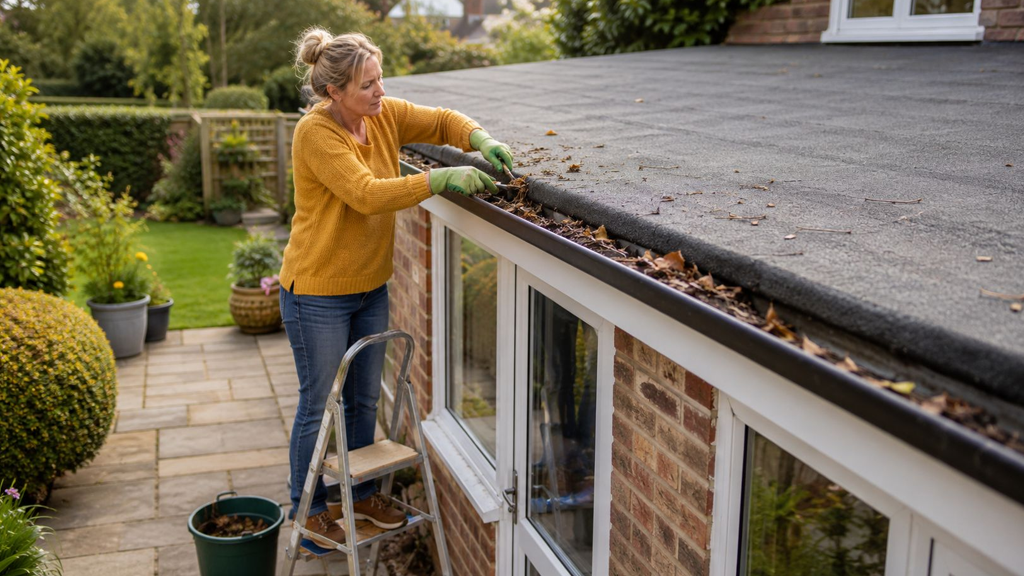
BS 6229:2018 recommends that flat roofs have sufficient fall to prevent water ponding. For most homeowners, the practical takeaway is simple. Keeping drainage outlets clear is the single most effective maintenance task for reducing premature failure.
If the roof was built with workable falls, blocked outlets are often what turn a manageable roof into a leaking one. You can’t easily change the roof geometry yourself, but you can stop leaves and debris from turning every rainfall into standing water.
This doesn’t need to be complicated:
Ground-level and window-level checks are usually enough to spot the obvious. If the roof is high, slippery, or already damaged, don’t risk climbing onto it. A safe visual check done regularly is more useful than one dangerous close-up inspection done once.
A simple notebook or photo record also helps. If a puddle always forms in the same spot, or a parapet detail keeps looking damp after rain, that pattern tells you something. Recurrent wet areas usually mean the cause hasn’t been corrected.
A flat roof that stays dry indoors still deserves inspection. Waiting for a ceiling stain is waiting too long.
The cheapest flat roof repair is usually the one that never becomes urgent. Clearing an outlet, spotting a loose flashing edge, or catching a small split early is far easier than opening up a soaked roof build-up after months of unnoticed ingress.
For landlords and business owners, routine checks also make it easier to separate a minor maintenance issue from a larger capital decision. That helps you plan work properly instead of reacting during the next spell of heavy rain.
Some flat roof issues are suitable for observation and basic maintenance. Others need a roofer straight away. If you can see sagging, persistent ponding, widespread splitting, wet insulation, or repeated leaks after earlier repairs, it’s time to bring in someone who deals with these roofs every week.

A good local roofer doesn’t just point at the damaged area and name a price. They should inspect drainage, identify the existing membrane, check whether water has spread under the surface, and explain whether you’re looking at a patch, a sectional rebuild, or replacement.
Call a professional if any of these apply:
That last point matters more than many owners realise. Approved Document L has tightened requirements for roof thermal performance, so a significant repair or replacement isn’t always just about making the roof watertight again. The build-up may also need to be assessed properly from an energy efficiency point of view.
A useful quotation should make clear:
If a contractor skips those points and jumps straight to a generic “seal it and see” approach, be careful.
For homeowners comparing local firms, details matter off the roof as well as on it. Even something as simple as a clear online portfolio helps you judge whether a company understands domestic roofing presentation and communication.
With flat roof repairs, local knowledge helps. Berkshire homes have recurring patterns. Rear extensions shaded by trees. Garage roofs neglected for years. Dormers and bays with awkward junctions. Small commercial roofs where drainage has been patched but not corrected.
A Windsor-based roofing company should understand those details, the local weather exposure, and the practical realities of access across older terraces, semis, and modern extensions in the area. They should also be able to explain things plainly, without trying to sell a full replacement where a sound repair will do, or pretending a failing roof can be rescued indefinitely with another quick patch.
If your flat roof is leaking, ponding, or showing signs of repeated failure, All Custom Roofing can inspect the roof and advise on the most practical next step for your property. We cover Windsor, Reading, Slough, Bracknell, Maidenhead, and surrounding towns across Berkshire, with clear recommendations, transparent pricing, and repair options that are matched to the condition of the roof rather than guessed from the ceiling stain alone.