
 (+44) 7900 515 552
16 Oct 2026
 insurance backed guaranteeinsurance backed guarantee
A flat roof often looks tidy, modern, and low-maintenance. Then a hard spell of Berkshire rain hits, and you notice a shallow puddle sitting there longer than it should. That’s usually the moment people realise the roof itself isn’t the only issue. The critical question is how water is supposed to leave.
That matters whether you own a rear extension in Windsor, a garage in Slough, a rental in Maidenhead, or a small commercial unit in Reading. Flat roof drainage systems are what stop rain from turning into leaks, stained ceilings, rotten timbers, and repeat repair bills. A roof covering can only do its job properly when the drainage has been planned just as carefully.
A Berkshire cloudburst is often when a flat roof shows what it has really been coping with. Rain falls hard, water begins to gather, and a roof that looked perfectly fine from the ground suddenly has nowhere clear to send it.
A flat roof should never hold water for long. It is built with a slight fall so rain can travel towards an outlet, gutter, or edge detail. If that route is poorly planned, even a sound-looking roof covering is being asked to sit under constant strain. Water stays on the surface, dirt settles, and the roof remains wet for longer than it should.
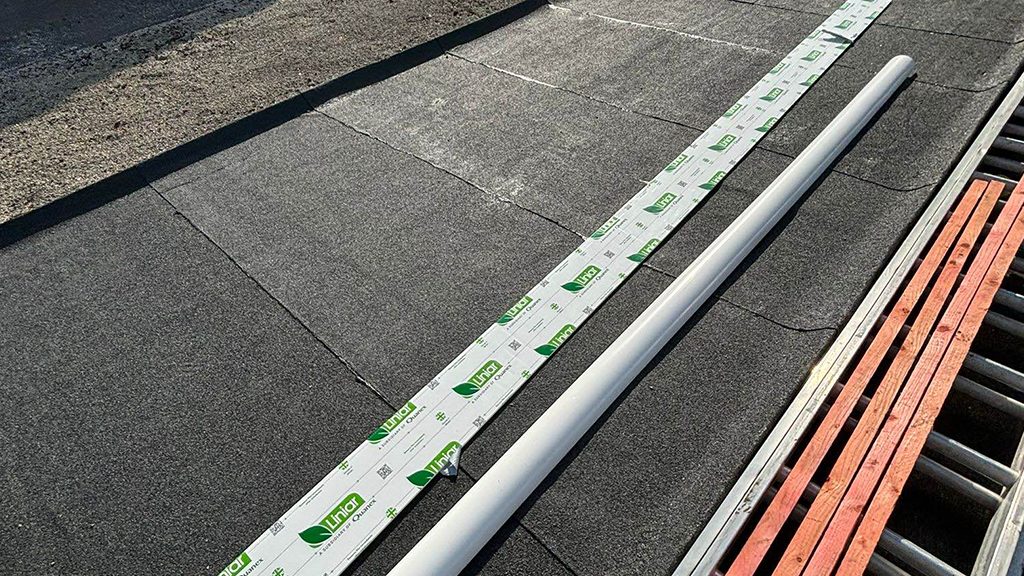
The early warning signs are easy to miss. A shallow puddle that is still there the next day. Water spilling over one corner instead of entering the outlet. Damp marks near the ceiling line. Moss, grime, or leaves collecting in the same area again and again. On many UK homes, especially older extensions and garages, those clues appear well before an actual leak indoors.
Property owners often focus on the visible layer of the roof. Felt, GRP, EPDM, or liquid waterproofing. That makes sense, because it is the part you can see and the part you are usually quoted for first. But the drainage layout decides how much standing water, debris, and weathering that surface has to cope with through the year.
A simple comparison helps here. The roof covering works like a waterproof coat. The drainage strategy is the route the rain takes off the coat instead of pooling in the folds. If the route is wrong, even a good material is under more pressure than necessary.
For domestic properties, the problem is rarely confined to the roof surface alone. The outlet might be clear, but if the gutter below is full of leaves or the downpipe cannot discharge properly, water still backs up onto the roof. That is why it helps to understand the full path from roof to ground. This guide to downpipes and gutters for homeowners explains that wider rainwater route in plain terms.
Practical rule: If water keeps sitting in the same place after rain, treat it as a warning sign and get it checked.
UK weather exposes weak drainage quickly. In Berkshire, roofs often deal with long wet periods, wind-driven rain, falling leaves in autumn, and sudden heavy showers in summer. A flat roof on a Victorian extension in Reading may have very different drainage pressures from a newer garden room in Bracknell or a commercial unit in Slough, but the principle is the same. Water needs a reliable escape route.
Local building style matters too. Many Berkshire properties combine older walls, retrofitted extensions, parapet details, and limited falls that were never ideal to begin with. In those cases, drainage needs to be planned around the building you have, not the neat textbook version shown in generic online advice.
There is also a compliance side. Flat roof drainage should be designed and installed in line with current UK requirements, with proper falls, suitable outlet positions, and a rainwater system that can cope with expected conditions. That is why a drainage strategy is more than adding a drain and hoping for the best. It means matching the roof size, shape, and outlet arrangement to the building and the local weather so you reduce the risk of ponding, leaks, and repeat repair work.
Not every flat roof drains in the same way. A small domestic extension usually doesn’t need the same system as a wide commercial roof. The easiest way to understand the main options is to think about how the water is being moved.
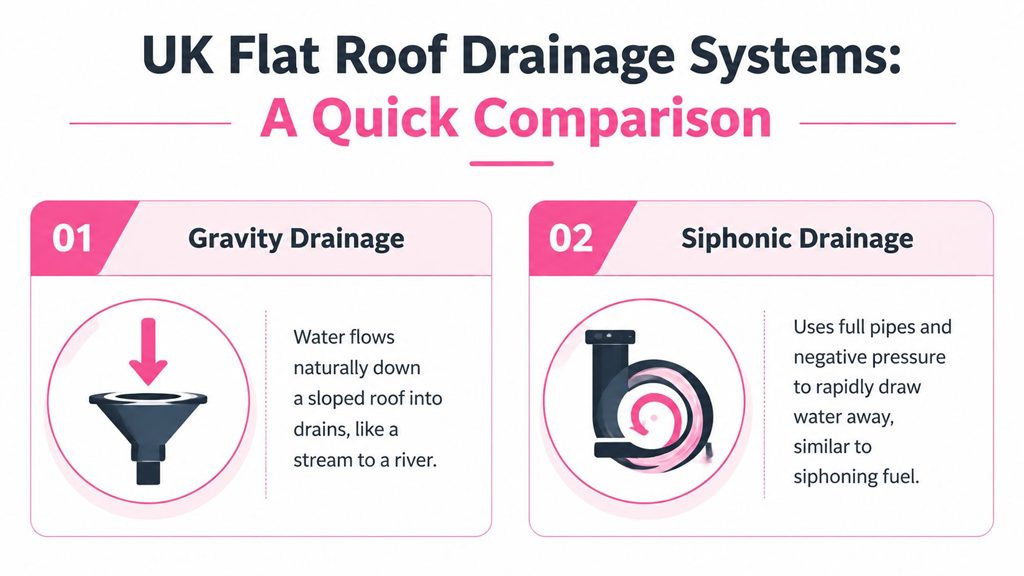
A gravity system is the familiar option. Water flows naturally downhill into roof outlets and then through pipework. It’s much like a standard bath drain. Nothing clever. Just a reliable route that depends on proper falls and correctly sized outlets.
This is common on houses, garages, and many smaller commercial roofs. It’s straightforward to understand and easier for most property owners to picture. But it still needs proper planning. If the roof has poor falls or the outlets are undersized, water won’t clear as intended.
A siphonic system is different. It’s designed so the pipework runs full of water, creating a vacuum effect that pulls rain away much faster than a standard gravity arrangement. This is usually reserved for larger roofs where long pipe runs and high drainage demand make ordinary systems less efficient.
Siphonic flat roof drainage under BS EN 12056-4:2000 can achieve 8-10x higher flow rates than gravity systems, can allow a 50% reduction in pipe sizing, and is used on over 60% of new UK commercial roofs larger than 2000m².
That doesn’t mean it’s automatically better. It means it’s better for the right building. On a domestic extension, it’s often unnecessary. On a larger commercial roof, it can make excellent sense.
Siphonic drainage is a performance system, not a shortcut. It only works properly when the design, outlet choice, and pipe layout are all correct.
For many smaller flat roofs, especially garages, porches, bay tops, and modest extensions, guttering is still a practical answer. Water runs towards the roof edge and drops into a gutter, then into a downpipe. It’s familiar, accessible, and usually easier to inspect than internal roof outlets.
Its weakness is exposure. Leaves, moss, and wind-blown debris can collect quickly, especially where trees overhang the property. That means regular cleaning matters more.
| System Type | Best For | Pros | Cons |
|---|---|---|---|
| Gravity | Homes, extensions, smaller commercial roofs | Simple, well understood, widely used | Needs good falls and careful outlet sizing |
| Siphonic | Large commercial roofs | Very high flow, smaller pipework, allows horizontal runs without slope | More specialised design and installation |
| Guttering | Garages, small domestic flat roofs, edge-draining roofs | Familiar, easy to inspect, practical for smaller roofs | More exposed to blockages and overflow |
If you’re unsure which category your roof falls into, start with a simple question. Is this a compact domestic roof with an obvious edge discharge, or a large roof area where internal drainage and high water volume need more engineering? That usually narrows the options quickly.
Good drainage starts on the drawing, not on the day the outlet is fitted. A flat roof can look tidy when it is finished and still hold water in the wrong places if the falls, outlet position, and waterproofing details were not planned together.
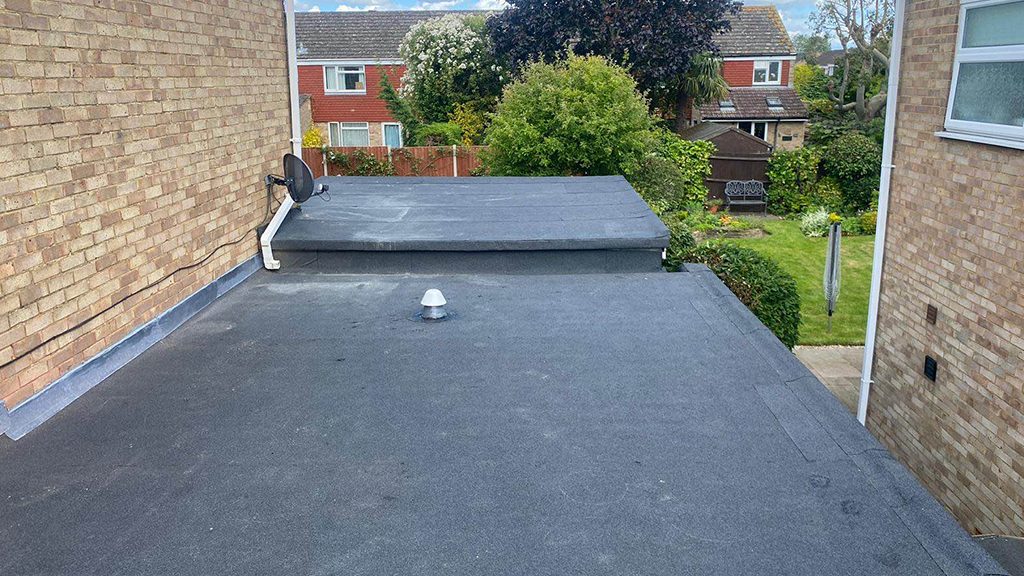
A flat roof is never perfectly flat. It needs a built-in slope, called a fall, so rainwater keeps travelling towards the outlet instead of settling into shallow hollows.
In UK roof design, a minimum 1:80 fall is a common target. That fall may be formed in the deck itself or created with tapered insulation. Either approach can work, but the goal is the same. Give water a clear route off the roof.
This catches many property owners out because the roof often looks level from the garden. That is normal. The slope is slight, rather like a road camber. You do not notice it much until water has to move across it.
Rainfall design is local work, not guesswork. A roof in Berkshire has to cope with the sort of heavy downpours we regularly see across southern England, especially in summer cloudbursts and wet winter spells. A layout that seems fine in light rain can struggle fast if outlet capacity, roof area, and pipe runs have not been matched properly.
That matters on older Berkshire housing stock in particular. Many extensions, garages, and converted outbuildings were added years after the main house was built, and the drainage is sometimes treated as an afterthought. You may have a modern flat roof covering feeding into ageing gutters or undersized pipework. The roof surface might be new, but the drainage route below it can still be the weak point.
Building Regulations also matter here. Part H covers drainage and waste disposal, and flat roof work still needs to discharge water safely away from the building. On a domestic property, that usually means checking more than the roof itself. You also need to know where the water goes after it leaves the roof.
An outlet only works well if it sits at the low point where water naturally gathers. Put it a little too high, or leave a dip elsewhere, and you create a shallow pond that lingers after every shower.
The easiest way to picture this is a kitchen worktop with a slight tilt. If the plug hole is in the wrong spot, a film of water always stays behind. Flat roofs behave the same way, just on a larger scale and with much higher stakes for the building below.
This is why good roofers spend time checking levels before the waterproofing goes down. Small errors at that stage can lead to years of nuisance later.
The roof covering and the drainage detail have to work as one system. An outlet on an EPDM roof is sealed differently from one on GRP or high-performance felt, and each material has its own rules for bonding, trimming, and finishing around the drain.
If you are still weighing up roof coverings, this guide to the best roofing materials for flat roofs will help you compare how different systems perform in practice.
A drain is not just a hole in the roof. It is one of the points most likely to leak if the membrane is cut, dressed, or sealed poorly.
A good contractor should be able to answer these clearly:
These are practical questions, not technical traps. Clear answers usually mean the drainage has been designed properly from the start.
You notice a brown mark on the ceiling after a night of heavy Berkshire rain. The roof did not suddenly fail that evening. In many cases, the warning signs had been there for months. Water sitting too long near an outlet, leaves building up in a hopper head, or a drain detail slowly pulling away from the membrane can all start small and then show up indoors when the weather turns.
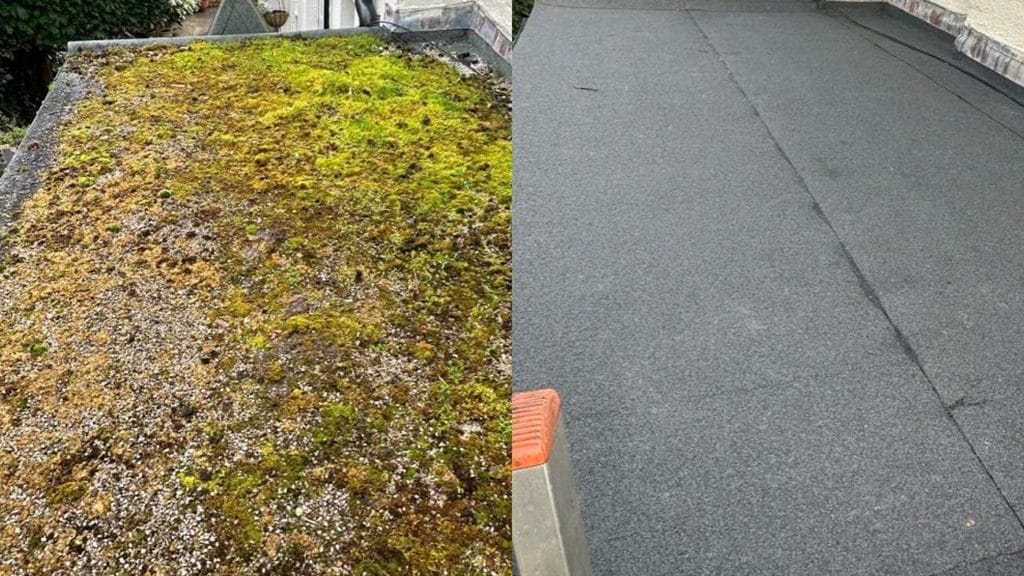
Flat roofs rarely give dramatic early warnings. They usually give quiet ones.
Three problems come up again and again on UK flat roofs.
The first is blockage. Outlets, gutters, and rainwater heads collect leaves, moss, silt, and fragments of old roofing. On Berkshire properties with nearby trees, this is especially common in autumn. Water then slows down, backs up, or spills over the edge instead of leaving through the planned route.
The second is poor falls. The outlet may be clear, but the roof still holds water because the surface does not guide it properly. A flat roof is more like a shallow tray than a pitched roof. If one part of that tray dips too low, water settles there and stays there.
The third is failure at the drainage detail. This is the point where the outlet joins the waterproof layer. If that junction has been cut badly, sealed poorly, or has aged and cracked, it often becomes the first place where water gets below the surface.
You can spot many drainage faults without climbing onto the roof. Others need a closer check by someone who knows what they are looking at.
Common signs include:
If you want a clearer idea of what a professional check involves, this guide to a flat roof inspection explains what should be looked at and why it matters.
One useful explainer on the practical signs of drainage trouble is below.
Poor drainage puts stress on the whole roof, not just the outlet. Standing water adds weight. Repeated wetting around joints shortens the life of seals and laps. In winter, trapped water and debris can worsen minor defects during cold spells, even in areas like Berkshire where severe freezing is less frequent than in colder parts of the UK.
A roof can also be repaired in the wrong place more than once if the underlying issue is drainage. Homeowners often focus on the visible leak indoors, but the cause may be water sitting elsewhere and travelling beneath the covering before it appears inside.
A simple rule helps here. If the same flat roof leaks during heavy rain, or only after several wet days in a row, check how the water is leaving the roof before assuming the membrane itself is the only problem.
Good drainage design does a lot of the heavy lifting. Regular maintenance keeps it working. In the UK, where leaf fall, frost, wind-driven rain, and moss are all part of normal roof life, a simple routine prevents many avoidable repairs.
Autumn is the season when many flat roof drainage systems start struggling. Leaves collect around outlets, gutters fill faster than expected, and damp debris turns into a compact blockage.
Use this time of year for practical checks:
In winter, frozen debris can make a minor blockage worse. Snow and ice aren’t everyday Berkshire problems, but cold snaps can still slow drainage around outlets and gullies.
Spring is a good time to inspect for damage left behind by wet weather. Summer is when sun exposure can harden or fatigue some details, especially around trims and outlet seals.
A sensible seasonal routine includes:
Spring clean-up
Remove leftover debris, especially around corners, edge gutters, and rainwater heads.
Membrane check
Look for splits, lifted edges, or wear around drainage points.
Water test after rainfall
Watch how the roof drains during or just after rain if it’s safe to do so.
Surface condition review
Note blisters, soft spots, or areas that hold dirt and remain damp.
Small maintenance jobs are cheap because they happen early. Roof failures get expensive when water has had time to travel.
Some tasks are fine for a careful property owner. Clearing visible leaves from an accessible gutter is one thing. Lifting edge details, probing suspected leaks, or walking on a fragile roof covering is another.
Call for professional help when you notice repeated ponding, recurring blockages, movement in the roof deck, or staining inside the building. Maintenance works best when it stays preventative. Once symptoms are repeating, the roof usually needs diagnosis, not just cleaning.
A common Berkshire scenario goes like this. An extension roof has leaked on and off for years, the outlet has been changed once or twice, and water still sits in the same place after heavy rain. The reason is usually simple. The roof is draining exactly as it was built to drain, and the original layout was never good enough for the way the roof is used now.
Older flat roofs often develop drainage problems after years of patch repairs, extra insulation, replacement coverings, or slight movement in the structure. A new outlet on its own rarely changes the overall path water takes across the roof. If the falls are poor, the details are inconsistent, or the gutter capacity is wrong, the same trouble returns.
A retrofit means improving drainage on an existing roof rather than designing a new roof from scratch. That might include forming new falls with tapered insulation, relocating outlets, altering edge gutters, or changing how the roof connects to the rainwater system below.
For UK properties, the benchmark is not guesswork or rule of thumb. The government’s approved guidance for moisture in buildings is set out in Approved Document C, and flat roofs are generally designed to finished falls that account for construction tolerances so water can drain properly in service. In plain terms, a roof that looks almost level on paper can end up holding water once it is built. That is why retrofit design matters so much on older homes and extensions around Windsor, Maidenhead, and Reading, where roof build-ups have often been altered more than once.
The easiest way to picture it is a kitchen worktop with a slight dip. You can wipe water toward the sink, but some still sits in the hollow. A flat roof behaves the same way. If the shape is wrong, replacing one component does not remove the hollow.
A drainage upgrade usually makes sense when the roof covering still has useful life left, but the way water leaves the roof is poor. Correcting falls and improving outlets can reduce recurring leaks and help the existing system last longer.
A full re-roof is often the better option when:
There is also a point where roof drainage and below-ground drainage overlap. If the roof is shedding water correctly but gullies, hoppers, or buried pipework cannot carry it away, the problem shifts from roofing to drainage infrastructure. Emergency drain repairs highlight the kind of drainage fault that may need separate specialist attention.
Costs vary with scope, not just roof size. Access, insulation changes, outlet positions, parapet details, and any need to alter internal pipework all affect the final figure. A straightforward job might involve adjusting local details around an outlet. A larger upgrade can mean rebuilding the falls across the whole roof and tying new waterproofing into trims, flashings, and rainwater goods.
Property owners frequently save or lose money concerning their flat roof drainage systems. Spending a little on a proper survey and drainage design at the start can prevent repeated call-outs for the same low spot.
The practical question is whether the upgrade fixes the cause. If water ponds because the roof shape is wrong, the lasting repair is to correct the falls. If the issue is a badly placed outlet, the answer may be relocation and re-detailing. Resealing the same area again and again usually costs more over time, especially in Berkshire winters when standing water, frost, and leaf build-up put extra stress on weak points.
Some drainage issues can wait for a routine inspection. Others shouldn’t. If water sits on the roof long after rain, if you’ve got visible damage around outlets, if blockages keep returning, or if you’re planning a new flat roof extension, professional advice is the sensible move.
Flat roof drainage systems look simple from the outside, but performance depends on falls, outlet sizing, detailing, and how the whole roof ties into the rainwater system. That’s why repeat leaks often trace back to design rather than just wear and tear.
If the problem extends beyond the roof itself, specialist drainage support can help too.
For roof drainage concerns in Berkshire, local knowledge matters. Different building types, extension styles, and weather exposure all affect the right solution.
If you need help with flat roof drainage, leaks, repairs, or a full roof assessment, contact All Custom Roofing in Windsor for expert support across Berkshire. We cover Windsor, Reading, Slough, Bracknell, Maidenhead, and surrounding towns, with practical advice, clear pricing, and reliable roofing work designed for UK properties.