 (+44) 7900 515 552
23 Oct 2026
 insurance backed guaranteeinsurance backed guarantee
If you’re looking up tiled roofs construction, there’s a good chance you’re standing in the garden, spotting slipped tiles from below, or weighing up whether a full reroof is worth doing properly. That’s a familiar position for homeowners across Windsor, Reading, Maidenhead and the wider Berkshire area. The roof still looks passable from the street, but you know it’s reaching the stage where patching one area only reveals the next weak point.
A tiled roof is still one of the most dependable choices for UK homes. It suits everything from Victorian terraces and 1930s semis to newer detached houses, and it handles our mix of rain, frost, moss and wind better than many people realise. But a good tiled roof isn’t just about picking a nice profile and colour. The result depends on structure, underlay, battens, fixings, ventilation, flashing and workmanship all working together as one system.
A reroof starts long before the first tile comes off. The first question is whether you’re replacing like for like or changing the roof covering altogether. That matters because the tile choice affects appearance, weight, detailing and the amount of supporting work needed underneath.
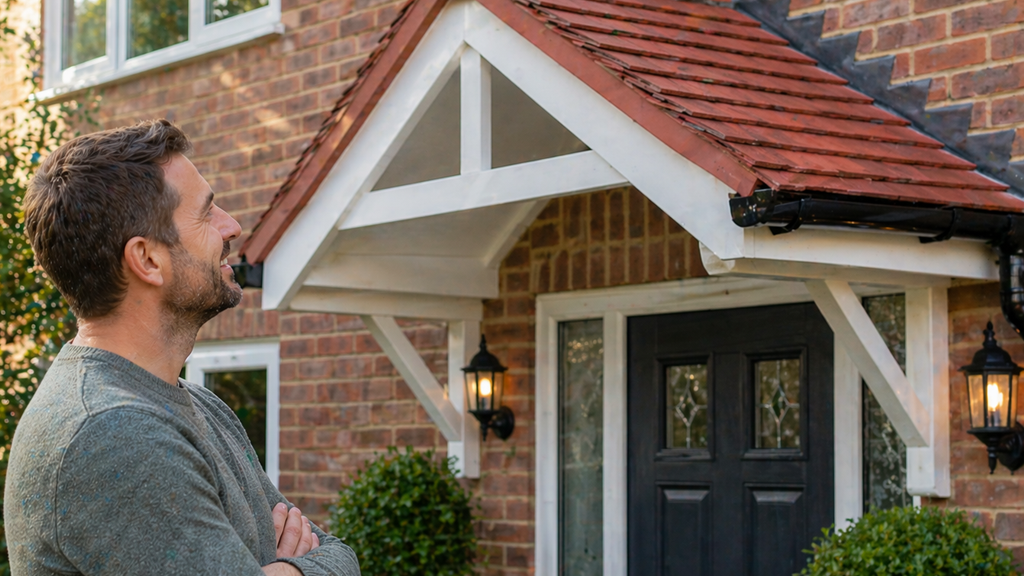
In Berkshire, the surrounding properties often tell you a lot about what will look right. Red clay can suit older streets in Windsor and village settings very well. Concrete tends to fit post-war and modern estates more naturally. The point isn’t to copy the neighbours blindly. It’s to make sure the new roof feels correct on the building.
A proper plan looks at:
Practical rule: The best time to correct hidden roofing faults is while the covering is off. Leaving old weak points in place under new tiles is false economy.
Tiles have deep roots in British building. In the 12th century, after repeated fires in London, King John ordered flammable thatch and reed roofs to be replaced with clay tiles, a move that helped shape roofing practice across England. That long history is one reason tile still feels right on so many Berkshire homes.
The tile you choose affects more than kerb appeal. It changes the roof’s weight, the installation method, the cost profile and how the finished job sits on the house. Most homeowners narrow the choice down to clay, concrete, or a slate-look tile used where the aim is a flatter, neater appearance.
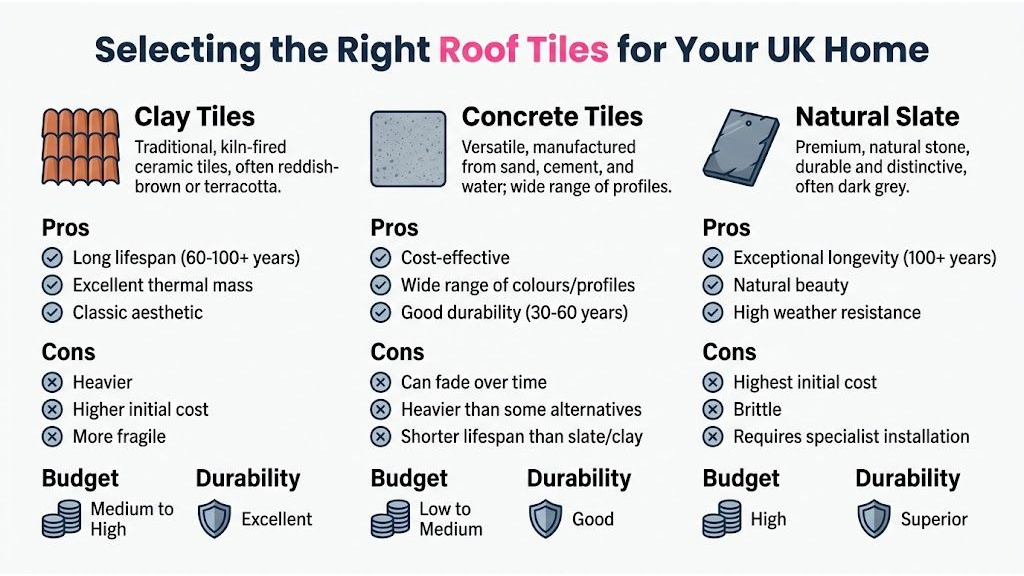
Clay has the traditional look many people want, especially on older properties. It weathers attractively, carries genuine character and doesn’t look out of place on heritage-style homes. High-quality clay tile roofs in the UK can last 100+ years when correctly installed and maintained.
That lifespan is a real strength, but clay isn’t the automatic answer for every house. It’s usually the premium choice and can be more vulnerable to breakage during handling if the roof traffic isn’t controlled carefully.
Concrete is popular for a reason. It gives homeowners a broad choice of profiles and colours, usually at a more approachable upfront cost than clay. It also suits a large share of Berkshire housing stock, especially suburban semis and detached homes built in the post-war period onward.
Where concrete works well, it gives a tidy, durable roof without pushing the budget as hard as clay or natural slate. Where it works less well is on homes that need a softer, more timeworn character. A sharp modern concrete profile can look too harsh on some period buildings.
This category appeals to homeowners who like the cleaner lines associated with slate but don’t want the same look-and-feel issues or higher-end spend of natural stone. In practice, these products can be a sensible middle ground for extensions, refurbishments and houses where a flatter roof finish is the goal.
The key is visual honesty. A slate-effect tile should suit the elevation and neighbouring roofs. If the house wants depth and texture, a very flat profile can look slightly forced.
| Tile Type | Average Lifespan | Typical Cost | Weight | Best For |
|---|---|---|---|---|
| Clay | 100+ years when correctly installed and maintained | Higher upfront cost | Heavy | Period homes, character properties, premium reroofs |
| Concrete | Long-lasting in practice, but generally seen as a shorter-life option than clay | More budget-friendly upfront | Heavy | Modern homes, post-war properties, cost-conscious reroofs |
| Slate-effect tiles | Varies by product and system | Mid-range to higher depending on specification | Varies | Homeowners wanting a flatter, neater appearance |
Rather than ask which tile is best overall, ask which tile is best for your house.
A sample board helps more than any brochure. Roof colour shifts in daylight, and the same tile can look different on a shaded Windsor street than it does on an open Bracknell plot. For a useful primer on matching products to property style, this guide on choosing the best materials for your new roofing project is worth a read.
Many homeowners focus on the visible roof covering and miss the more important question underneath. Can the existing roof structure safely carry the proposed tiles? On an older house, that’s never something to assume.
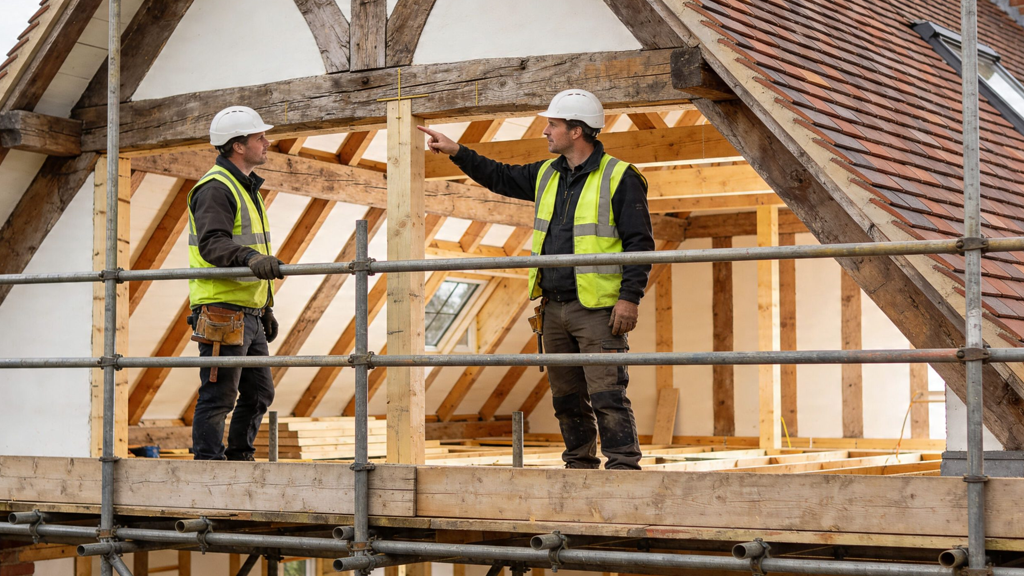
Victorian terraces, Edwardian homes, 1970s builds and later trussed roofs all behave differently. Some are perfectly capable of taking a tiled finish. Others need a closer look at rafters, purlins, bracing and bearing points before anyone commits to a heavier covering.
A proper structural review usually looks at the condition and layout of:
The difficult part for homeowners is that there’s a recognised information gap here. There’s very little UK-specific public guidance on structural reinforcement costs for older homes, even though this is an important issue for Windsor and Berkshire properties. In practical terms, that means you shouldn’t trust blanket pricing until the roof has been assessed properly.
The roof covering is only as reliable as the frame carrying it. If the structure is marginal, the smartest decision is to find out early, not after the tiles arrive.
Sometimes the answer is simple. The structure is sound, and the project can proceed with standard preparation. Other times, a roofer may flag the need for structural input before the reroof goes further.
Possible measures can include:
Most failures in tiled roofs construction don’t start with the tile itself. They start in the layers beneath it. A modern tiled roof depends on three hidden systems doing their job together. Underlay, insulation and ventilation are what keep the inside of the roof dry, stable and efficient.
The underlay sits below the tiles and acts as the roof’s secondary weather defence. On older roofs, you often find tired bitumen felt that has become brittle, torn or badly draped. Once it reaches that state, wind-driven rain and condensation have an easier route into the structure.
For roofs in moderate exposure zones like Windsor, UK Building Regulations Part C require high-performance underlays, and evidence shows that without them, plus proper ventilation using counter-battens, the risk of interstitial condensation and timber decay rises significantly according to BRE guidance on moisture risk in roof systems. That’s why underlay shouldn’t be treated as a hidden extra. It’s one of the main protective layers.
Insulation isn’t just an energy topic. It changes how the roof behaves. Warm air from the house rises, and if the roof build-up is poorly detailed, that heat can meet colder surfaces in the loft or rafter zone and create condensation.
Good roof insulation needs to be considered alongside ventilation and the rest of the build-up. Fitting one without the other can create as many issues as it solves.
A sound approach usually includes:
Ventilation is where many roofs fail unobserved. The tiles may look fine from outside, but stale, trapped moisture in the void can affect battens, rafters and insulation performance over time.
Counter-battens matter here because they create a ventilated path beneath the covering. On a well-built roof, that airflow helps moisture escape instead of lingering in the structure.
Site advice: If a roof has repeated mould, musty loft smells or damp staining under the covering, the problem often isn’t the tile. It’s the lack of balanced ventilation and moisture control.
Clay tiles also need to cope with British winters. BRE-backed guidance notes that for clay products, freeze-thaw cycle compliance is critical, especially in places like Berkshire that can see 40-60 annual freeze events through the year, making tile quality and specification important in real-world conditions on local homes.
For a broader look at how membranes, ventilation and finishes work together, this article on complete roof systems is a useful companion read.
Once the structure is confirmed and the hidden layers are in place, the roof can be built out properly. This is the stage commonly pictured when considering tiled roofs construction, but it only works if every line, gauge and fixing is set out accurately from the start.
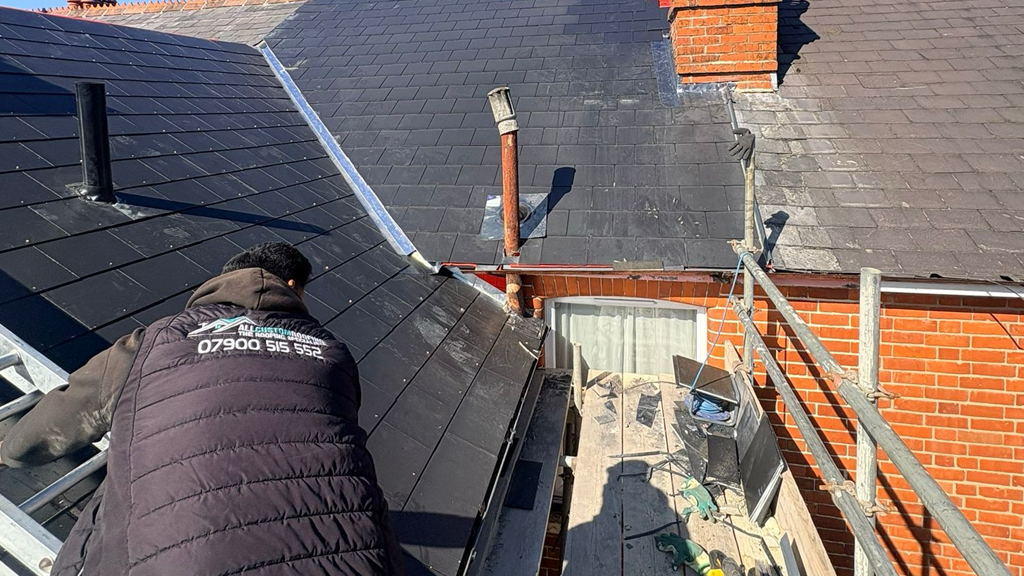
Battens are fixed horizontally across the roof and create the fixing lines for the tiles. Their spacing isn’t guessed. It has to match the tile type, headlap requirements and roof geometry so the courses run true from eaves to ridge.
If the gauge is wrong, the roof can look uneven and perform poorly. You may end up with inconsistent overlaps, awkward cuts near the ridge, or unnecessary stress on individual tiles.
A careful installer pays close attention to:
Older roofs sometimes relied too heavily on the tile’s own hanging position. That isn’t enough by modern standards. BS 5534 requires specific fixing patterns to resist wind uplift, and in parts of Berkshire, double nailing with corrosion-resistant nails can reduce the risk of tile detachment by up to 65% in severe gusts, as outlined in the NFRC’s guide to BS 5534 and wind loading.
The same standard also sets minimum strength expectations for tiles so they can cope with maintenance foot traffic and snow loading. That matters on real roofs. Soffit corners, verges, ridges and exposed slopes are where weak fixing choices usually show up first.
A tidy-looking roof isn’t always a secure roof. The fixing pattern is what decides how it behaves in hard weather.
Here’s a useful visual reference on installation methods and sequencing:
The final layer of craftsmanship shows at every interruption in the roof line. Chimneys, abutments, valleys, rooflights and wall junctions are where water tries to get in. If the flashing work is poor, even expensive tiles won’t save the roof.
Common weak spots include:
This is why experienced roofers spend so much time on the details. The broad slopes are usually straightforward. The junctions decide whether the roof stays watertight.
The price of a reroof is never just the tile cost multiplied by the roof area. That shortcut leaves out the practical parts that often shape the final figure, such as scaffolding, strip-off, waste removal, timber repairs, leadwork and access difficulty. On one property, the roof is a simple rectangle. On the next, it has valleys, dormers, awkward side returns and limited access for materials.
The big pricing drivers are usually these:
A useful way to avoid false comparisons is to ask each contractor what is included, not just what the bottom line says. One quote may allow for new underlay, battens, lead details and disposal. Another may look cheaper because key elements are excluded or vaguely described.
Most homeowners want one answer to the question, “How long will it take?” The honest answer is that the sequence matters more than any blanket promise. A typical reroof involves scaffold erection, removal of the old covering, inspection of the exposed structure, installation of the new roof build-up, tiling, finishing details, then site clearance.
Weather can interrupt the programme. So can hidden defects uncovered once the roof is stripped. A simple house with clear access will move faster than a larger property with multiple roof sections and more junction work.
A sensible contractor should be able to explain:
One of the biggest gaps in roofing advice is that many sources stop at a square metre price. They don’t deal properly with total cost of ownership, even though that’s the right way to compare a tiled roof with shorter-lived alternatives. A proper comparison should include maintenance patterns in the UK climate, energy performance for British homes, and possible effect on resale appeal.
That’s why the cheapest quote isn’t always the most economical roof. A well-built tiled system often costs more to install than a lightweight short-life alternative, but it can make far more sense over the years if it needs fewer major interventions.
Budget mindset: Price the roof you want to live with, not just the roof you can install fastest.
If you’re comparing proposals, this guide on the factors that influence new roof costs can help you ask sharper questions. If spreading the spend matters, some roofing firms also offer finance through regulated partners, subject to status, which can make a full reroof easier to manage than repeated repair cycles.
A Berkshire homeowner usually notices roof trouble too late. A damp patch appears after a week of rain, a few bits of mortar show up in the gutter, or a tile slips on the rear slope where nobody looks from the driveway. By that point, the repair is often bigger than it needed to be. Tiled roofs reward steady care, and they punish neglect slowly, then all at once.
In this part of the county, the usual enemies are predictable. Wind-driven rain, winter frost, moss on shaded north-facing slopes, and leaf build-up from mature trees all shorten the life of a roof if small defects are left alone. The roof covering may be tile, but the whole system matters, including ridges, flashings, fixings, underlay, ventilation and drainage paths.
A tiled roof does not need constant interference. It does need regular checks from the ground and a proper inspection when warning signs appear. On older properties around Windsor, Maidenhead and the Berkshire villages, I often find that the main problem is not failed tiles. It is blocked gutters, slipping ridge tiles, or flashings that have started to lift.
Useful maintenance usually includes:
Clay and concrete tiles can both give long service in the UK if the roof was built properly in the first place and repairs are done promptly. The larger point for homeowners is simple. Lifespan depends less on brochure claims and more on workmanship, exposure, and whether defects are picked up early.
Some faults look minor from the garden and are not minor at roof level.
One slipped tile near a valley or abutment can direct water onto battens and underlay instead of into the guttering system. A loose ridge might point to wider failure in the ridge line. Damp in the loft can come from failed flashings, condensation, blocked ventilation paths, or water entering higher up and travelling before it shows.
Call a roofer if you notice any of the following:
On Berkshire homes, especially 1930s semis, Victorian terraces and detached houses with later extensions, junction details are often where trouble starts. That is also where a quick patch can become false economy.
The right contractor should understand more than just tile replacement. They should understand the roof as a system and be able to explain how the work will comply with current UK practice, including BS 5534 for slating and tiling. That matters because fixing methods, batten specification, mechanical restraint and exposure all affect whether the roof performs properly in local wind and weather conditions.
A good quote should tell you, in plain English, what is being removed, what is being replaced, what is being retained, and what happens if hidden defects are found once the covering is stripped. If that information is vague, expect problems later.
Use this checklist:
The best roofing projects usually start with a careful survey and a detailed quotation, not pressure.
If your home is listed, sits in a conservation area, or you are changing the appearance of the roof, check planning and local authority requirements before work begins. A contractor who knows Windsor and the surrounding Berkshire area should raise that point early, especially on period properties where tile type, profile and colour can affect approval.
If you’re planning a reroof, repair, or need practical advice on tiled roofs construction, All Custom Roofing can help. Based in Windsor, we cover Berkshire and surrounding towns including Reading, Slough, Bracknell, Maidenhead and nearby areas, with expert support for new tiled roofs, reroofing, repairs and maintenance. Contact All Custom Roofing in Windsor for a no-obligation quote and clear advice on the right roof for your property.