 (+44) 7900 515 552
16 Oct 2026
 insurance backed guaranteeinsurance backed guarantee
A lot of Berkshire business owners only look up at the roof when there’s a problem. A ceiling tile stains in Slough. A warehouse unit in Bracknell starts losing heat. Rain gets behind tired cladding on a small industrial block near Maidenhead. By then, what should have been a manageable job often turns into an urgent one.
That’s why commercial roofing and cladding need a practical approach, not guesswork. You don’t need a lecture in building science. You need to know what system suits your building, what tends to fail in local conditions, what a proper installation looks like, and how to avoid paying twice for the same problem.
In Windsor and the surrounding towns, the challenges are usually straightforward. Flat roofs deal with standing water, old detailing, split membranes, failed flashings, and neglected outlets. Cladding problems often start around joints, trims, fixings, and insulation gaps. Add rain, wind, frost, and the usual pressure to keep your premises open, and every decision has to balance cost, disruption, and service life.
If you own a shop, office, workshop, nursery, café, or light industrial unit, your roof and cladding do more than keep the rain out. They protect stock, electrics, ceilings, insulation, internal finishes, and day-to-day trading.
The trouble is that many defects stay hidden for too long. A small split in a flat roof covering can let in water for months before it appears indoors. Loose edge trims or open cladding joints can let wind-driven rain track behind panels without any obvious sign from ground level.
Most commercial clients call after one of these issues appears:
A roof doesn’t need to be collapsing to be a problem. It only needs to be underperforming.
Practical rule: If a commercial roof has already needed multiple patch repairs in the same area, the issue is usually no longer “just a repair”.
A good decision comes down to a few basics.
First, identify the roof type and wall build-up properly. Many owners are quoted for systems they don’t fully understand. Second, separate cosmetic wear from structural or weatherproofing problems. Third, compare the whole-life value of each option, not just the cheapest line on the quote.
That matters even more with commercial roofing and cladding because access, safety set-up, and disruption often cost almost as much as the material choice itself. If you have to revisit the same roof too soon, the saving disappears.
For most small businesses in Berkshire, the right answer isn’t the fanciest system. It’s the one that suits the building, handles local weather well, and can be maintained without constant disruption.
Commercial buildings around Windsor, Reading, Slough, and Bracknell tend to fall into a few familiar categories. You’ll usually see flat roofs on retail units, schools, offices, and light industrial buildings. Cladding is common on warehouses, trade counters, workshops, and mixed-use commercial blocks.
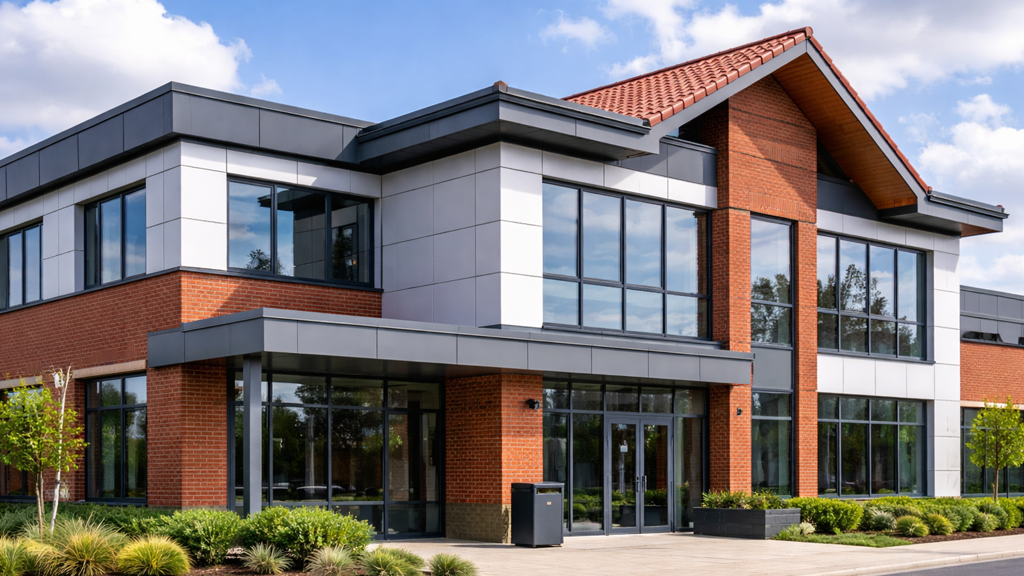
The best system depends on the deck beneath, the building use, the insulation target, the amount of rooftop plant, and how easy future repairs need to be. Cost matters too. Recent UK market analysis puts average upgrade costs for commercial flat roofs at around £50 to £100 per square metre (UK market analysis on commercial flat roof upgrade costs).
Three systems come up again and again on light commercial properties.
| System | Where it suits | What works well | What to watch |
|---|---|---|---|
| Single-ply membrane | Larger flat roofs, cleaner layouts, newer refurbishments | Lightweight, tidy finish, efficient on broad areas | Detailing and seam quality matter a lot |
| Built-up felt | Smaller commercial roofs, patch-heavy refurbishments, older buildings | Familiar system, practical for phased repairs | Can become patchwork if maintained poorly |
| Liquid-applied systems | Refurbishment work with awkward details and penetrations | Useful where full strip-off isn’t ideal | Surface prep has to be right |
Single-ply membranes such as PVC or TPO are often chosen where owners want a modern, neat finish on a broad flat roof. They’re especially useful on warehouse and office roofs with simpler shapes. If the substrate is sound and the detailing is done properly, they can be a very clean solution.
Built-up felt is still common across Berkshire because many older commercial roofs already use it. That can make localised repairs easier in the short term. The downside is that some felt roofs end up with years of patching over patching. At that point, the roof becomes harder to trust because the weak points are spread everywhere.
Liquid-applied systems are useful where penetrations, upstands, awkward junctions, or access limits make sheet systems less practical. They’re often chosen as part of refurbishment rather than full replacement.
For a closer look at low-slope systems and where they fit, this guide on commercial flat roof options is a useful starting point.
Commercial cladding is not one single product. In practice, most owners compare metal profile sheets with insulated composite or architectural wall panels.
Profile sheeting is common on industrial units and trade premises. It’s practical, familiar, and often cost-conscious. If the existing frame and rails are suitable, it can be an efficient way to restore weather protection. It usually makes most sense where appearance is secondary to durability and function.
Insulated panels do more at once. They provide outer finish, insulation, and internal lining in one system. On offices, refurbished mixed-use units, and smartened-up industrial premises, they often give a better overall result because thermal performance and appearance both improve.
If a building feels cold around perimeter walls and roof junctions, cladding design is often part of the problem, not just the roof covering.
There isn’t a universal winner. There is only a system that matches the building.
The wrong comparison usually starts with price alone.
Owners sometimes compare a basic overlay quote against a full strip, insulation upgrade, and detailed perimeter works as if they are equal options. They are not. One may buy time. The other may reset the roof properly.
Another common mistake is overlooking maintenance access. A roof with lots of vents, condensers, ductwork, and skylights needs a system that can be detailed and serviced well. Neat-looking product brochures don’t tell you how a roof behaves after years of foot traffic from other trades.
In commercial roofing and cladding, the parts that fail first are often the small ones. Joints, outlets, penetrations, flashings, trims, and terminations decide whether the whole system earns its keep.
A commercial roof doesn’t have to look impressive from ground level. It has to perform in British weather, week after week, with as little drama as possible.
In Berkshire, that means handling prolonged rain, cold snaps, wind uplift, blocked gutters, moss build-up in neglected areas, and the wear that comes from service traffic. The strongest-looking roof on paper can still fail early if the drainage is poor or the detailing is weak.
Most flat roof failures are not caused by the main field of the roof. They start at edges, joints, outlets, penetrations, or standing water.
The drainage side matters more now because the weather is harder on roofs than it used to be. The Met Office forecasts a 22% increase in extreme weather events for South East England, and inadequate drainage is linked to a 28% spike in storm-related insurance claims, which is why roof drainage designed to BS EN 12056-3 for 1-in-100-year events deserves serious attention.
That affects real choices on site:
A commercial roof is also part of your insulation line. If the roof build-up is weak, the building feels it. Staff notice cold areas. Condensation risk rises. Heating systems work harder.
This is why many owners now look at the roof and cladding together rather than as separate jobs. A better-insulated envelope can improve comfort and reduce waste, but only if the insulation layer is continuous and the junctions are properly thought through.
If you’re considering panels or future renewables, it also helps to understand roof suitability for solar installations before the roofing work starts. The roof covering, loading, penetrations, and long-term access all affect what’s sensible later.
For buildings using panel systems, this overview of composite panel roofing helps explain where these assemblies make practical sense.
Durability sounds like a material question, but on commercial roofs it’s usually a workmanship question first.
A long-lasting roof depends on the details that don’t stand out from the ground:
A roof can be made from good materials and still fail early if people rush the detailing.
You should expect a roof and cladding system to do three things well at the same time.
One, keep water out reliably in heavy rain and wind. Two, hold stable thermal performance across the build-up rather than just in isolated areas. Three, remain serviceable when electricians, HVAC engineers, telecoms installers, and maintenance staff will need access.
That last point gets missed. Roofs are not museum pieces. On commercial premises, other trades will be on them. A sensible specification accounts for that.
When an owner asks whether a roof is “good”, the practical answer is simple. It should shed water properly, keep the building comfortable, and tolerate real-world use without becoming a recurring repair bill.
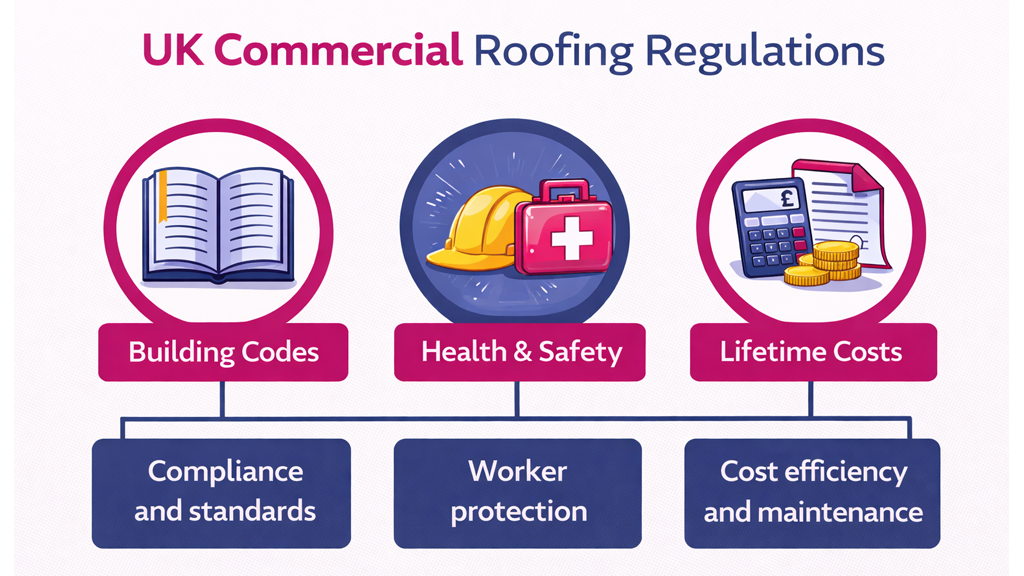
A shop owner in Windsor gets two reroofing prices. One looks pleasantly low. Six months later, the true costs start showing up in extra insulation work, revised edge details, waste removal, access equipment, and a Building Control query about thermal upgrades. That is common on commercial jobs. The first number is not always the job cost.
For small business owners and landlords, the difficulty is rarely the roof covering alone. It is working out what the building needs, what the regulations trigger, and what can be afforded without storing up trouble for later. In Berkshire, that often means dealing with older units, mixed-use premises, tight access, and patch-repaired roofs that have already had one too many temporary fixes.
Part L matters because roof replacement work can trigger thermal upgrade requirements. If a significant portion of the roof is being refurbished, insulation levels and overall build-up stop being optional design choices and start becoming part of compliance. The official guidance sits within the UK government’s Approved Document L for buildings other than dwellings.
On a real project, that changes the conversation early. A landlord may ask for a simple recover or sheet replacement. Once the existing build-up is opened up, it may become clear that the insulation is poor, the falls are inadequate, or the deck condition makes a like-for-like shortcut a false economy.
Post-Brexit labour pressure has added another layer. Good installers are harder to book at short notice, and programme delays cost money if your tenant, staff, or customers are working below the affected area. That is one reason a clear scope at tender stage matters more now than it did a few years ago.
Commercial roofing should be priced over the period you expect it to serve, not only by the invoice total this quarter.
| Approach | Short-term result | Long-term effect |
|---|---|---|
| Minimal overlay | Lower immediate spend, quicker mobilisation | Older defects can remain buried, and future repairs become harder to isolate |
| Planned refurbishment | Higher initial cost and more design work | Better thermal performance, cleaner detailing, and fewer avoidable call-backs |
| Phased upgrade | Costs spread over time | Practical for occupied sites, but only if each phase leaves the building properly weathered and compliant |
A phased route often makes sense for smaller commercial properties. Deal with the worst elevation or roof zone first, then schedule the next area around cash flow, lease events, or quieter trading periods. It only works if the sequence is planned properly. Random patching across different years usually costs more.
The headline figure on the quote is only one part of the decision. The rest sits in the operational impact of the work and the quality of what gets left behind.
A new outer layer on top of weak details is still a weak roof.
The better jobs are usually the ones where the owner asks a few direct questions before signing anything:
That last question matters. A lower quote can still be the right choice if the building is due for redevelopment, the lease term is short, or the roof only needs to last for a defined period. If you expect to hold the property and keep trading from it, better detailing and better insulation usually pay for themselves in fewer interruptions and a steadier building.
Finance can also be part of the decision where delay is likely to make the defect worse. Some contractors and FCA-regulated finance partners can help spread the cost of major works. Used properly, that is not about buying extras. It is about carrying out the right scope before water ingress, heat loss, or recurring repairs turn a manageable project into a disruptive one.
For most Berkshire owners, the sensible target is straightforward. Choose a roof or cladding upgrade that meets the rules, suits the building, and stays out of your way for years rather than months.
A commercial reroofing or recladding job doesn’t need to feel chaotic. When the site is organised well, you should know what’s happening, when access changes, which parts of the building are affected, and what the finished standard will be.
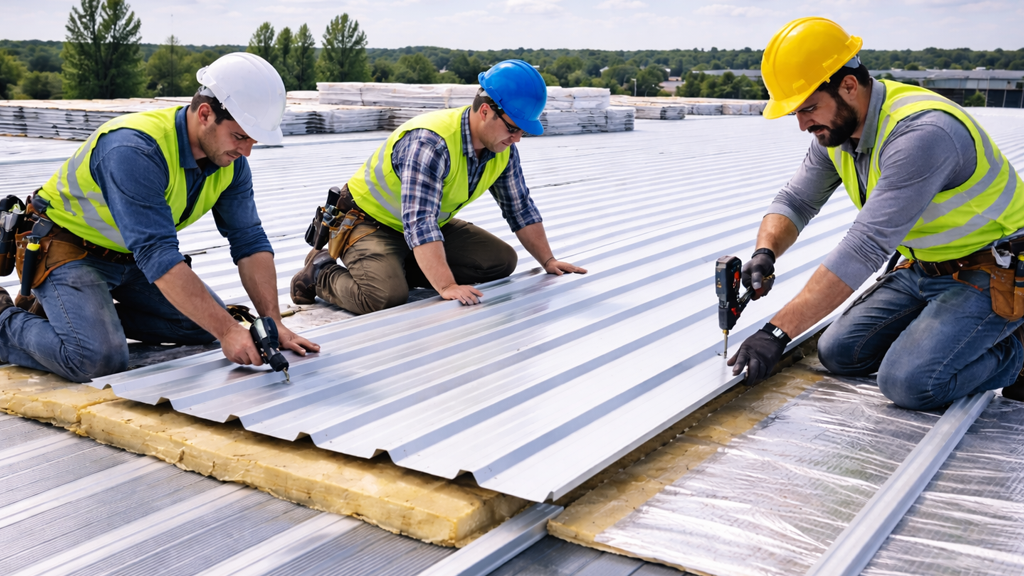
The process usually starts long before materials arrive. A proper survey checks the condition of the existing roof deck, drainage layout, edge details, access routes, and any rooftop equipment. On cladding jobs, the contractor also needs to assess the substrate, support rails, openings, and junctions around doors and windows.
Good preparation saves time later.
You should expect:
This is also the stage where awkward details should be identified. Rooflights, ducts, plant supports, parapets, and service penetrations all need proper treatment. That’s often where cheaper quotes stay vague.
If the job involves removing the old roof covering, expect noise and visible mess at this point. A professional team manages that carefully with controlled waste handling, protected access routes, and regular clean-downs.
Preparation matters more than many owners realise. The deck has to be sound. Wet or damaged areas need dealing with properly. If insulation is being upgraded, the new build-up must sit level and support the finished system correctly.
On most commercial roofs, the success of the final weatherproofing layer depends on how well the substrate was prepared underneath it.
Once the base is ready, the main installation begins. That may include vapour control layers, insulation boards, membranes, felt layers, liquid coatings, sheets, panels, trims, flashings, and rainwater goods, depending on the system.
The pace can look quick from ground level. The quality check is in the details. Junctions around edges, outlets, penetrations, and upstands should be neat, deliberate, and consistent. Those are not finishing touches. They are the points most likely to fail if rushed.
A short site video often helps clients understand what a commercial roofing project involves in practice:
The final day shouldn’t just mean “the lads have gone”.
A proper handover usually includes:
If your business remains open during the works, communication matters as much as workmanship. You should know which areas are restricted, when roof access is taking place, and whether weather might alter the sequence.
The best installations don’t just produce a watertight roof. They leave you with confidence that the roof was built in a controlled, inspectable way.
Materials matter, but the contractor matters more. A well-specified system can still perform badly if the site management is poor, the detailing is rushed, or the quote hides too much.
That risk is not small. Many small business owners report project overruns when using non-vetted contractors. That’s why careful vetting is one of the most practical ways to avoid cost and delay problems on commercial work.

Local knowledge counts. A contractor working across Windsor, Slough, Reading, Bracknell, Maidenhead, and nearby towns is more likely to understand the common building types, access issues, and weather exposure you deal with.
Check for these basics:
If the contractor uses digital scheduling and job tracking well, that usually shows in how the project runs. Even a simple example of field service scheduling software can show the kind of organised workflow that helps keep labour, materials, and site visits aligned.
Some warning signs are obvious. Others are subtle.
| Red flag | Why it matters |
|---|---|
| Vague quote | You can’t compare offers properly if scope is unclear |
| Pressure to decide quickly | Usually a sign the contractor wants commitment before scrutiny |
| No discussion of details | Edges, outlets, penetrations, and trims are where failures often start |
| No recent local commercial work | Domestic-only experience doesn’t always transfer well |
| Too much focus on price alone | That often means key elements are omitted |
Ask each contractor what they think the weak points of your roof are. Then listen carefully. The stronger answer usually mentions specifics such as drainage falls, outlet capacity, perimeter terminations, foot traffic, existing deck condition, or wall junctions.
A weaker answer stays generic. It talks about “sorting it all out” without identifying how.
All Custom Roofing is one local option for Windsor-area owners who need commercial roofing and cladding work on light commercial properties, including reroofing, repairs, maintenance, and flat roof systems. More important than the name, though, is the standard you should expect from any firm you appoint: a clear survey, a defined scope, tidy delivery, and paperwork that matches the work on the roof.
Good contractors don’t only explain what they’re installing. They explain what they’re refusing to ignore.
A commercial roof isn’t just overhead cover. It protects your trading space, staff, stock, and long-term property value. The same goes for cladding. When those systems are right, the building runs better. When they’re neglected, small defects spread into expensive ones.
The strongest approach is usually the least dramatic one. Choose a system that suits the building. Focus on drainage, detailing, insulation, and maintainability. Judge quotes on whole-life value, not just the starting figure. Then choose a contractor who can explain the work in plain English and carry it out without cutting corners.
If your roof is ageing, leaking, patched too many times, or dragging down the performance of the building, regular upkeep often gives you the clearest next step. This guide to commercial roofing maintenance is worth reading before a small issue turns into a major project.
For business owners and landlords in Windsor and the wider Berkshire area, the right roofing decision is rarely about buying the most elaborate system. It’s about buying reliability, service life, and fewer surprises.
If you need practical advice on commercial roofing and cladding, contact All Custom Roofing in Windsor. We cover Windsor, Reading, Slough, Bracknell, Maidenhead, and surrounding towns, with support for commercial repairs, reroofing, maintenance, and flat roof upgrades.