 (+44) 7900 515 552
23 Oct 2026
 insurance backed guaranteeinsurance backed guarantee
If you own or manage an industrial unit in Windsor, Slough, Reading or Maidenhead, the roof often stays out of sight until something goes wrong. A leak over stock, drips near electrics, rising heating bills, or stained wall panels usually force the issue.
That is when many people realise they are not just dealing with “a roof”. They are dealing with a full external envelope made up of roofing, cladding, insulation, flashings, gutters, fixings and junction details. Each part affects how the building handles rain, wind, heat loss and day-to-day wear.
Industrial roofing and cladding can look technical from the outside. In practice, the key questions are simple. What system suits your building type, how long will it last, what will it need from you in maintenance, and how do you avoid paying twice by choosing the wrong specification the first time?
Industrial roofing and cladding are the outer layers that protect a commercial or industrial building. Think of them as the building’s protective skin.
The roof keeps out rain, resists wind uplift, manages drainage and helps hold heat inside. The cladding does similar work on the walls, while also shaping the appearance of the property from the street or estate road.

On a typical UK industrial building, roofing and cladding usually include:
Many owners get confused because they see only the top layer. A contractor sees the whole assembly. That matters because the weak point is often not the main sheet or membrane. It is a failed lap, a badly formed corner, a blocked outlet, or a poorly detailed junction.
A modern industrial roof is not just there to stop obvious leaks. It also affects comfort, running costs and the condition of the structure below.
Modern industrial roofing systems are designed to reduce thermal bridging and poor detailing at junctions can increase heat loss by 20 to 30%. For a warehouse or light commercial unit in Berkshire, that can mean a building that is harder and more expensive to heat.
Key takeaway: Good industrial roofing and cladding is not one product. It is a coordinated system that keeps water out, controls heat loss, limits condensation and protects the value of the building.
If your premises are older, you may already have signs that the envelope is underperforming:
Once you view the roof and cladding as one working system, decisions become clearer. You stop asking only, “How do I patch this leak?” and start asking, “What does this building need to stay dry, efficient and reliable for years?”
Choosing between industrial roofing and cladding systems is a bit like choosing outerwear for different jobs. A waterproof shell, a heavy work coat and an insulated winter jacket all have their place. Buildings are the same.
A trade counter in Slough, a warehouse in Bracknell and a retail unit in Reading may all need different answers, even if the square metreage looks similar on paper.

Single-ply membranes are lightweight waterproof sheets used mainly on flat or low-pitch roofs.
They suit commercial extensions, offices, schools, retail units and many light industrial properties where the roof structure needs a lighter covering. Installation can be clean and relatively fast, and repairs are often straightforward when the roof has been properly detailed.
The trade-off is that workmanship matters hugely. Flat roofs do not forgive poor drainage design, weak detailing around penetrations, or careless edge work.
Composite panels combine outer and inner metal sheets with an insulated core. They are popular on warehouses, production buildings and larger industrial units where quick enclosure and thermal performance matter.
They offer a neat finish and can simplify installation because insulation is built into the panel. They are often a strong option where owners want a modern, uniform appearance with fewer separate components on site.
If you are weighing up this route, this guide to composite panel roofing gives a useful overview of where composite systems fit best.
Built-up systems are assembled from separate layers, usually an outer profiled sheet, insulation and an inner liner. They are common on industrial units and have long been used across the UK market.
They give designers flexibility and can perform very well when the details are right. They are also useful where the building needs strong structural performance and effective weather resistance.
One important point is specification. For steel roofing systems, profiled sheets should be designed with at least 0.55mm base metal thickness, and the system must allow for thermal expansion. Without that, temperature changes can lead to panel distortion and fastener fatigue.
Built-up felt remains a familiar option on flat roofs, particularly where owners want a traditional layered waterproofing system.
It can be suitable for smaller commercial roofs, refurbishments and some access-heavy areas. It is proven, repairable and widely understood by experienced flat roofing contractors.
Its main drawback is that quality depends on correct layering, edge detailing and drainage falls. On neglected roofs, standing water and ageing joints can become the weak points.
This is one of the most recognisable finishes on industrial estates. It is practical, durable and available in a wide range of profiles and colours.
It suits warehouses, factories, workshops and trade premises. It is often chosen for its balance of strength, speed of installation and straightforward maintenance.
These provide outer finish and insulation in one product. They are often selected when thermal performance, speed of build and a clean appearance are priorities.
For owners upgrading older stock, insulated panels can also help modernise the building visually while improving day-to-day efficiency.
Rainscreen systems are more common where appearance matters as much as protection, such as mixed-use developments, office-led schemes or upgraded commercial frontages.
They create a smart external finish and can work well when paired with modern insulation strategies. They are usually more design-led than standard profiled cladding, which can make them less suitable for every industrial budget.
Timber and decorative façade systems also appear on some commercial sites.
| System Type | Best For | Key Benefit | Typical Lifespan | Cost Indicator |
|---|---|---|---|---|
| Single-ply membrane | Flat and low-pitch commercial roofs | Lightweight and clean finish | Varies by product and maintenance | ££ |
| Composite panels | Warehouses and modern industrial units | Insulation and enclosure in one system | Varies by specification and upkeep | £££ |
| Built-up metal roofing | Larger industrial roofs | Flexible specification and strong performance | Varies by detailing and maintenance | £££ |
| Built-up felt | Smaller flat roofs and refurbishments | Familiar layered waterproofing | Varies by workmanship and inspection routine | ££ |
Practical tip: Do not choose purely by material name. Ask how the full system deals with drainage, insulation, edge details, penetrations and future repairs.
A sensible first filter is not brand. It is building use.
The best system is the one that suits the building you own, the activities inside it, and the level of maintenance you are realistically prepared to carry out.
Owners often get handed technical terms without much explanation. U-values, thermal bridging, condensation risk, wind uplift and weatherproofing all sound specialist. What matters is what they mean for your unit on a cold January morning or after a week of heavy rain.
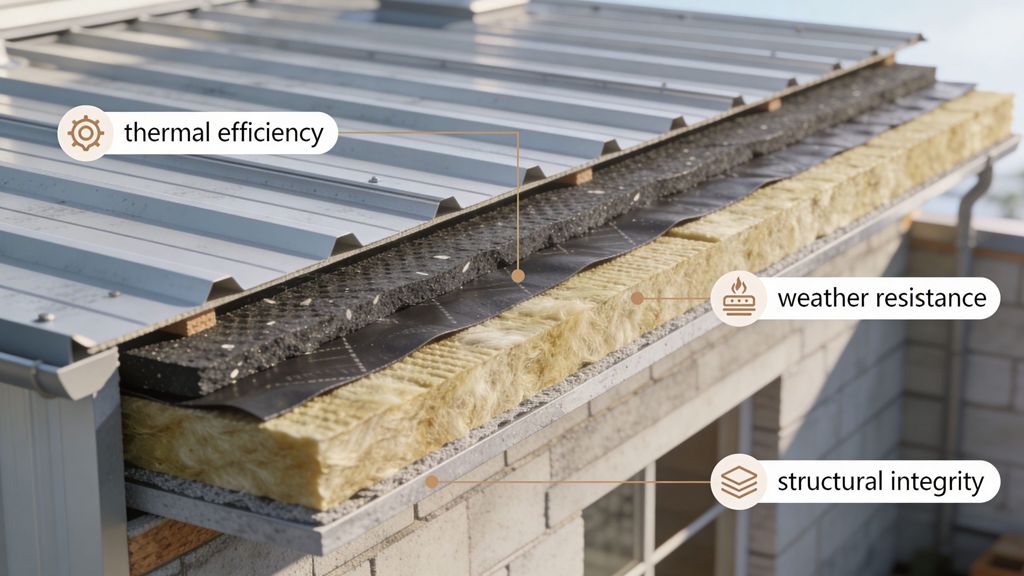
If your building loses heat quickly, you pay for it every day. Staff feel it, tenants notice it, and heating systems work harder than they should.
Modern industrial metal roof systems can achieve a U-value as low as 0.07 W/m²K, which helps minimise heat loss in non-domestic buildings. In practical terms, that means a better-insulated roof can make a warehouse, workshop or trade unit easier to heat and more consistent inside.
Thermal performance is not just about insulation thickness. It also depends on how well the system is put together. Junctions, fixings, laps and penetrations all affect the finished result.
Condensation often causes more confusion than leaks because the symptoms can look similar. Water droplets on liners, damp patches, mould growth and musty smells are not always from rain penetration.
Warm moist air inside the building can reach colder surfaces and turn into water. That is why insulation continuity, vapour control and airtight detailing matter so much on industrial roofs.
Typical warning signs include:
Tip: If you only repair the visible damp patch and ignore the condensation path, the problem usually returns.
UK weather tests roofs hard. In Berkshire and surrounding towns, long spells of rain can expose weaknesses that looked minor in dry weather.
On flat and low-pitch systems, drainage is one of the first things I would inspect. Water must move away properly. If outlets are undersized, gullies are blocked, or falls are poor, the roof stays under stress for longer than it should. This is significant because leaks are often blamed on membrane failure when the underlying issue is standing water around details, terminations or plant upstands.
A short visual explanation can help make these build-ups easier to understand:
Industrial roofs do not sit still. Materials expand and contract as temperatures change, and exposed sites can face significant wind pressure.
If the fixing pattern, support structure and movement allowance are poorly planned, owners may start seeing loose fixings, stress around holes, rattling sheets or water entry at vulnerable points. These signs usually appear gradually, then worsen after rough weather.
For buildings in open trading estates or edge-of-town locations, wind performance should never be treated as a side issue.
Acoustic performance matters more than many owners expect. Rain on metal roofs, vibration from rooftop plant and external traffic noise can all affect working conditions.
This is especially relevant for offices within industrial units, training spaces, showrooms and buildings where people spend long shifts indoors. A roof that is structurally sound but uncomfortable to work beneath still creates a business problem.
A well-chosen roof and cladding system should give you:
Performance specs matter because they show whether the roof will cover the building, or actively improve how the building works.
A roof can be installed well and still fail early if nobody looks after it. That is common on commercial sites where maintenance is reactive and access is infrequent.
The costliest defects usually start small. A blocked outlet, a split seal, a slipped flashing or debris trapped behind a parapet can sit unnoticed until the next spell of bad weather.

The South East has seen harsher weather pressure on roofs. According to UK Met Office data, recent years have seen an increase in severe storm days compared to the average. That raises the chance of ponding water, lifted edges and wind-related damage on industrial flat roofs.
In plain terms, roofs that might once have coasted through a year now need a closer eye.
Most owners do not need to become roofing experts. They do need a simple routine.
Inspect before and after the roughest weather periods.
These are the places where I usually find trouble earliest:
You do not always need to get onto the roof to spot a problem. Inside the building, watch for:
For a more detailed upkeep approach, this guide on commercial roofing maintenance is a useful reference point for planning checks and avoiding avoidable repair bills.
Maintenance rule: If a defect can be fixed with a seal, bracket, outlet clearance or localised repair, deal with it early. Once water reaches insulation or internal finishes, the cost and disruption rise quickly.
Owners often ask how long a system will last. The honest answer is that lifespan depends on installation quality, exposure, use of the building and maintenance discipline.
A well-kept roof generally outperforms a neglected “premium” roof. The material matters, but routine attention matters just as much.
If your building has not had a proper roof check in some time, the most useful first step is not guessing the remaining lifespan. It is finding out the roof’s current condition and where the vulnerable details are.
Most roofing budgets go wrong for one reason. The owner prices only the visible covering and not the full job.
Industrial roofing and cladding costs are shaped by access, edge details, insulation, waste removal, rooflights, penetrations, drainage work, temporary weather protection and how much repair is needed to the deck or supporting structure beneath.
The final figure usually moves up or down because of practical site factors such as:
A simple rectangular unit is easier to price and install than a roof broken up by multiple upstands, old patch repairs and congested service areas.
A lower quote can still be the more expensive option over time if it leads to frequent maintenance, repeated leak call-outs or energy waste. Lifecycle costing is important here.
For example, an owner choosing a flat roof system should think beyond installation day. How easy is it to inspect. How often are outlets likely to need attention. Will future repairs be simple. How disruptive would a local failure be to operations below.
If your property includes a low-slope or flat section, this overview of commercial flat roofs is helpful for comparing practical flat roofing considerations.
Budget conversations have also changed because more owners now want energy-efficient improvements, not just like-for-like replacement.
There has been a rise in demand for energy-efficient cladding, and some businesses may be able to access support such as certain roof retrofit grants, which can cover a significant portion of costs for qualifying Berkshire businesses.
That does not mean every project will qualify. It does mean it is worth asking early whether a planned upgrade could align with available support or finance.
Instead of asking for one headline price, ask for a quote that separates:
That level of detail helps you compare like with like. It also shows whether one contractor has priced a complete solution and another has priced only the visible surface.
Budget tip: A clear, itemised quote protects you twice. You understand what you are paying for now, and you can spot costly omissions before work starts.
The contractor you choose affects far more than workmanship. They influence programme, site safety, communication, disruption levels and how well the finished roof performs after the handover.
On industrial roofing and cladding jobs, small specification mistakes can turn into expensive defects. That is why local knowledge and system knowledge both matter.
Start with evidence, not promises.
Ask each contractor for:
If they cannot explain how they handle drainage, edge details, penetrations and weatherproof sequencing, keep looking.
A contractor working regularly across Berkshire understands the practical realities of the area. They know the effect of wind-driven rain on exposed sites, the access issues around busy trading estates, and the need to keep works organised where tenants or staff still occupy the building.
That local familiarity often leads to better planning and fewer surprises once the job begins.
A short quote with one total number may look attractive, but it often hides exclusions. Ask for itemisation and clarity on repairs, waste disposal, temporary protection and making good.
On a live business site, owners need updates in plain English. You should know who to call, how changes are approved and how issues are recorded.
A contractor’s website is not proof of quality, but it does reveal how clearly they explain services, process and past work.
Practical check: If a contractor is vague before the contract is signed, they rarely become clearer once the work starts.
The right contractor is not only the cheapest or the fastest available. It is the one who can explain the system properly, price it transparently and deliver it safely without turning your roof into a rolling problem.
Real projects vary, but a few local-style examples show how industrial roofing and cladding decisions play out in practice.
The owner’s main complaint was not a dramatic leak. It was repeated overflow during heavy rain and water staining near the eaves line.
An inspection would likely focus first on drainage capacity, outlet blockages, gutter alignment and edge details. In a case like this, the answer is often targeted remedial work rather than a full replacement. Once water starts backing up, even a decent roof covering can appear to be failing.
The practical lesson is simple. Solve the water path before assuming the whole roof is finished.
This type of property often has an older metal roof that keeps the rain out but leaves the unit cold in winter and prone to condensation.
In that situation, the owner is usually choosing between another patch-repair cycle or an upgrade that improves thermal performance as well as weather protection. A better-specified system can make the building easier to let, easier to work in and less troublesome to maintain.
For landlords, that matters because tenant complaints often start with comfort before they ever mention the roof itself.
After rough weather, the occupier noticed rattling panels and minor water entry near a perimeter detail.
That points to a different type of issue. The field area may still be sound, but movement at edges, fixings or flashings can open the door to repeated failure if left alone. A focused repair, followed by a maintenance plan, is usually the sensible route unless wider deterioration is present.
That depends on access, building use and whether the site stays occupied. Good planning can reduce disruption, but industrial roofing works are never completely invisible. The right contractor should explain work phases, delivery arrangements, safety controls and any periods where internal protection is needed.
No. Some leaks come from isolated defects such as failed flashings, blocked outlets or local membrane damage. Others point to broader age-related failure. The only reliable answer comes from a proper inspection of the system, not just the wet patch inside.
If the cladding is still structurally sound, repair or overclad options may be viable. If fixings, corrosion, thermal performance and junction detailing are all poor, replacement may offer better long-term value.
At minimum, roofs should be inspected routinely and after major storms. High-risk sites, older roofs and flat roofs with drainage history often need closer attention.
Have photos, approximate roof area if known, details of recurring issues, and any records of previous repairs. Access information also helps. The clearer the brief, the better the quote.
Usually omissions. One quote may include insulation upgrades, drainage works and edge details, while another may only price the visible covering. Always ask what is included, what is excluded and what assumptions have been made.
Industrial roofing and cladding works best when the owner understands the building, the contractor understands the system, and both sides are clear about the outcome. That is how you avoid false savings and get a roof that performs properly in real UK conditions.
If you need expert advice on roof repairs, maintenance, flat roofing or re-roofing for a home or light commercial property, contact All Custom Roofing in Windsor for straightforward guidance and transparent pricing. We cover Windsor, Reading, Slough, Bracknell, Maidenhead and surrounding towns across Berkshire.