 (+44) 7900 515 552
16 Oct 2026
 insurance backed guaranteeinsurance backed guarantee
Swapping a flat roof for a pitched one is a major home improvement, but it’s one that tackles common issues like leaks and poor drainage head-on while seriously boosting your property’s value. The process involves building a new timber frame on top of your existing structure, creating a proper slope that can then be tiled or slated. Think of it less as a repair and more as a long-term investment in your home’s durability and kerb appeal.
For many homeowners in Berkshire, a flat roof can feel like a constant source of worry. The relentless UK rain, coupled with a design that’s prone to pooling water, often leads to a frustrating cycle of repairs and maintenance. If you’re tired of patching leaks or simply want to give your property a much-needed facelift, converting to a pitched roof is a brilliant solution.
This isn’t just a cosmetic tweak. It’s a fundamental improvement that addresses the core weaknesses of a flat roof, especially in our damp climate. A pitched design simply works with gravity, shedding rain and snow effortlessly. This drastically cuts the risk of water getting in and causing the kind of structural damage that can be a real headache.
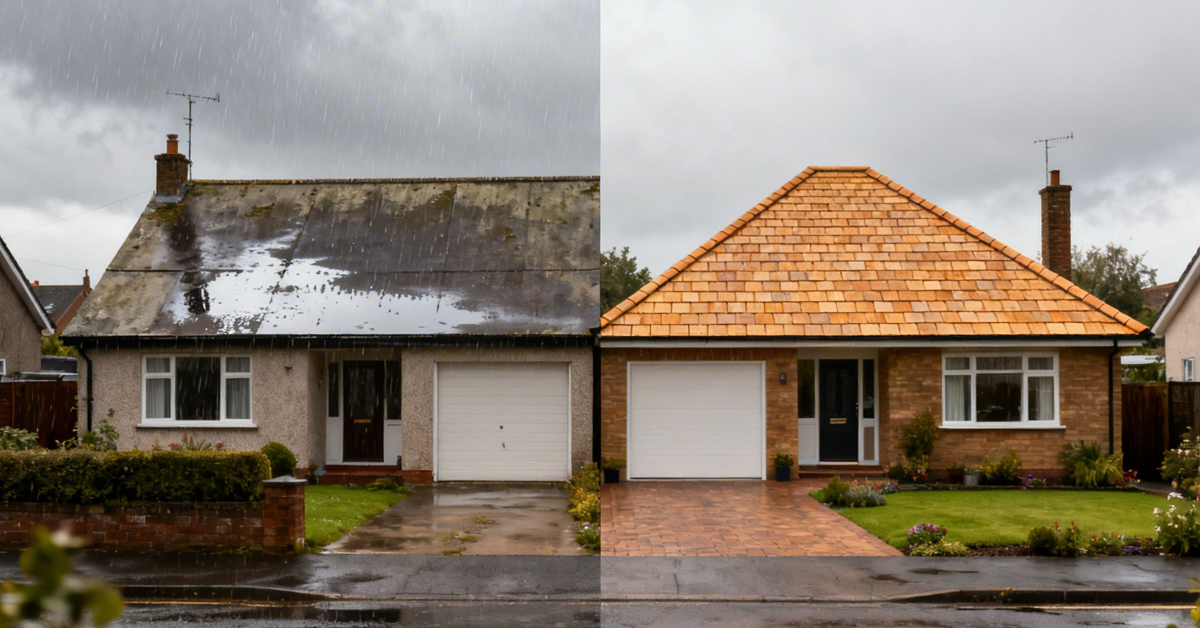
Deciding to make the switch from a flat to a pitched roof brings a whole host of practical advantages you’ll feel straight away and appreciate for years to come. The benefits go far beyond just stopping drips.
Making the switch is a big decision, but it’s helpful to see how the two roof types stack up directly.
Here’s a quick breakdown of the pros and cons for each, keeping the typical British home and climate in mind.
| Feature | Flat Roof | Pitched Roof |
|---|---|---|
| Lifespan | Shorter, typically 10-20 years | Much longer, often 50+ years depending on materials |
| Maintenance | Regular checks needed for pooling water and membrane damage | Minimal maintenance, occasional tile checks |
| Weather Resistance | Vulnerable to pooling water, leaks more common | Excellent drainage, sheds rain and snow easily |
| Initial Cost | Generally lower | Higher upfront investment |
| Property Value | Can sometimes detract from value, seen as a liability | Significantly increases kerb appeal and overall property value |
| Energy Efficiency | Can be difficult to insulate effectively | Creates loft space, allowing for excellent insulation levels |
| Usable Space | Can be used as a terrace or for a green roof | Creates potential for loft storage or a full conversion |
While a flat roof has its place, for most UK homeowners looking for durability and peace of mind, a pitched roof is the clear winner.
Let’s put this into a real-world context. Imagine you’re a homeowner in Windsor with a tired, leaky flat roof, a common story in the UK, where we get around 133 days of rainfall each year. Replacing it with a pitched roof isn’t just about plugging a leak; it’s a strategic move that enhances your home’s value and resilience for the long haul.
After the conversion, properties in the Windsor area can see their kerb appeal skyrocket. Local estate agents suggest it could add 5-10% to the resale value. While it’s a significant initial outlay, it’s an investment that protects your home from future storms and boosts its charm. You can explore more details on the financial benefits of a roof conversion to see how it pays off.
By swapping a problematic flat roof for a durable pitched one, you are not just solving today’s problems. You are future-proofing your property against the British weather, reducing long-term maintenance costs, and making a sound financial investment.
For residents in Slough, Maidenhead, or Bracknell weighing up this project, the benefits are compelling. It’s a move that improves comfort, cuts down on future costs, and adds lasting value to your most important asset. Contact All Custom Roofing for an expert assessment of your property. We cover Windsor, Reading, Slough, Bracknell, Maidenhead, and surrounding towns.
Getting to grips with the finances is always the first real step in a successful roof conversion. When you decide to swap a leaky, high-maintenance flat roof for a pitched one, you’re making a serious investment in your home. For property owners in Maidenhead, Slough, or Windsor, moving past ballpark figures to a clear, itemised budget is absolutely essential.
The final bill is shaped by a handful of key factors. The size of your roof, the materials you fall in love with, and other vital services like scaffolding all play a part. A transparent breakdown of these costs from the start helps you plan with confidence and sidesteps any nasty surprises down the line.
Several different elements all feed into the final quote for a flat-to-pitched roof conversion. Each one is vital for the project’s quality, how long it will last, and how it looks.
Thinking about these factors upfront gives you a much more realistic budget to work with. Our team provides detailed quotes that explain every single aspect, so you know exactly where your money is going. It’s also worth taking a look at our guide on the factors that influence new roof costs.
While every single project is different, knowing the average costs can give you a useful starting point for your own planning. In the UK, flat roofs are notorious for springing leaks, which is why a conversion is such an attractive long-term fix.
For a straightforward conversion built over an existing flat roof, you could be looking at a cost of between £3,000 and £4,500, with the work often wrapped up in just a couple of days. This makes the project a really accessible option for homeowners in the Windsor area.
For example, affordable concrete tiles can cost as little as £0.75 to £3 per tile, making them a great fit for a garage or extension. If you’re after ultimate longevity, natural slate will set you back anywhere from £1 to £12 per tile. Other bits like soffits and battens will add to the total, but the benefits quickly outweigh the costs through less maintenance and much better insulation, which could trim your energy bills by 15-20%.
A well-budgeted roof conversion isn’t just an expense; it’s a strategic upgrade. It eliminates recurring repair costs, improves your home’s thermal performance, and can even create valuable new loft space for storage or future conversion.
We know that a full roof replacement is a significant financial commitment. To help make this valuable home improvement more manageable, we offer accessible finance options through our trusted partner, Phoenix Financial Consultants, who are FCA regulated (subject to status). This lets you spread the cost over a timeframe that suits you, bringing your dream roof within reach.
To get started with your financial planning, you can easily request a roofing estimate for your conversion project. For a personalised quote and to chat about finance solutions for your home in Berkshire or the surrounding towns, get in touch with our team in Windsor. We’re here to provide a clear, no-obligation assessment for your property.
Tackling the paperwork for a major home improvement can feel like a headache, but when you’re converting a flat roof to a pitched one, it’s a step you simply can’t skip. Getting to grips with the rules set out by your local Berkshire council is non-negotiable. It’s what ensures your project is legal, safe, and built to stand the test of time.
It’s a common mistake to think Planning Permission and Building Regulations are the same thing. They’re not. They serve very different purposes, and confusing them can lead to expensive delays or, worse, enforcement action from the council.
Planning Permission is all about how your project looks and its impact on the neighbourhood. It considers how the new, taller roof will fit in and whether it might overshadow your neighbours or affect their privacy. Since swapping a flat roof for a pitched one dramatically changes your home’s height and appearance, you’ll almost certainly need a formal application.
Be sure to budget for this. For homeowners in Windsor, Reading, or Slough, a typical planning application costs upwards of £462. Local authorities usually take around eight weeks to reach a decision, a timeline that’s crucial for scheduling the actual building work.
A good contractor will handle this entire process for you. They’ll prepare the necessary drawings and paperwork, dealing directly with the local planning department to keep things moving smoothly.
If planning permission is about the ‘what’ and ‘where’, Building Regulations are about the ‘how’. These are the strict technical standards that guarantee your new roof is structurally sound, safe, and energy-efficient. They cover everything from the strength of the new timber frame to the quality of the insulation and proper ventilation.
Compliance is mandatory, and a building control officer from your local council will check the work at key stages before signing it off. They’ll be paying close attention to a few key areas:
Navigating the complexities of local council requirements is where an experienced roofing company proves its worth. Since 2008, All Custom Roofing has guided clients in Windsor and across Berkshire through this process, handling the paperwork so they can focus on the exciting transformation of their home.
All construction must follow specific British Standards, and for pitched roofing, BS 5534 is the rulebook. It sets the benchmark for workmanship, detailing exactly how tiles should be fixed to withstand gale-force winds and how the structure underneath should be built. Following this standard isn’t just about ticking a box; it’s your peace of mind that the roof is built to cope with the famously challenging British weather.
Getting planning permission is the critical first step. It’s worth remembering that UK industry reports show pitched roofs can slash leak-related callouts by as much as 60% compared to flat roofs. That’s a massive improvement, especially when you consider the UK gets around 133 days of rain per year.
A contractor who knows BS 5534 and local building codes inside and out will ensure your project meets every requirement without cutting corners. For a stress-free project in Maidenhead, Bracknell, or the surrounding towns, get in touch with All Custom Roofing. We manage the entire legal process, from the first drawings to the final sign-off.
It’s one thing to decide on converting your flat roof, but it’s another to picture what the work actually involves day-to-day. A flat to pitched roof conversion is a serious bit of construction, and we believe in keeping you in the loop at every stage. We want you to feel confident and clear about what’s happening, from the moment our team arrives to the final handshake.
The real work starts long before the first hammer swings. Every project kicks off with a detailed structural survey. This isn’t just a box-ticking exercise; it’s a crucial safety check to make sure your home’s existing walls and foundations can handle the extra weight of a new pitched roof. A qualified structural engineer carries out this assessment, giving us the go-ahead or highlighting any reinforcements that might be needed.
Once the plans are signed off and permissions are sorted, the physical work can get underway.
The first thing you’ll see is the scaffolding going up. This gives our team a safe platform to work from and is a non-negotiable legal requirement for any professional roofing job in the UK. We take care to set it up with as little disruption to your daily routine and access as possible.
With the scaffolding secure, the next job is to carefully remove the old flat roof. Our team dismantles the existing structure, stripping away the old felt, timber decking, and any insulation. All the rubble is managed responsibly and put straight into a skip, keeping your property as tidy as we can throughout the process.
This is the point of no return and where the real transformation begins.
With a clean slate, our carpenters get to work on the new timber frame. For most conversions, we build a trussed roof structure. These are pre-made triangular timber frames that are craned into position and securely fixed to your home’s existing wall plates. It’s an efficient method that’s incredibly strong and guarantees a perfectly uniform pitch across the whole roof.
The heart of the project is a complete new roof installation, changing the very profile of your home. Once the timber trusses are up, we cover them with a breathable membrane. This modern, high-tech felt acts as a second line of defence against wind and rain while letting moisture from the new loft space escape, which is absolutely vital for stopping condensation.
Next, a grid of timber battens is fixed horizontally across the trusses. These are what the tiles or slates will hang on, and their spacing has to be calculated with precision to match the specific tile you’ve chosen.
This chart breaks down the permit process, a key step before we can start building.

As you can see, while the steps are straightforward (submission, waiting, and approval) the time it takes is something you definitely need to factor into your project timeline.
Now the roof really begins to look the part. The tiles or slates are laid, starting from the eaves and working up, with each course overlapping the one below. Our team are experts at cutting tiles to fit perfectly around features like chimneys or Velux windows, ensuring the finish is both flawless and completely weatherproof.
A critical, but often overlooked, part of the process is insulation. The new loft space is the perfect opportunity to install high-performance insulation between the ceiling joists. This is essential for meeting UK Building Regulations and will make a noticeable difference to your home’s warmth and energy bills.
Finally, we install brand new guttering, fascias, and soffits. These not only complete the look of your new roof but play a crucial role in directing rainwater away from your property and protecting your brickwork from damp.
The last step is a full site clean-up and a final inspection. We’ll walk you through the finished job to make sure you’re 100% happy with every detail. For homeowners in Windsor, Reading, Slough, and across Berkshire, this methodical approach guarantees a top-quality result with minimal stress. Contact All Custom Roofing in Windsor to discuss how we can manage your conversion from start to finish.
Once you’ve decided to convert your flat roof to a pitched one, the next big decision is what to cover it with. This isn’t just a practical choice; the material you select will define your home’s character, its resilience against the British weather, and the level of upkeep it’ll need for decades to come.
For most homeowners in areas like Reading and Bracknell, the choice typically narrows down to three fantastic options: versatile concrete tiles, classic clay tiles, and premium natural slate. Each has its own unique blend of looks, durability, and cost, and getting to grips with these differences is the key to a smart, long-term investment you’ll be happy with for years.
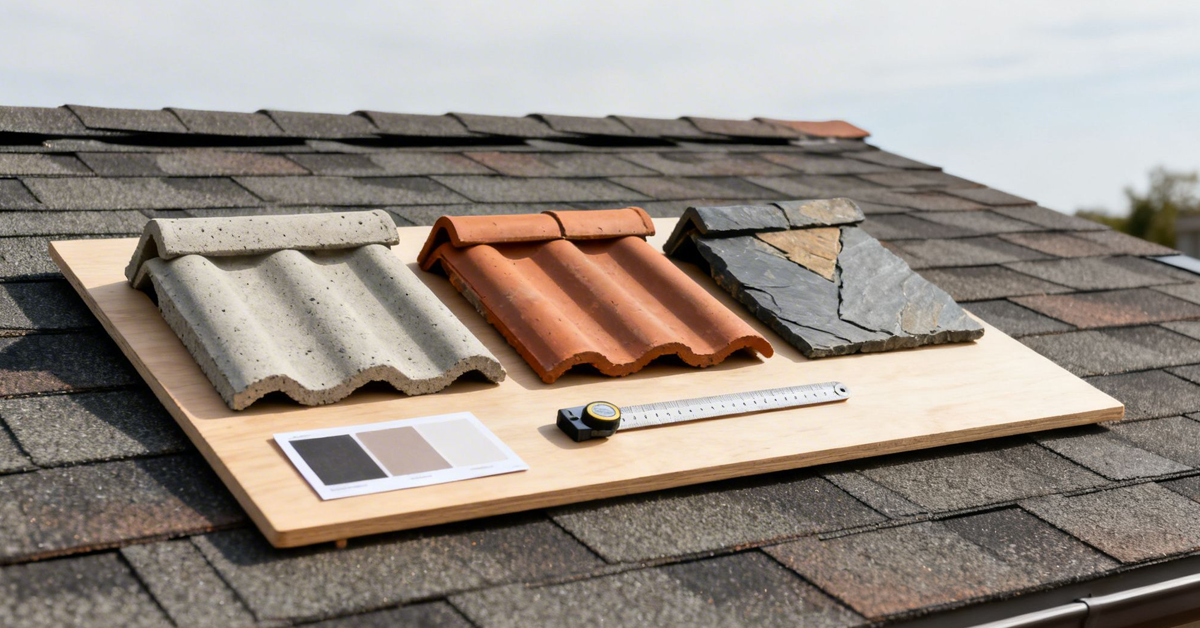
Concrete tiles are the real workhorse of the UK roofing industry, and for good reason. They’re incredibly durable and come in a massive variety of shapes and colours, which means they can convincingly mimic more expensive materials like clay or slate. This makes them a brilliant choice if you’re after a specific look without the premium price tag.
They’re popular because they tick a lot of boxes:
For that classic, warm aesthetic, nothing quite beats the look of natural clay tiles. They’ve been a staple on British homes for centuries, prized for their rich, earthy colours and traditional charm.
While they do come with a higher initial cost than concrete, their longevity and timeless appeal often make them a worthwhile investment. Clay tiles are known for lasting 60 years or more; they frequently outlive the people who install them!
The real magic of clay is its colour retention. Unlike pigmented concrete, the colour is baked right through the tile, so it won’t fade over time. The beautiful look you get on day one is the same look you’ll have decades down the line, adding significant character and value to your property.
If you’re looking for the absolute pinnacle of roofing materials, natural slate is it. It offers outstanding durability and a sophisticated, elegant finish that’s hard to match. Quarried from the earth, every single slate is unique, creating a beautiful, natural texture on your roof.
It’s the most expensive option, no doubt. But with a lifespan that can easily exceed 100 years, it’s a true ‘fit and forget’ solution.
For period properties or for homeowners who simply want the best in performance and appearance, natural slate is the ultimate choice. That high upfront cost can actually make it the most cost-effective material over the entire lifetime of your home.
This investment pays off with a stunning look and incredible resilience against the harshest weather conditions.
To help you visualise the options, here’s a side-by-side look at the most popular roofing materials. This should help you decide what’s best for your Berkshire property.
| Material | Average Lifespan | Typical Cost | Best For |
|---|---|---|---|
| Concrete Tiles | 40-50 years | £ | Budget-conscious projects, modern homes, versatility in style. |
| Clay Tiles | 60+ years | ££ | Traditional properties, long-term colour vibrancy, kerb appeal. |
| Natural Slate | 100+ years | £££ | Period homes, ultimate durability, premium aesthetic. |
Ultimately, the best material depends on your budget, your home’s style, and your long-term goals. For a deeper dive into all the options, have a look at our ultimate guide to choosing the right roofing material for your home.
Whether you’re in Maidenhead, Slough, or Windsor, our team at All Custom Roofing can show you physical samples and provide expert advice to help you choose the perfect material for your new pitched roof.
Let’s be honest, choosing the right team to replace your flat roof with a pitched roof is easily the most important decision you’ll make in this entire process. The quality of the workmanship is what dictates the longevity, safety, and performance of your new roof for decades to come.
When you’re searching for a contractor in the Windsor area, my advice is to always prioritise those with a proven, local track record. A company with deep roots in Berkshire will understand our local architecture and, crucially, the challenges posed by our specific weather patterns. A strong portfolio of completed projects isn’t just nice to have; it’s non-negotiable. It gives you tangible proof of their skill.
Before you even think about committing, make sure any potential contractor can tick these essential boxes. A reputable company will have no problem providing evidence for each point.
A contractor’s reputation is built on trust and transparency. At All Custom Roofing, our 5-star reviews and open communication process ensure you feel confident and informed from our first meeting to the final inspection.
Ultimately, choosing an experienced, reliable contractor removes the stress from what is a major home improvement project. For your home in Reading, Slough, Bracknell, Maidenhead, or any of the surrounding towns, a local expert is always your best investment.
Contact All Custom Roofing in Windsor for a free, no-obligation survey and a detailed quote for your project.
Taking the plunge and swapping your flat roof for a pitched one is a big decision, and it’s only natural to have a few questions buzzing around. We get asked these all the time by homeowners across Berkshire, so we’ve put together some straight-talking answers to help you feel more confident about the process.
For a typical semi-detached or terraced house, the actual on-site build usually takes between one and three weeks. Of course, this can shift a bit depending on how complex the job is, the size of your roof, and let’s be honest, the classic British weather.
But it’s crucial to remember that’s just the construction phase. Before our team even sets foot on your property, there’s the pre-construction prep work. This involves things like the structural survey, getting the design just right, and securing the necessary permissions from your local council, which can easily add another 8 to 10 weeks to the timeline.
Yes, in nearly every case, it absolutely will. When you build a pitched roof, you automatically create a new loft space. Depending on the pitch and design you go for, this new area can be perfect for simple storage or even converted into a proper, habitable room, as long as it meets Building Regulations. It’s a brilliant way to add both practicality and value to your home.
This is one of the most important questions and something we take very seriously. A pitched roof is a lot heavier than a flat one, so a qualified structural engineer must carry out a full survey before any work kicks off.
They’ll check your home’s existing walls and foundations to make sure they can take the extra load. If any reinforcements are needed, they’ll be specified clearly in the project plan and our quote, so there are no surprises down the line.
It’s worth knowing that in almost all full conversions, we completely remove the old flat roof structure. This allows us to build a brand new, sturdy timber frame. Our team handles the responsible disposal of all the old materials, keeping the site clean and professional from day one.
Ready to transform your home? The team at All Custom Roofing has been serving Windsor, Maidenhead, Slough, and the surrounding areas since 2008. Contact us for a free, no-obligation survey and let’s discuss what’s possible for your property.