 (+44) 7900 515 552
16 Oct 2026
 insurance backed guaranteeinsurance backed guarantee
A flat to pitched roof conversion is a major structural upgrade where we replace a horizontal roof with a sloped one. Think of it as giving your home a proper, well-angled hat designed to effortlessly shed the relentless UK rain, solving common issues like leaks and poor insulation for good.
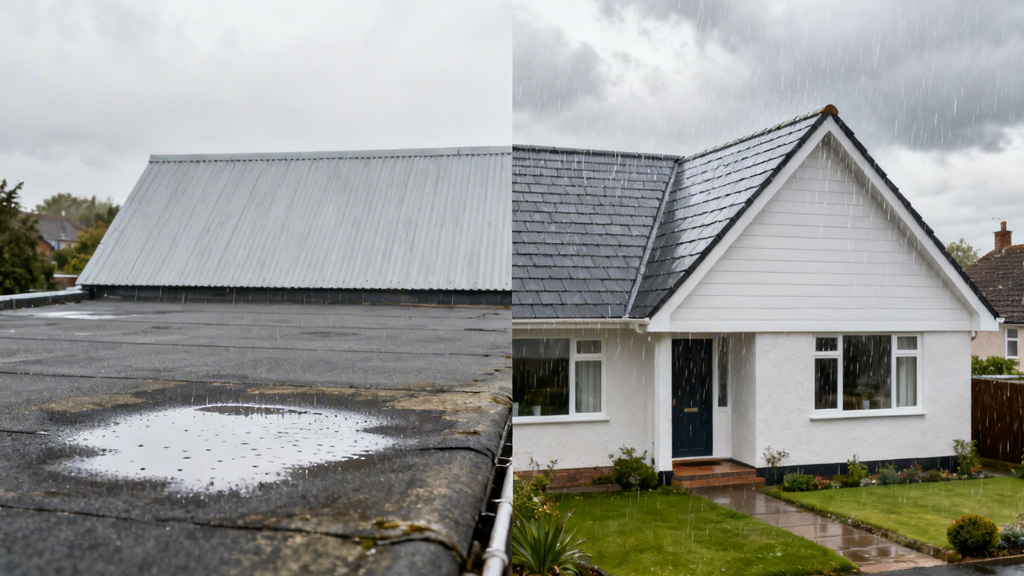
Are you tired of staring at persistent puddles on your flat roof after every downpour? You’re not alone. For many property owners in Berkshire, a flat roof can become a source of constant worry, from recurring leaks to poor thermal efficiency. It is a common headache that a simple patch-up job often cannot permanently fix.
A flat to pitched roof conversion is more than just a repair; it is a fundamental upgrade to your home’s defences against our unpredictable weather. The process involves building a new timber frame over your existing roof structure to create a slope, which we then cover with your choice of tiles or slates.
Homeowners across Windsor, Reading, and Slough are choosing this upgrade for several compelling reasons. The main driver is usually to put a definitive end to the drainage problems and leaks that plague so many flat roofs. A sloped design ensures rainwater runs off immediately, preventing it from pooling and eventually seeping through.
Beyond just performance, there are other great benefits:
In the UK, converting from flat to pitched has become incredibly popular, especially with the push for better energy efficiency. Even a well-insulated flat roof struggles to compete with a pitched design that allows for superior loft insulation. This is crucial when you realise an uninsulated roof can account for a staggering 26% of a home’s heat loss.
The long-term return is compelling, too. A well-maintained pitched roof can easily last over 50 years, far outstripping the lifespan of a typical flat roof.
Before you jump into flat to pitched roof conversions, it’s worth getting your head around the basics. Having a solid understanding of roof pitch is a great starting point, as it helps you appreciate how the angle of your new roof will impact everything from material choices to planning permission.
As your local, family-run guide, All Custom Roofing is here to help you navigate every step of the project. We’ve helped countless homeowners across Berkshire transform their properties, providing peace of mind with a durable, attractive, and high-performing roof. Contact All Custom Roofing in Windsor for expert roof repairs across Berkshire.
Deciding to convert a flat roof to a pitched one is a big step, but the pay-off goes well beyond just fixing an old leak. Think of it as a serious investment in your home’s performance, comfort, and long-term value. Let’s break down the tangible advantages homeowners across Berkshire are seeing.
The most immediate win is far better weather defence. Flat roofs, just by their nature, are prone to collecting pools of water, which puts constant stress on the roofing material. A pitched roof, on the other hand, makes gravity its friend, effortlessly shedding rain and snow. This dramatically cuts the risk of water getting in and causing the kind of costly structural damage that gives homeowners nightmares.
A key benefit you’ll notice with your first winter energy bill is the huge improvement in thermal performance. The conversion process literally builds a new loft space, which is the perfect chance to pack in high-performance insulation. This new thermal barrier keeps your home much warmer in winter and cooler in summer, meaning you won’t have to lean on the central heating as much.
For many, this translates into serious savings. In fact, within the UK’s growing £7.2bn roofing market, it’s estimated you could save between £400-£600 on your heating bills each year after a conversion. It is not just an aesthetic upgrade; it is a financially smart move towards a more energy-efficient home.
One of the most exciting parts of a flat to pitched roof conversion is the creation of brand new, usable space. That void created by the new roof structure offers immediate potential.
This new loft area can be used right away for clean, dry storage, freeing up valuable space elsewhere in your home. Looking ahead, it also provides the structural foundation for a future loft conversion, allowing you to add a new bedroom, office, or living area down the line.
This potential adds a whole new dimension to your property, allowing it to adapt as your family’s needs change over time. It’s a feature that makes your home incredibly more versatile.
Finally, you cannot overstate the impact on your property’s look and market value. A well-designed pitched roof adds character, elegance, and that traditional charm so many buyers are looking for. This instant boost in kerb appeal makes your home a standout in the neighbourhood, whether you’re in Maidenhead, Woking, or Bracknell.
This kind of upgrade is recognised as a major home improvement that delivers a strong return on investment. It solves the known problems that come with flat roofs, which can be a red flag for buyers, while adding real value through better looks, extra space, and improved energy performance. A pitched roof sends a clear signal that a property is well-maintained and built for the future.
To give you a clearer picture, it’s helpful to see how a new pitched roof really stacks up against a typical flat one. The differences in longevity, upkeep, and value are pretty stark.
| Feature | Typical Flat Roof | Pitched Roof Conversion |
|---|---|---|
| Lifespan | 15-25 years, requires frequent checks. | 50+ years with standard maintenance. |
| Maintenance | Regular inspections for pooling water and membrane damage. | Minimal, mainly clearing gutters and checking for damaged tiles. |
| Weather Performance | Vulnerable to leaks from standing water and debris build-up. | Excellent drainage, shedding rain and snow efficiently. |
| Property Value | Can be a concern for buyers due to maintenance issues. | Significantly increases kerb appeal and overall market value. |
As you can see, swapping out a high-maintenance flat roof for a durable, pitched alternative is an upgrade that pays dividends for years to come.
If you’re considering this transformative project, the team at All Custom Roofing is ready to help. We cover Windsor, Reading, Slough, Bracknell, Maidenhead, and surrounding towns.
Thinking about a flat to pitched roof conversion can feel like a huge step, but once you understand the process, it’s a lot less daunting. A well-planned project isn’t a chaotic mess; it follows a clear, logical path that takes you from the first chat right through to the final tile being laid. Here’s a simple walkthrough of what you can expect when you work with a professional team like ours here at All Custom Roofing.
The entire process is methodical, moving from detailed planning to precise, careful work on-site. This step-by-step approach means your new roof won’t just look great, it will be structurally sound and fully compliant with all UK standards.
It all starts with an on-site consultation. A member of our team will pop over to your property in Windsor, Reading, or one of the surrounding towns to chat about what you want to achieve. We’ll take a good look at your existing flat roof and get a feel for your vision. This is not just a quick glance; it is a detailed evaluation of your home’s current structure.
During this survey, we’ll be sure to:
This first meeting is all about gathering the right information. It gives us everything we need to provide you with an accurate, no-obligation quote and a realistic idea of how the project will unfold.
Once you’re happy to move forward, the project shifts into the design phase. This is where we bring in an architect or a structural engineer to turn your ideas into a technical blueprint. They’ll produce detailed drawings that map out the new roof’s shape, pitch, and overall look.
Even more importantly, they carry out critical structural calculations. These numbers confirm that your property’s existing walls and foundations can safely handle the extra weight of the new pitched roof. This step is non-negotiable as it guarantees the long-term safety of your home and forms the backbone of your planning permission application.
A flat to pitched roof conversion is a major structural change, which means it almost always requires planning permission from your local council. The project must also follow UK Building Regulations to make sure it meets all the standards for structural safety, fire resistance, and thermal efficiency.
A key regulation you’ll hear about is BS 5534, the Code of Practice for Slating and Tiling. This is the official standard that governs how pitched roofs in the UK must be fixed to stand up to our famously windy and wet weather. It’s what ensures your new roof is genuinely built to last.
Navigating all this paperwork can feel overwhelming, but an experienced roofer will handle it for you. We prepare and submit all the necessary applications and make sure the final design is fully compliant, giving you complete peace of mind.
This infographic shows how a pitched roof improves your home’s defences, efficiency, and marketability.
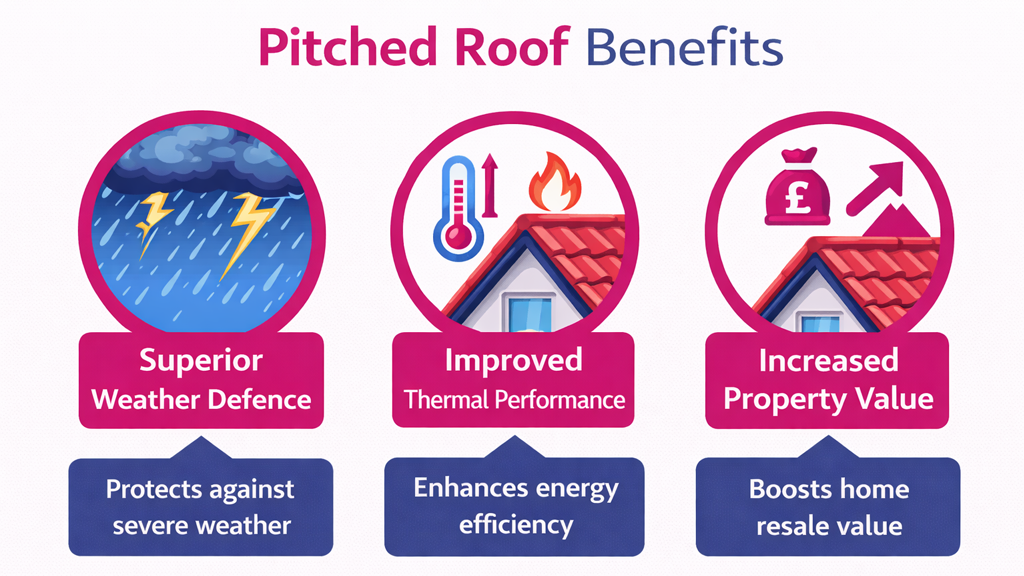
The visual breakdown highlights that a conversion is a multi-faceted investment, enhancing weather protection while also delivering financial and comfort benefits.
With all the approvals sorted, the physical work can begin. We manage the construction process carefully to keep disruption to a minimum.
This organised approach, from the first survey to the final inspection, ensures your flat to pitched roof conversion is a smooth and successful upgrade. For expert guidance across Berkshire, get in touch with All Custom Roofing in Windsor to start your project.
Thinking about a flat to pitched roof conversion is exciting, but it’s a project that involves more than just timber and tiles. Before any of the physical work can get started, there’s some essential paperwork to sort out. It might seem a bit daunting, but getting this right ensures your new roof is safe, legal, and built to last.
For homeowners across Berkshire and the surrounding areas, this means dealing with two distinct but equally important sets of rules: Planning Permission and Building Regulations. They cover different things, but they both work to guarantee your project is a complete success. Don’t worry, though, a professional contractor will handle all of this for you, making the whole process straightforward.
Planning permission is all about how your home looks and how it fits into the local neighbourhood. Because a flat to pitched roof conversion dramatically changes your home’s shape and height, you will almost certainly need to apply for it. Councils, like the Royal Borough of Windsor and Maidenhead, need to sign off on any major changes to a building’s external appearance.
The application itself requires detailed drawings of your proposed new roof. The planners will be looking at a few key things:
Before you get too far down the road, it’s vital to get a solid grasp of the legal side, including understanding if your roof conversion requires planning permission. Getting this clear from the start saves a lot of headaches later.
While planning permission looks at the aesthetics, Building Regulations are purely about the technical side of the construction. This is a non-negotiable set of standards designed to make sure your new roof is structurally sound, safe, and performs exactly as it should. Compliance is checked at key stages of the build by either a local authority inspector or an approved private inspector.
These regulations are not just red tape; they are your guarantee that the finished roof is safe for your family, energy-efficient, and tough enough to handle whatever the British weather throws at it. They cover every critical detail, from the strength of the new timber frame to the quality of the insulation.
Here are the main areas Building Regulations cover:
A seasoned contractor like All Custom Roofing takes full ownership of this entire process. We manage the applications, coordinate with the inspectors, and make sure every single part of your project is fully compliant. It leaves you free to focus on the exciting transformation of your home.
Right, let’s get straight to the big questions on every homeowner’s mind: how much will this cost, and how long will it take? While it’s impossible to give a one-size-fits-all price without seeing your property, we can give you a transparent look at what goes into the final quote.
It’s helpful to think of this project as a long-term investment in your home, not just another expense. The upfront cost is certainly more than a simple flat roof repair, but the payoff in property value, lower energy bills, and sheer peace of mind is massive.
The final figure on your quote is a combination of several key variables. From the sheer size of the roof to the style of tile you choose, every detail plays a part.
Here’s a breakdown of the main things that will influence the price of your flat to pitched roof conversion:
| Cost Factor | Description & Impact on Price |
|---|---|
| Roof Size & Complexity | This is the biggest one. A larger roof requires more materials and more time on site. A simple gable-end design will be more straightforward (and less costly) than a complex roof with multiple hips, valleys, or dormer windows. |
| Choice of Materials | The tiles you choose have a major impact. Cost-effective concrete tiles are a popular and hard-wearing choice. For a more traditional look, classic clay tiles are fantastic. At the top end, natural slate offers incredible longevity and a stunning finish but comes with a premium price tag. |
| Structural Requirements | During our initial survey, we’ll assess your home’s existing structure. If the walls or foundations need strengthening to handle the weight of the new pitched roof, this will be factored into the project cost. |
| Site Access & Scaffolding | How easily we can get to your roof matters. A house on a tight terraced street might need a more complex and expensive scaffolding setup than a detached property with plenty of space around it. |
Getting to grips with how these elements affect the budget is the first step. For a more detailed look, you might find our guide on understanding the factors that influence new roof costs helpful.
The real value shines through when you weigh up the alternatives. A basic felt flat roof replacement might cost between £1,200 and £7,500, but a pitched conversion gives you far superior performance and a much longer lifespan. Although the initial cost is higher, it opens the door for future improvements like a loft conversion, which can add 20-30% to your home’s value.
Beyond the budget, you need to know how long your home will be a building site. While every job has its own unique quirks, a standard flat to pitched roof conversion follows a fairly predictable pattern.
For a typical three-bedroom semi-detached house, the on-site construction work usually takes between two to four weeks. This can be affected by the complexity of the job and, of course, the lovely British weather! This timeframe covers everything from the day the scaffolding goes up to the moment the last tile is laid and we clear the site.
It’s important to remember this does not include the prep work. The design, structural calculations, and getting planning permission from the local council can take several weeks or even a couple of months before we even break ground.
We get it, a roof conversion is a significant investment. To help make this game-changing home improvement more accessible, we’ve partnered with Phoenix Financial Consultants, a fully regulated firm, to offer flexible finance options.
This allows you to spread the cost over a fixed term with manageable monthly payments (subject to status), meaning you do not have to put your plans on hold. If you’re in Windsor or anywhere across Berkshire, just get in touch with us at All Custom Roofing. We can walk you through the options and get you started with a no-obligation quote.
Choosing the right partner for a project as big as a flat to pitched roof conversion is easily the most important decision you’ll make. You can understand all the technical details, but at the end of the day, the quality of the work comes down to the skill and integrity of the team on your roof. This is where real experience and a genuine local commitment make all the difference.
At All Custom Roofing, we aren’t just another contractor. We’re a family-run business that has carefully built a 5-star reputation across Berkshire since 2008. Our roots are firmly planted in Windsor, but we’ve spent years protecting homes and businesses in Reading, Slough, Maidenhead, and neighbouring towns like Woking and Staines-upon-Thames.
We firmly believe that a major home improvement shouldn’t be a source of stress. It should be an exciting and positive experience. That’s why our entire approach is built around you, the homeowner. We make clear, honest communication a priority from the very first phone call to the final site clean-up, ensuring you feel informed and confident every step of the way.
Our commitment to our clients always includes:
Choosing a local, family-run business means choosing accountability. We live and work in the same community as our clients, and our reputation is our most valuable asset. We are dedicated to upholding it with every single project we undertake.
We encourage you to browse our gallery of completed projects. These are not stock photos; they are real-world examples that showcase the care, precision, and quality we bring to every home. You’ll see the transformations we’ve delivered for families just like yours, turning problematic flat roofs into durable, attractive, and high-performing pitched ones. Each photo backs up our promise of delivering excellence.
Ready to begin your home’s transformation with a team you can rely on? Let’s have a chat about how a flat to pitched roof conversion can solve your roofing issues for good and add lasting value to your property.
Contact All Custom Roofing in Windsor today for your free, no-obligation consultation and quote. We are proud to serve homeowners across Berkshire, including Windsor, Reading, Slough, Bracknell, Maidenhead, and all surrounding areas.
Deciding to convert your flat roof to a pitched one is a big step, and it’s completely normal to have questions swirling around. To help clear things up and give you a bit more confidence, we’ve put together answers to the questions we hear most often from homeowners around Berkshire.
For a standard home here in the UK, you can expect the on-site building work to take somewhere between two and four weeks. The exact timing really depends on the size of your roof, how complex the new design is, and, let’s be honest, the famously unpredictable British weather.
Keep in mind, that’s just the construction part. Before our team even arrives, there’s the pre-construction phase. This involves getting architectural drawings sorted, running the structural calculations, and getting planning permission from the local council, which can take a good few weeks on its own.
Yes, absolutely. In nearly every case, you can carry on living at home while we work. We’ve designed the whole process to cause as little disruption as possible, since the vast majority of the work happens outside.
We build the new timber roof structure right over the top of your existing flat roof. It’s a clever approach that means the old roof stays put, keeping everything inside safe and dry until the new one is completely watertight. You’ll hear some noise, of course, but our team is professional and will always keep the site safe, tidy, and organised.
Without a doubt. A flat to pitched roof conversion is one of the best home improvements you can make in terms of return. It’s about so much more than just fixing the endless problems that come with flat roofs; it brings a whole host of long-term financial upsides.
Here’s where you’ll really see the benefits:
When you add it all up, it’s a very smart financial move for the long haul.
You’ve got a great range of options to pick from, so you can find something that fits your home’s style and your budget. The most popular choices for UK homes are all about durability and versatility, designed to handle our climate.
Your main choices are typically cost-effective and tough concrete tiles, the more traditional and elegant clay tiles, or the premium, long-lasting natural slate. When we come out for a consultation, our team at All Custom Roofing can show you samples and help you decide on the best material for your property’s character. We’ll make sure it not only looks right but also meets all the performance needs and local planning rules in Windsor and across Berkshire.
Ready to transform your home with a team you can trust? Contact All Custom Roofing in Windsor for a free, no-obligation consultation and quote. We proudly serve homeowners across Berkshire, including Reading, Slough, Bracknell, Maidenhead, and all surrounding areas. Contact All Custom Roofing today for a quick friendly chat about your options.
Looking at other ways to reshape or extend a roof? Our guides on conservatory roof options and fitting a pitched roof on a garage conversion cover two of the most common projects we are asked about.