 (+44) 7900 515 552
16 Oct 2026
 insurance backed guaranteeinsurance backed guarantee
When it comes to the safety of your roof, its ability to resist fire is one of the most important factors to consider. A Class A1 fire rating isn't just a bit of technical jargon; it's the highest possible standard a building material can achieve in the UK, signifying that it is completely non-combustible.
For property owners, that rating is your ultimate assurance of safety and protection.
The official standard used in UK Building Regulations is BS EN 13501-1. This isn't just a guideline; it's the definitive benchmark for fire safety. For anyone owning or managing property in Windsor and the surrounding areas, choosing materials that meet this top-tier rating is a critical step towards guaranteeing maximum safety and full regulatory compliance.
Following significant updates to UK fire safety laws in recent years, the focus on using non-combustible materials has become more intense than ever. Opting for a Class A1 rated roofing system gives you total peace of mind, knowing that the materials protecting your home won't ignite, help spread flames, or release dangerous smoke if a fire breaks out.
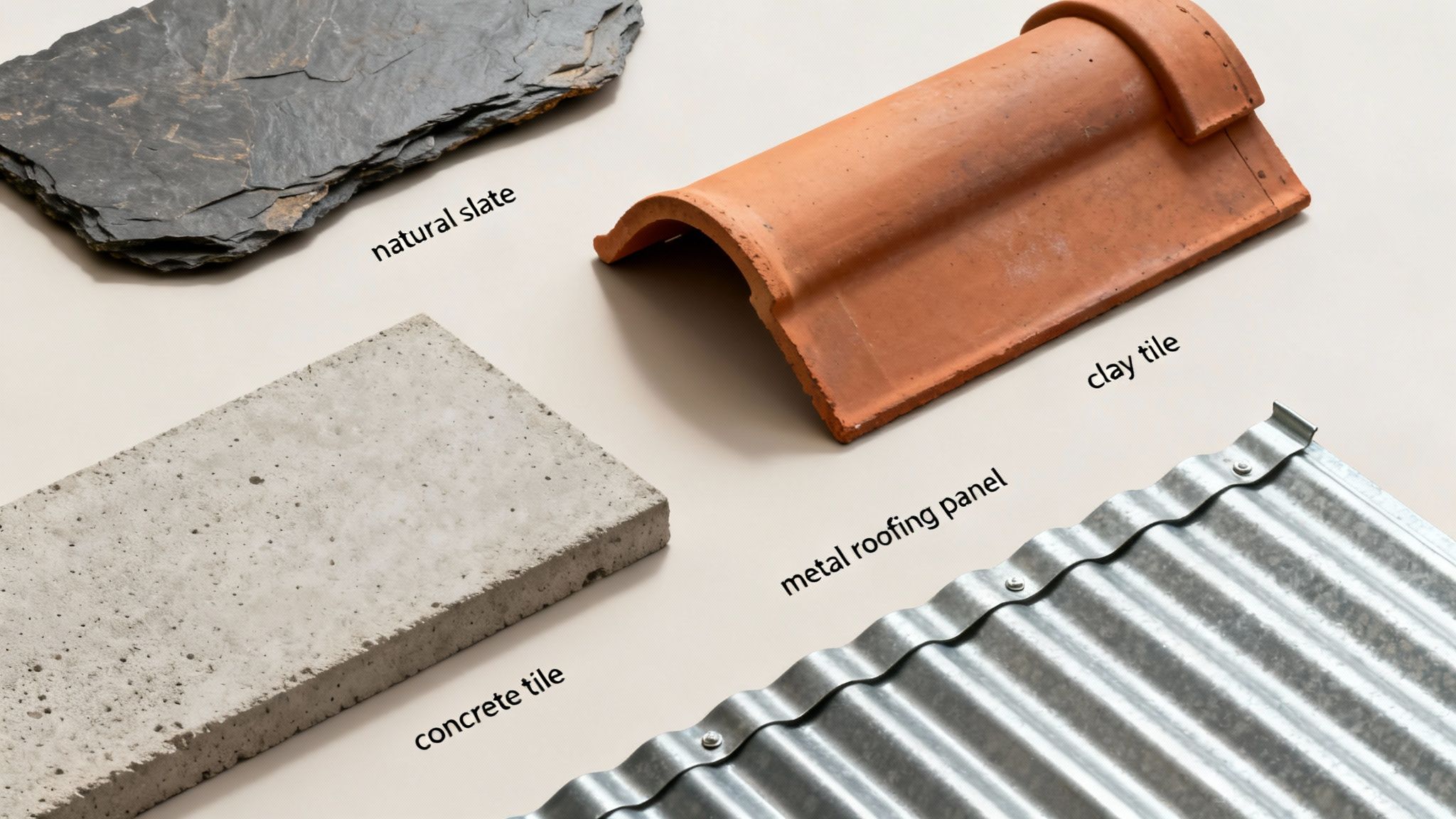
It's a simple but powerful concept: a non-combustible material will not burn or catch fire, no matter how much heat it's exposed to. Think of materials like natural slate, clay tiles, concrete, and metal – their inherent properties make them resistant to fire without needing any special chemical treatments.
This is a world away from materials that are merely 'fire-resistant'. Those materials might slow down the spread of a fire for a while, but they will eventually succumb. A1-rated materials simply won't contribute to the fire at all.
A Class A1 rating is the gold standard. It means a material poses virtually zero risk of fuelling a fire, playing a vital role in creating a fire-safe building that protects the structure, its occupants, and even neighbouring properties.
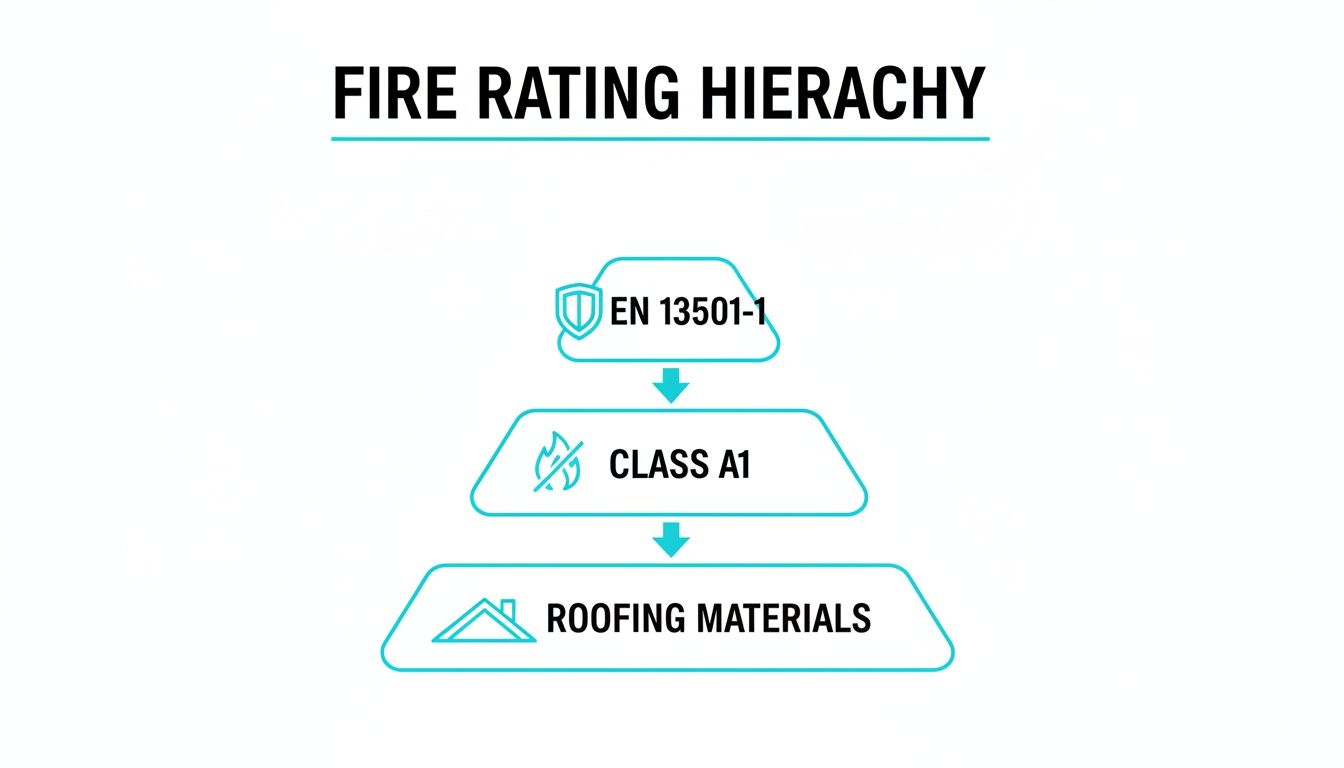
To make things clear and consistent, the BS EN 13501-1 standard organises materials into different 'Euroclasses' based on how they react to fire. It’s a straightforward hierarchy that lets you quickly assess a material's performance.
To give you a clearer picture, here’s a simple breakdown of the Euroclass system as it applies to UK roofing materials.
| Rating Class | Combustibility Level | Typical Roofing Materials |
|---|---|---|
| A1 | Completely Non-combustible | Natural slate, clay tiles, concrete tiles, metal roofing sheets |
| A2 | Limited Combustibility | Some fibre cement boards, certain composite panels |
| B – F | Progressively More Combustible | Various plastics, untreated timber, and other flammable materials |
This table shows exactly where each material stands. As you can see, the Classes range from A1 (completely non-combustible) down to F (highly combustible), providing a clear scale of fire safety.
Achieving a Class A1 rating is the absolute peak of fire safety certification.
This certification isn’t just a label; it’s proof that your roof is built with the safest materials available under UK and European standards. For expert advice on specifying A1-rated materials for your property in Berkshire, Surrey, or beyond, contact All Custom Roofing in Windsor today.
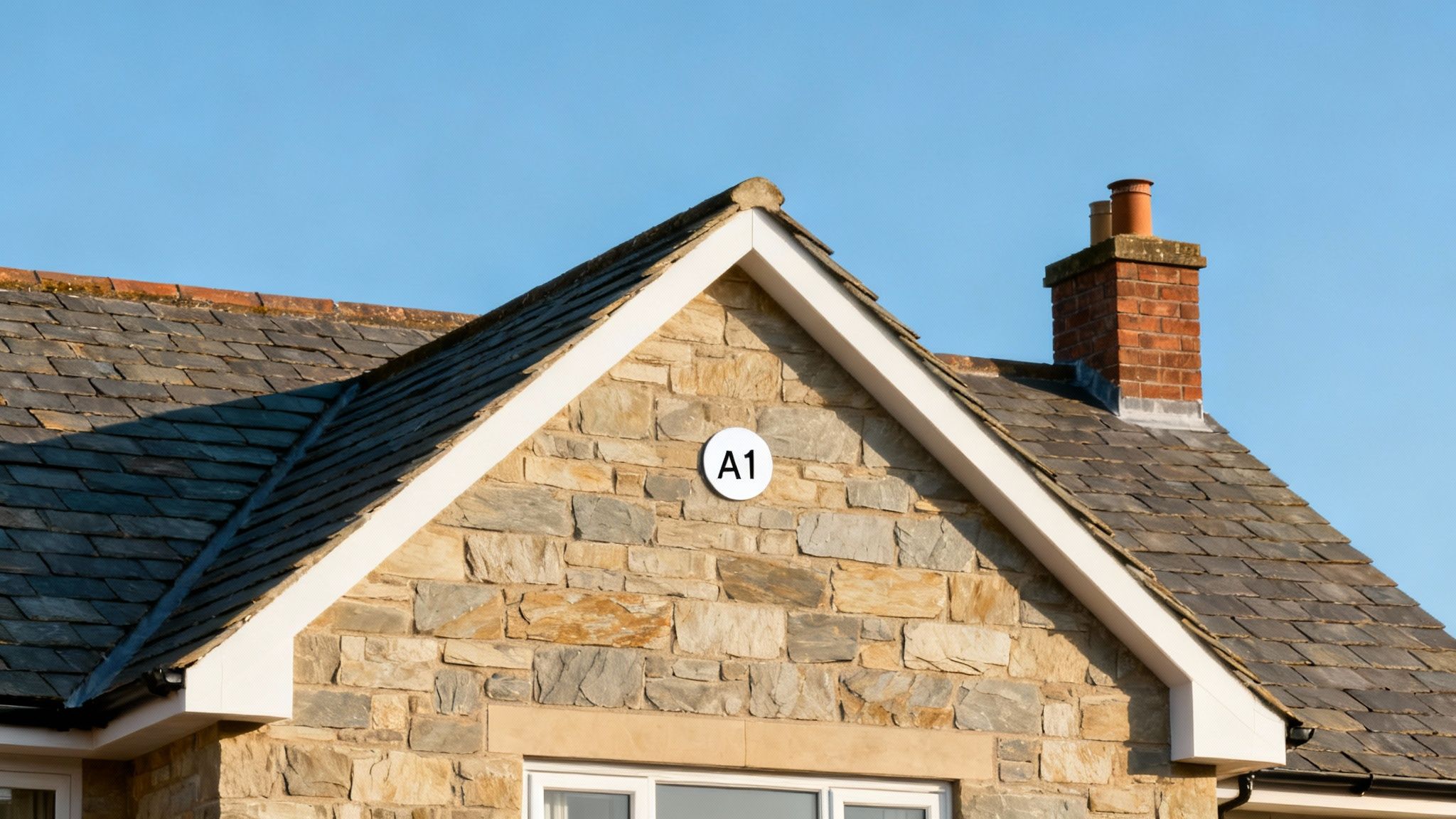
A Class A1 fire rating isn’t just a sticker slapped on a product. It’s a hard-won certification, earned only after a material survives a series of incredibly demanding scientific tests. These evaluations, laid out in the European standard BS EN 13501-1, are designed to push materials to their absolute breaking point to see how they behave in a real fire. This isn’t just a case of holding a lighter to a tile; it’s a deep dive into a material’s very makeup.
For any roofing material to earn that coveted A1 classification, it must be proven to be completely non-combustible. In simple terms, this means it adds zero fuel to a fire. This makes it the safest possible choice for properties across Windsor, Berkshire, and beyond. This critical quality is confirmed through two main, incredibly tough lab tests.
The first and most important hurdle is the non-combustibility test (officially known as BS EN ISO 1182). A sample of the material – say, a piece of natural slate or a chunk of mineral wool insulation – is placed inside a special furnace and heated to a blistering 750°C.
During this intense test, scientists are watching for several key things:
Think about putting a bit of wood in that furnace. It would instantly ignite, burn fiercely, and release a huge amount of heat, failing the test on every count. A slate tile, on the other hand, would just sit there – glowing red hot but fundamentally unchanged.
To back up the first test, materials also have to pass a calorific value test (BS EN ISO 1716). This analysis measures the total amount of heat energy a material can release when it’s completely burned in a pure oxygen environment. It’s like measuring how much fuel is locked inside the material.
To get an A1 rating, a material must have an exceptionally low calorific value. Essentially, it has to prove that it contains almost no energy that could be released to feed a fire. It’s this scientific certainty that gives the Class A1 rating its weight. When you see that A1 label, you know the product will not contribute to the “fire load” of a building in any significant way. This is precisely why the fire rating of insulation is so vital to the safety of the entire roof structure.
It’s worth noting that the BS EN 13501-1 standard has replaced older British standards like Class 0. While Class 0 was a good indicator of how flames spread across a surface, it doesn’t offer the same complete assurance as the A1 classification, which rigorously tests for true non-combustibility. A1 is now the gold standard.
All this science has very real, practical consequences for your property. A roofing system built entirely with A1-rated materials – from the tiles on top to the insulation underneath – forms a protective, non-combustible shield over your home or business. If a fire were to start nearby, that shield won’t add fuel, produce lots of smoke, or help the flames get a foothold.
Choosing A1 isn’t just about ticking a box for building regulations; it’s about using materials that have been scientifically proven to be inert in a fire. For genuine peace of mind and the highest level of safety, always insist that your roofing contractor uses materials with a certified Class A1 fire rating. For expert advice on building a fully compliant and fire-safe roof, contact All Custom Roofing. We serve homes and businesses across Berkshire, Surrey, and the surrounding areas.
Understanding the science behind a Class A1 fire rating is one thing, but seeing how that translates into the actual materials protecting your property is another. This is where theory meets practice on your rooftop. For homeowners and landlords here in Windsor, making an informed choice about roofing materials is absolutely fundamental to achieving both long-term durability and the highest possible level of fire safety.
The good news is that many of the most popular and time-tested roofing materials used across the UK naturally meet the A1 standard. These options give you a superb combination of good looks, resilience against our unpredictable British climate, and complete non-combustibility.
When you’re selecting a new roof covering, you have several fantastic choices that are inherently non-combustible. These materials don’t need any chemical treatments to resist fire; their natural makeup makes them inert.
Here are the leading A1-rated materials we frequently install on properties throughout Berkshire and Surrey:
It’s crucial to remember that a truly fire-safe roof is more than just its surface covering. A complete roofing system is an assembly of multiple components, and every single one plays a role in overall fire safety.
Achieving genuine fire safety means looking at the entire roof structure, from the timber rafters right up to the final tile. While that external A1-rated covering provides the primary shield against sparks and flames, the components underneath are just as important for preventing fire from spreading internally.
This includes the roof deck, the insulation, and especially the roofing underlay or felt. These hidden layers must also have high fire performance ratings to ensure the whole system is secure. Using cheaper, lower-quality underlays can create a serious weak link, potentially allowing fire to spread beneath an otherwise non-combustible surface.
This is why UK standards like BS 476 remain so relevant for these components. Under the UK’s BS 476 testing, a Class 1 fire rating – often a stepping stone to the superior Class 0 – measures the surface spread of flame on materials. It limits the spread to under 165mm after key test intervals, making it vital for the underlays we use here at All Custom Roofing in Windsor.
Choosing between slate, clay, concrete, or metal often comes down to your budget, the architectural style of your home, and your personal taste. Each one offers a unique set of benefits beyond its excellent Class A1 fire rating. It’s helpful to think about long-term performance and what best aligns with your property’s needs. For more guidance on this, check out our guide on how to choose the best materials for your new roofing project.
At All Custom Roofing, we help property owners in the Windsor area navigate these choices every day. We make sure that every component we install, from the visible tiles down to the hidden underlay, works together to create a cohesive, compliant, and fire-safe roofing system. Our expertise is in knowing how these materials perform in our local climate and fitting them correctly to give you decades of protection.
Knowing the science behind a Class A1 fire rating is one thing, but understanding how it fits into UK law is where it really counts. The rules around fire safety in buildings can feel like a maze, but they all share a single, clear purpose: to protect lives and property. Whether you’re planning a small extension or a complete roof replacement, these regulations aren’t just suggestions – they’re a legal requirement.
The go-to document for fire safety in England is Approved Document B (Fire Safety), which falls under the wider Building Regulations. It lays down the ground rules for how buildings must be designed and built to stop fire in its tracks. For your roof, this means making sure the materials and the entire system offer solid protection, not just for your home but for your neighbours’ too.
Approved Document B takes technical standards like BS EN 13501-1 and turns them into practical, real-world requirements. When it comes to your roof, the main goals are to stop fire from spreading across the surface and to prevent it from breaking through from an external source, like a fire next door.
This is especially vital in built-up areas like Windsor, Maidenhead, and Staines-upon-Thames. For terraced or semi-detached homes, the risk of fire hopping from one property to the next is a serious concern. Using A1-rated, non-combustible materials such as slate or clay tiles creates a powerful fire break, effectively boxing in a blaze and buying precious time for the emergency services to arrive.
The regulations are particularly strict about how close your property is to the boundary line.
The tragic Grenfell Tower fire on 14 June 2017, which resulted in 72 deaths and highlighted shocking failures in building cladding, prompted a rapid overhaul of UK fire safety regulations. The focus shifted decisively towards non-combustible materials like those with a Class A1 fire rating.
By December 2018, updates to Approved Document B mandated that external walls on new residential buildings over 18 metres tall must achieve at least a Class A2-s1, d0 rating, with A1 being the gold standard. For roofing – our speciality at All Custom Roofing across Windsor and Berkshire – this means choosing membranes and insulation with EN 13501-1 Class A1 certification is vital for compliance, especially on multi-storey extensions or flat roofs. You can learn more about how these standards came about by reading the history of the Class 1 fire rating.
Following these regulations isn’t just about staying on the right side of the law; it’s a smart financial and practical move. Insurers and mortgage lenders are more clued-up than ever about the risks of combustible materials. A property with a fully compliant, A1-rated roof is simply seen as a lower risk.
Choosing a Class A1-rated roof is a proactive step that can lead to lower insurance premiums and make your property more attractive to future buyers and lenders. It demonstrates a commitment to safety that goes beyond the bare minimum, future-proofing your investment.
When you’re discussing a project with a roofer, it’s crucial to ask the right questions to ensure they’re fully compliant. Never hesitate to ask for paperwork that confirms the fire classification of every material they plan to use. A professional company like All Custom Roofing will have this information ready and will be happy to share it.
By getting to grips with these regulations, you can make sure your roofing project isn’t just weatherproof and visually appealing, but also completely safe and legally sound. For expert help navigating UK Building Regulations for your roof, contact All Custom Roofing in Windsor for a professional consultation. We serve homes and businesses throughout Berkshire, Surrey, and the surrounding areas.
Choosing a roof with a **Class A1 fire rating** goes far beyond just ticking a box for UK Building Regulations. Think of it less as an expense and more as a fundamental investment in your property’s security, its value, and – most importantly – your safety.
The biggest benefit, without a doubt, is the sheer peace of mind you get. An A1-rated roof, made from non-combustible materials like natural slate or metal, essentially acts as a protective shield over your home or business. If the worst happens and a fire breaks out, your roof won’t add fuel to the flames. It actively helps to contain the fire, protecting your family, tenants, or staff inside.
This isn’t just a theory; it’s a proven lifesaver. According to Home Office data for England (2022/23), there were 29,211 primary dwelling fires. In 3.8% of those cases, roofing failures played a part, often because combustible insulation helped the fire spread. The push to mandate A1/A2 ratings on high-rise buildings has directly led to fewer fire-related casualties, showing just how critical these materials are. You can explore these fire safety findings on the official government website.
Beyond the crucial safety aspect, an A1-rated roof delivers some very real financial returns, making it a smart move for any property owner.
Insurers are all about managing risk, and a non-combustible roof is a much lower risk. Many insurance providers recognise this and offer lower premiums for properties with certified A1-rated roofing systems. From their perspective, these materials drastically cut the chances of catastrophic fire damage, making your property a safer bet.
It also boosts your property’s market value. In a post-Grenfell world, prospective buyers and surveyors are more switched on to fire safety standards than ever. Having a documented A1-rated roof is a powerful selling point. It tells them the property is secure, up to modern standards, and built to last.
For landlords and commercial property owners in Windsor and the surrounding areas, the benefits are even clearer. Installing a roof with a Class A1 fire rating is an unambiguous statement about your commitment to the safety of your tenants and the public.
By proactively choosing the highest standard of fire protection, you not only fulfil your legal duty of care but also minimise your potential liability. This responsible approach protects your investment, your reputation, and the people who use your property.
Ultimately, opting for an A1-rated roof is one of the smartest, most proactive decisions you can make. It secures your property against fire, can lower your ongoing costs, and adds tangible, long-term value.
For expert advice on upgrading to a fire-safe roofing system, contact All Custom Roofing. Serving homes and businesses across Berkshire, Surrey, and beyond.
Understanding what a class A1 fire rating means is a brilliant first step. But the next one is even more critical: getting those materials installed perfectly by a professional crew who knows the UK Building Regulations like the back of their hand. A truly fire-safe roof isn’t just about the tiles or slates you choose; it’s a complete system, and every single component has to work together flawlessly.
When it comes to safety and compliance, professional installation is simply non-negotiable. Even the best non-combustible material can fail if it’s fitted poorly, creating weak spots that could compromise your entire property in a fire. From ensuring the ventilation is correct to using the right fixings and underlays, expert workmanship is what guarantees your A1-rated roof will perform as designed when it matters most.
This is the peace of mind we deliver to property owners across Windsor, Berkshire, and Surrey.
Our whole process is built on being thorough and sticking to the highest safety standards. We don’t just put roofs on buildings; we engineer complete protective systems for your home or business.
Choosing the right partner is just as important as choosing the right materials. Your roofing contractor is your frontline defence, responsible for translating fire safety science into a physical barrier that protects your home or business.
We firmly believe that making your property safe shouldn’t be out of reach. That’s why we provide clear, upfront pricing and offer flexible finance options to help make these essential upgrades manageable. We take enormous pride in our work, which is why we’ve become a trusted choice for homeowners, landlords, and businesses alike. If you’re weighing up your options, our guide on how to choose the right flat roof installers for your project has some helpful pointers.
For a complete roofing solution that lets you sleep at night, contact All Custom Roofing in Windsor for expert advice and a no-obligation quote.
It’s completely normal to have questions when you’re diving into the technical side of a roofing project. We get it. That’s why we’ve put together clear, no-nonsense answers to the most common queries we hear from property owners in Windsor about the class A1 fire rating.
Our aim here is to cut through the jargon and give you the practical knowledge you need to make smart, confident choices for your property, ensuring your roof is safe, sound, and fully compliant with UK regulations.
Not always. The UK Building Regulations are primarily concerned with new builds, extensions, or major refurbishments like a full re-roofing project. If your current roof is in good shape and you aren’t planning any significant work, there’s generally no legal mandate forcing you to replace it just to meet the A1 standard.
However, the moment you decide on a full replacement or an inspection shows your roof is failing, things change. Any new installation must comply with the current fire safety standards detailed in Approved Document B. That’s the point where specifying A1-rated materials becomes a crucial part of the project.
It’s a common misconception that A1-rated automatically means a huge price jump. While some premium materials like natural slate do sit at the higher end, many others, such as concrete tiles, are incredibly cost-effective. The final cost really boils down to the specific material you choose, the complexity of your roof design, and the labour involved.
It’s better to think of it as a long-term investment rather than just an upfront cost.
Choosing a roof with a class A1 fire rating not only boosts your property’s safety but can also lead to lower insurance premiums and increase its overall value. When you weigh these benefits, they often more than justify any initial difference in material costs, delivering fantastic value over the life of your roof.
Any trustworthy roofing contractor will make this completely transparent and simple. You should always ask to see the official product documentation for any materials they propose using on your roof.
Here’s what you should ask for:
Never just take a contractor’s word for it. A true professional will be more than happy to provide this proof, giving you total confidence that the materials being installed are genuinely non-combustible and fully compliant. If they hesitate or make excuses, that’s a major red flag.
For a detailed roof inspection or expert advice on achieving a fire-safe roof for your property, trust the professionals at All Custom Roofing. We provide transparent, compliant roofing solutions for homes and businesses across Windsor, Berkshire, and Surrey. Learn more about our services at staging-allcustomroofing.on-forge.com/.